Share Price
Share price is the quoted or traded price of one stock share. Learn how bid, ask, and last prices differ and how price relates to value and market cap.
Share price is the market price quoted or paid for one share of a company’s stock at a particular time. Stock price, market price per share, and market value per share usually refer to the same basic concept. The displayed last price, however, may not be the price at which a new order can trade.
Key Takeaways
- A stock quote can show a bid, ask, and last-traded price; these are related but not interchangeable.
- Share price is a per-share amount, not the total market value of the company.
- Price records what market participants currently pay, while intrinsic value is an estimate based on assumptions.
- Stock splits mechanically change the price per share and share count but do not, by themselves, create value.
- Historical return analysis should use prices adjusted consistently for splits and, where appropriate, distributions.
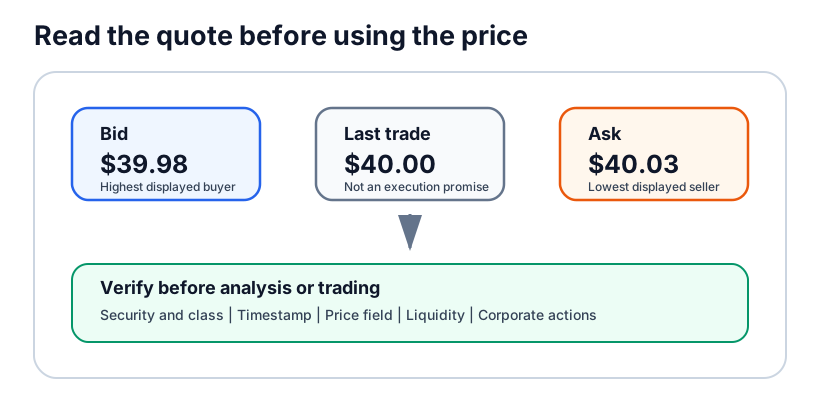
Bid, Ask, and Last Price
A quote commonly includes:
- Bid: the highest displayed price at which a buyer is willing to buy a stated quantity.
- Ask or offer: the lowest displayed price at which a seller is willing to sell a stated quantity.
- Last price: the price of the most recently reported trade.
- Bid-ask spread: the difference between the ask and bid.
Investor.gov’s bid and ask glossary explains these quote components. The spread is an immediate trading cost: a buyer typically pays near the ask, while a seller typically receives near the bid, subject to order type, available liquidity, and market movement.
Quote Example
Suppose a quote shows:
- bid:
$39.98for600shares - last trade:
$40.00 - ask:
$40.03for400shares
An order to buy is not automatically entitled to the $40.00 last price. A market buy order would generally seek available offers, beginning near $40.03, but the execution price can change if the order is larger than the displayed quantity or the quote moves. Investor.gov’s order-type guide notes that a market order prioritizes execution rather than guaranteeing a price.
What Moves a Share Price
A share price changes when incoming buy and sell interest meets the orders available in the market. The reasons behind that order flow can include:
- earnings, cash-flow, or guidance updates
- changes in expected growth or business risk
- interest-rate and discount-rate changes
- financing, dividends, repurchases, or new share issuance
- industry, economic, regulatory, or geopolitical developments
- index changes, fund flows, short covering, or other positioning
- liquidity conditions and market-wide volatility
Price movement does not prove which factor caused it. A careful explanation separates confirmed issuer disclosures and market events from speculation about investor motives.
Share Price vs. Market Value and Intrinsic Value
| Measure | Question answered | Typical source |
|---|---|---|
| Share price | What is one share quoted or trading at now? | Exchange or market-data quote |
| Market capitalization | What is the total market value of outstanding common equity? | Share price times outstanding shares |
| Book value per share | What accounting net assets are attributed to each share? | Financial statements and share count |
| Intrinsic value per share | What does an analyst estimate one share is worth? | Valuation model and assumptions |
| Par value | What nominal legal or accounting amount is assigned to a share? | Charter and accounting records |
A $200 share is not automatically more expensive in valuation terms than a $20 share. Analysts compare price with a relevant denominator, such as earnings, book value, sales, or cash flow, and assess the quality and risk of that denominator. A high price alone says nothing about whether a stock is overvalued.
Share Price and Market Capitalization
Market cap converts the per-share quote into total common equity value:
If Company A trades at $100 with 10 million shares outstanding, its market cap is $1 billion. If Company B trades at $10 with 500 million shares outstanding, its market cap is $5 billion. Company B has the lower share price but the larger equity value.
Stock Splits and Adjusted Prices
In a two-for-one split, each old share becomes two shares and the price adjusts to roughly half its prior level, all else equal. The SEC’s stock split explanation shows why the lower post-split price does not itself reduce a shareholder’s total market value.
Raw historical closes can become misleading after splits or distributions. An adjusted closing price restates prior observations under a stated methodology so periods can be compared more consistently. Data providers can differ in how and when they adjust for dividends, special distributions, rights, spin-offs, or corrections, so the methodology matters.
How Analysts Use Share Price
Share price is used as:
- an input to market cap and equity valuation multiples
- a benchmark against a model’s estimated value per share
- the denominator in ratios such as dividend yield
- a trigger or reference in orders, options, convertibles, and compensation plans
- a measurement point for returns and portfolio values
- evidence in event studies and market-reaction analysis
The quote must match the purpose. A trader may need the current bid and ask, an accountant may need an official closing price on a reporting date, and an analyst may use a volume-weighted average or unaffected price for a transaction study.
How to Evaluate a Price Quote
Before using a displayed price, verify:
- Security: Confirm the ticker, exchange, currency, and share class.
- Timestamp: Distinguish real-time, delayed, previous-close, premarket, and after-hours data.
- Price field: Identify whether the number is a bid, ask, last trade, close, official close, or adjusted close.
- Liquidity: Review spread, displayed size, recent volume, halts, and unusual trading conditions.
- Corporate actions: Check splits, dividends, rights, spin-offs, symbol changes, and listing changes.
- Analysis date: Match the quote to the financial statements, transaction announcement, or valuation date.
FINRA’s stocks overview explains that stock prices fluctuate and can fall substantially. A current quote is therefore evidence of current market pricing, not a promise of liquidity, safety, or future return.
Common Mistakes and Risks
- Treating the last price as executable. The available bid or ask may already differ.
- Using a market order as a price guarantee. It seeks prompt execution, not a fixed execution price.
- Comparing nominal prices across companies. Share counts and stock splits make the comparison incomplete.
- Calling price intrinsic value. Price is observable; intrinsic value is an uncertain estimate.
- Mixing adjusted and unadjusted history. This can create false returns around corporate actions.
- Ignoring liquidity. A quote for a thinly traded security may represent little available size.
- Assuming a low-priced stock has less downside. A security can lose a large percentage regardless of its nominal price.
Related Terms
- Market Capitalization: The total market value of a company’s outstanding shares.
- Market Quotes: Bid, ask, last price, and related quote information.
- Market Order: An order that prioritizes prompt execution but does not guarantee price.
- Limit Order: An order with a specified price constraint.
- Adjusted Closing Price: A historical price restated for specified corporate actions.
- Price-to-Earnings Ratio: A valuation multiple comparing share price with earnings per share.
FAQs
Is the last price the price I will pay?
Why is adjusted closing price different from closing price?
This article is educational and does not recommend any security, order type, valuation, or trading strategy. Prices can move rapidly, execution can differ from displayed quotes, and stocks can lose value.