Bond Yield
Bond yield is a return quotation linking price with coupon, principal, timing, and redemption assumptions for fixed-income comparison.
Bond yield is a percentage return quotation that links a bond’s price with its coupon, principal, timing, and redemption assumptions. The term is an umbrella: it can mean coupon rate, current yield, yield to maturity, yield to call, yield to worst, bond-equivalent yield, or another convention.
A yield number is useful only when its label and assumptions are known. It is not automatically the investor’s expected or realized return.
Key Takeaways
- Bond yield can refer to several different measures; always identify which one is quoted.
- Coupon rate is based on face value, while market yields depend on price and cash-flow assumptions.
- For a plain fixed-rate bond, price generally falls when required yield rises and rises when required yield falls.
- Current yield captures coupon income but ignores redemption gain or loss.
- YTM, YTC, and YTW depend on specified payment and redemption scenarios.
- Annualization, compounding, day count, clean or dirty price, and settlement can change quoted yield.
- High yield can compensate for credit, liquidity, duration, call, currency, or other risk.
- Realized return depends on actual payments, sale price, reinvestment, costs, taxes, and holding period.
Price and Yield Mechanics
For a plain fixed-rate bond with N remaining coupon periods:
where:
Pis the full price;Cis coupon cash per period;Fis principal paid at maturity; andris yield per coupon period.
The quoted annual yield depends on the market convention. A U.S. bond paying semiannually commonly reports a nominal annual bond-equivalent yield equal to twice the six-month periodic yield.
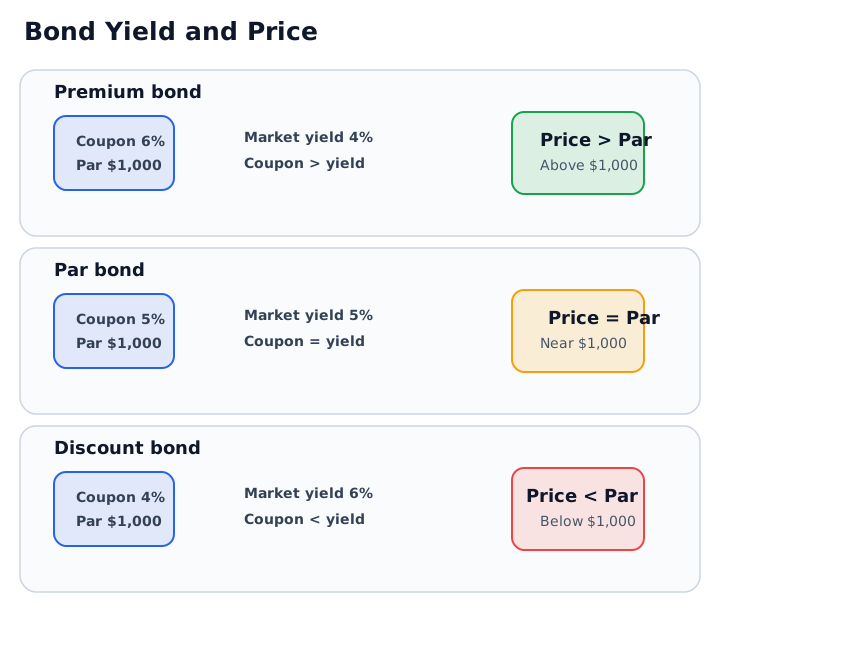
With unchanged promised cash flows, a higher discount rate lowers present value. That is why price and yield move in opposite directions for a plain bond.
Main Bond Yield Measures
| Measure | Core calculation or scenario | Best use | Main limitation |
|---|---|---|---|
| Coupon Rate | Annual coupon / face value | Contractual interest terms | Ignores current price |
| Current Yield | Annual coupon / current price | Current-income screen | Ignores redemption and timing |
| Yield to Maturity | Price and scheduled cash flows through final maturity | Plain-bond full cash-flow comparison | Assumes payment and maturity path |
| Yield to Call | Price and cash flows through one call date | Callable-bond scenario | Applies only to the selected call |
| Yield to Worst | Lowest yield among specified contractual redemptions | Conservative contractual comparison | Does not model default or every outcome |
| Bond Equivalent Yield | Short-term or periodic yield converted to bond-style annual basis | Quote normalization | Convention-sensitive and not necessarily effective annual yield |
| Realized yield or holding-period return | Actual cash received and ending value | Performance measurement | Known only after the period |
Do not compare percentages until they are on compatible price, day-count, compounding, and redemption bases.
Worked Five-Year Example
Assume a noncallable bond has:
$1,000face value;- five years to maturity;
- a 6% annual coupon paid once per year for simplicity; and
- a current price of
$920immediately after a coupon date.
Coupon rate
Current yield
Yield to maturity
YTM solves:
The annual YTM is approximately 8.00%.
| Measure | Result | Why it differs |
|---|---|---|
| Coupon rate | 6.00% | Uses face value |
| Current yield | 6.52% | Uses current price but ignores maturity gain |
| YTM | 8.00% | Includes coupons, timing, and gain from $920 to $1,000 |
The discount does not guarantee the investor receives $1,000. The 8.00% YTM assumes the issuer makes all scheduled payments and the bond remains outstanding through maturity.
YTM Is Not One-Year Realized Return
Suppose the investor receives the $60 coupon and sells the bond after one year for $940:
The realized one-year return is 8.70%, not the original 8.00% YTM, because the sale price reflects market conditions at the end of the year. If the sale price had fallen to $850, the holding-period result would have been negative despite the positive starting YTM.
YTM is a price-implied full-horizon rate under a modeled path. Holding-period return is based on what actually happens during the investor’s horizon.
Premium, Par, and Discount
For a plain fixed-rate bond:
| Price state | Coupon rate compared with required yield | Typical interpretation |
|---|---|---|
| Premium | Coupon rate above required yield | Buyer pays extra for above-market coupon cash flows |
| Par | Coupon rate approximately equal to required yield | Coupon and current required yield are aligned |
| Discount | Coupon rate below required yield | Lower price compensates for below-market coupons |
This is not a quality ranking. A discount can reflect a low coupon, higher benchmark rates, weak credit, poor liquidity, unfavorable options, or several factors. A premium bond can be exposed to call risk and principal loss at redemption.
Bond Prices at Par, Premium, or Discount explains these price labels in detail.
Yield, Spread, and Benchmark
A corporate or municipal bond’s all-in yield can be considered in relation to a benchmark:
1All-in bond yield = benchmark yield + quoted spread
This is a quotation framework, not a complete expected-return equation. Credit Spread can reflect expected credit loss, liquidity, risk premia, optionality, and market technicals.
The benchmark must match duration, currency, curve, and convention. Comparing a five-year corporate bond with a single 10-year Treasury yield can obscure curve and maturity effects.
Nominal, Real, and After-Tax Yield
- Nominal yield measures return in currency units before inflation adjustment.
- Real yield measures purchasing-power return or the yield on an inflation-linked structure under its convention.
- After-tax yield reflects applicable tax treatment and investor circumstances.
- Tax-equivalent yield converts a tax-advantaged yield into a taxable comparison under stated assumptions.
A positive nominal yield can still produce a negative real return if inflation is higher. Tax treatment can change the ranking of securities, but tax conclusions depend on instrument, jurisdiction, account, and investor facts.
Clean Price, Dirty Price, and Settlement
Bond prices are often quoted clean, excluding accrued interest. The full or dirty settlement price includes accrued interest. A yield engine needs the correct settlement date, coupon dates, day-count convention, and full cash outlay.
Using a clean price as though it were settlement cash can distort a manually calculated yield. Professional systems typically incorporate accrued interest and settlement timing, but readers should verify the source methodology.
Yield Conventions by Instrument
| Instrument | Common yield focus | Main complication |
|---|---|---|
| Fixed-rate bullet bond | YTM, current yield, spread | Credit, duration, clean/dirty price |
| Callable bond | YTC, YTW, option-adjusted spread | Call timing and reinvestment |
| Putable bond | Yield to put and YTW | Exercise assumptions |
| Treasury bill | Discount rate and investment or bond-equivalent yield | Price denominator and day count |
| Floating-rate note | Discount margin and index spread | Future coupon resets |
| Inflation-linked bond | Real yield and inflation compensation | Indexation and inflation lag |
| Mortgage-backed security | Yield and option-adjusted spread under projected cash flows | Prepayment and changing average life |
| Distressed bond | Scenario return and recovery analysis | Promised cash flows may not be paid |
A single YTM should not be forced onto an instrument whose cash flows depend materially on options, prepayments, defaults, or future reference rates.
Positive and Negative Bond Yields
A positive yield means the price and modeled cash flows imply a rate above zero under the stated convention. It does not guarantee a positive holding-period or real return.
A Negative Bond Yield means the price and scheduled cash flows imply a nominal rate below zero. A buyer can still realize a positive trading return if the bond is sold at a sufficiently higher price, while a positive-yield bond can lose value when yields rise.
What Changes Bond Yield?
- benchmark interest rates and expected policy path;
- inflation expectations and real rates;
- issuer credit quality and recovery expectations;
- maturity, duration, and convexity;
- calls, puts, prepayment, conversion, and other options;
- liquidity, dealer inventory, and transaction size;
- collateral and financing conditions;
- currency and hedging costs;
- supply, demand, index eligibility, and market technicals; and
- tax treatment and regulatory demand.
These drivers interact. A yield change should be decomposed into benchmark, spread, option, and security-specific effects rather than attributed automatically to one headline event.
How To Evaluate a Bond Yield
- Identify the exact yield label and quotation convention.
- Confirm security identifier, price source, quote time, size, and executable status.
- Check clean or dirty price, accrued interest, settlement date, and day count.
- Map coupon, principal, call, put, sinking-fund, conversion, and prepayment cash flows.
- Compare YTM, YTC, and YTW where relevant.
- Separate benchmark yield from credit and liquidity spread.
- Review duration, convexity, key-rate exposure, and holding period.
- Assess payment probability, seniority, collateral, covenants, and recovery.
- Include bid-ask cost, financing, taxes, inflation, currency, and reinvestment.
- Compare realized performance with the original scenario rather than treating the quote as a promise.
Common Mistakes
- Calling coupon rate the bond’s current market yield.
- Treating current yield as total return.
- Comparing yields with different compounding or day-count bases.
- Ignoring calls when using YTM for a premium bond.
- Treating YTW as a default-loss forecast.
- Assuming high yield means undervaluation rather than high risk.
- Using a stale or non-executable price.
- Ignoring accrued interest and settlement.
- Comparing nominal and real yields directly without understanding the instruments.
- Treating a positive starting yield as a guaranteed positive holding-period return.
Authoritative Sources
- FINRA’s bond yield and return guide distinguishes coupon yield, current yield, YTM, YTC, YTW, and realized return.
- MSRB’s bond prices and yields guide explains price-yield mechanics and municipal bond yield concepts.
- Investor.gov bond education explains bond principal, interest, maturity, price, and major risks.
- TreasuryDirect’s pricing guide explains Treasury bill, note, bond, TIPS, and floating-rate-note pricing conventions.
- U.S. Treasury interest-rate FAQ explains bond-equivalent CMT quotation and why curve rates may differ from actual-security yields.
This article provides general financial education, not individualized investment, legal, tax, or accounting advice. Actual analysis requires the security documents, current market record, and relevant professional guidance.
Related Terms
- Current Yield: Annual coupon income relative to current market price.
- Yield to Maturity: Price-implied yield through final maturity under stated assumptions.
- Yield to Worst: Lowest calculated yield among specified contractual redemptions.
- Bond Equivalent Yield: Convention for placing short-term or periodic yield on a bond-style annual basis.
- Duration: First-order price sensitivity that should accompany yield comparison.
- Credit Spread: Yield difference above a benchmark associated with credit, liquidity, and risk premia.