Duration
Interest-rate sensitivity measure showing how strongly a bond's price should react to yield changes.
Duration is a measure of how sensitive a bond’s price is to changes in interest rates. In fixed income, people often say bond duration to mean this same concept. It is one of the most important risk measures in fixed income because it helps investors estimate how much a bond may rise or fall when yields change.
At a high level, duration tells you:
- how much interest-rate risk the bond carries
- how much timing of cash flows matters
- why two bonds with the same maturity can still behave differently
Why Duration Matters
Many beginners assume maturity alone explains bond sensitivity. That is incomplete.
Duration matters because it accounts not just for final maturity, but for the timing of all coupon and principal cash flows.
A bond that returns more cash earlier usually has lower duration than a bond that returns more cash later.
Basic Interpretation
As a practical rule of thumb:
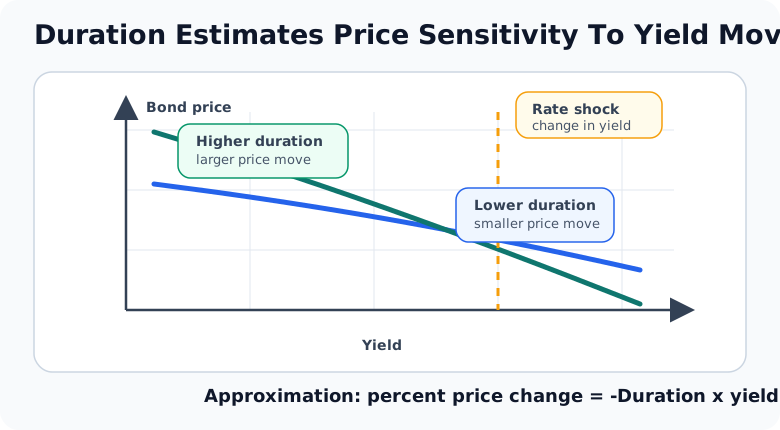
- higher duration means greater price sensitivity to rate changes
- lower duration means less sensitivity
So if two bonds experience the same market-rate move, the bond with higher duration usually has the larger price change.
Duration and Price Change
Duration is often used as a first-order approximation:
Where:
- \(D\) is duration
- \(\Delta y\) is the change in yield
The negative sign reflects the inverse relationship between bond prices and yields.
Worked Example: Portfolio Price Sensitivity
Assume a bond portfolio has a market value of $25 million and modified duration of 4.8. If its relevant yield rises by 25 basis points, convert the rate move to decimal form before applying duration:
The estimated market-value decline is therefore:
If the relevant yield fell by 25 basis points, the first-order estimate would be a 1.20% gain instead. The actual gain and loss will not be perfectly symmetric because convexity, nonparallel curve moves, spread changes, trading costs, and changing cash flows can alter the result.
This is a rate-sensitivity estimate, not a forecast of total return. Coupon income, credit spread movement, defaults, cash flows, and portfolio trades can produce a different realized outcome.
What Analysts Need To Define
Duration is useful only when the version and assumptions are clear:
| Input | What To Check | Why It Matters |
|---|---|---|
| Duration type | Macaulay, modified, effective, key-rate, or dollar duration | Each version answers a different risk question |
| Yield move | Parallel shift, key-rate move, spread move, or scenario path | A single duration number can hide yield-curve shape risk |
| Bond structure | Coupon, maturity, call features, amortization, floating rate, and embedded options | Cash flows can change when rates change |
| Price basis | Clean price, dirty price, accrued interest, and settlement date | Price sensitivity depends on the measured price |
| Portfolio use | Single bond, portfolio average, benchmark comparison, or liability match | The same duration can mean different risk in different contexts |
Types of Duration
The term “duration” can mean different versions depending on context:
- Macaulay duration measures weighted average time to receive cash flows
- Modified Duration adjusts duration into direct price sensitivity
- Effective Duration is often used when bonds have embedded options
Duration vs. Maturity and Convexity
| Measure | Main question | Best use | Main limitation |
|---|---|---|---|
| Duration | How much should the bond’s price react to a small yield move? | First-pass rate-risk analysis and portfolio sensitivity checks | Less accurate when yield moves are large or the bond has embedded options |
| Maturity | When is the final principal repayment due? | Basic time-to-repayment reference | Says little about the timing of coupons or true rate sensitivity |
| Convexity | How does the duration estimate bend as yields move? | Refining price sensitivity for larger rate moves | Harder to interpret quickly than duration |
That is why fixed-income teams often start with duration, not maturity, when they want an actionable view of rate risk.
Duration vs. Maturity
Maturity and duration are related, but not the same.
- maturity is the final repayment date
- duration is a cash-flow-weighted sensitivity measure
A high-coupon bond and a low-coupon bond with the same maturity can have different durations because their cash-flow timing is different.
Why Duration Is So Useful
Duration helps with:
- interest-rate risk control
- bond portfolio construction
- matching assets and liabilities
- comparing fixed-income securities quickly
It is one of the central tools used in both portfolio management and risk management.
Public Source Checks
Useful public sources include:
- FINRA Brush Up on Bonds: Interest Rate Changes and Duration: Investor education on duration, maturity, coupon, and approximate bond-price sensitivity.
- MSRB Evaluating a Municipal Bond’s Interest Rate Risk: Explains duration, convexity, and how call features affect municipal-bond rate risk.
- OCC Interest Rate Risk Comptroller’s Handbook: Supervisory reference covering Macaulay duration, modified duration, options risk, and model assumptions.
- U.S. Treasury Daily Treasury Rates: Yield-curve observations that can support clearly dated rate-shift scenarios.
These references support the general convention and scenario context. Bond-specific duration still requires security-level terms, price, coupon, maturity, embedded options, and a yield or curve model.
When Duration Misleads
Duration can mislead when:
- the yield move is large enough that convexity becomes important
- the bond has calls, puts, prepayment risk, or other embedded options
- a portfolio has key-rate exposure that a single average duration hides
- credit spreads move differently from Treasury rates
- floating-rate coupons reset quickly
- cash flows are uncertain because of default or restructuring risk
- the duration number is stale relative to price, yield, or portfolio holdings
In those cases, pair duration with convexity, key-rate duration, spread duration, scenario analysis, and credit review.
Practical Review
When reviewing Duration, ask whether the number changes rate-risk exposure, benchmark alignment, liability matching, security selection, rebalancing, or portfolio sizing. A duration figure is useful only when it connects to a concrete risk decision.
Review Checklist
Before relying on duration, document:
- duration type and calculation source
- price date, yield date, settlement date, coupon, maturity, and day-count assumptions
- whether the bond has embedded options or changing cash flows
- whether the risk question is a parallel shift, curve twist, spread move, or scenario path
- portfolio weight, benchmark duration, and liability or mandate target
- convexity, key-rate duration, or scenario checks when the position is material
- the portfolio action that changes if duration changes
Related Terms
- Modified Duration: Converts duration into a more direct price-sensitivity measure.
- Effective Duration: A better fit when the bond’s expected cash flows can change with rates.
- Key Rate Duration: Shows sensitivity to specific maturity points on the yield curve.
- Convexity: Improves on duration when yield changes are large and price effects become curved rather than linear.
- Interest-Rate Risk: The broader risk that duration helps measure.
- Maturity Date: A simpler time measure that duration refines.
- Yield to Maturity (YTM): One of the inputs influencing duration calculations.