Price to Tangible Book Value (PTBV)
Price to tangible book value compares market price with tangible book value, often for banks, insurers, and asset-heavy companies.
Price to tangible book value (PTBV) compares a company’s market price with tangible book value per share. It is a stricter version of the price-to-book ratio because it removes goodwill and many intangible assets from the book-value base.
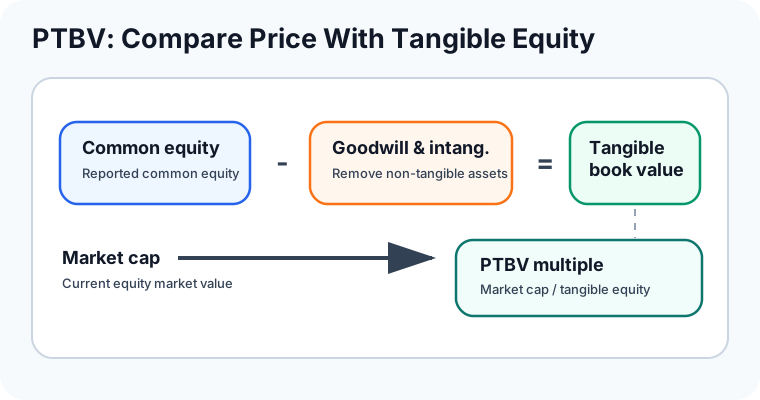
For whole-company analysis, analysts often express the same idea as market capitalization divided by tangible common equity.
Why It Matters
PTBV matters because ordinary book value can include assets that may not protect investors in stress. Goodwill, acquired customer relationships, trade names, deferred acquisition costs, and other intangibles may be valuable in a going concern, but they are not the same as tangible capital that can absorb losses.
That makes PTBV especially useful for:
- banks and insurers where tangible common equity is a core valuation anchor
- asset-heavy companies with large balance-sheet bases
- acquisition analysis where goodwill and purchase-accounting effects matter
- distress or downside analysis where asset quality is central
What Analysts Need To Define
PTBV is sensitive to how the denominator is defined:
| Item | What To Check | Why It Matters |
|---|---|---|
| Market price | Price date, share class, currency, and market-cap source | A stale or mismatched price can distort the multiple |
| Tangible equity base | Common equity, tangible common equity, or adjusted tangible book | Preferred stock, minority interests, and adjustments change the denominator |
| Intangible assets | Goodwill, acquired intangibles, software, deferred acquisition costs, and other non-physical assets | Different companies and industries classify intangibles differently |
| Per-share count | Basic shares, diluted shares, buybacks, and period-end shares | Tangible book value per share depends on both equity and share count |
| Asset quality | Loan losses, reserves, fair-value marks, impairments, and credit risk | Tangible book can still be overstated if assets are weak |
| Profitability | ROE, return on tangible common equity, and cost of equity | A premium to tangible book is easier to defend when returns exceed required returns |
Tangible Book Value per Share
Tangible book value per share usually starts with common equity and subtracts goodwill and identifiable intangible assets:
Some analysts use tangible common equity, which also adjusts for preferred equity or other non-common claims. The chosen basis should be stated because a small denominator change can materially change PTBV.
Where PTBV Works Best
| Situation | Why PTBV helps | Main caution |
|---|---|---|
| Banks and insurers | Tangible capital is closely tied to loss absorption and regulatory capital analysis | Credit quality, reserves, and fair-value marks still need review |
| Asset-heavy companies | Tangible assets can be a useful valuation anchor | Replacement value and liquidation value may differ from accounting book |
| Acquisition-heavy companies | PTBV strips out goodwill created by past deals | Acquired intangibles may still support real earnings power |
| Distress or downside review | Tangible equity can frame asset coverage | Balance-sheet values can be too high if impairments are delayed |
PTBV is less useful for companies whose value comes mainly from software, network effects, brand, intellectual property, or human capital. In those cases, removing intangibles may make the denominator conservative but not necessarily more economically meaningful.
Public Source Checks
Use source documents before treating PTBV as decision-ready:
- SEC EDGAR Company Search: Annual and quarterly filings for common equity, goodwill, intangible assets, share count, preferred equity, and risk disclosures.
- SEC Financial Statement Data Sets: Structured statement data that can help tie equity, assets, liabilities, goodwill, and share counts to filings.
- SEC Company Facts API: XBRL facts for company-level validation of equity, goodwill, intangible assets, and per-share values.
- Company earnings releases and investor supplements: often include tangible common equity, tangible book value per share, return on tangible common equity, and management reconciliation tables.
When using a company-adjusted tangible book measure, reconcile it back to reported equity. The adjustment may be reasonable, but it should not hide preferred equity, minority interests, accumulated other comprehensive income, or credit marks.
Quiz
When PTBV Misleads
PTBV can mislead when:
- goodwill or intangible assets still support real earning power
- tangible assets are overstated or not marked to realistic values
- loan losses, reserves, impairments, or fair-value marks are delayed
- preferred equity, minority interests, or accumulated other comprehensive income are handled inconsistently
- peer companies use different accounting or acquisition histories
- profitability is weak, making even a low tangible-book multiple difficult to defend
- the business is asset-light, so tangible book value is not the real economic base
Review Checklist
Before relying on PTBV, document:
- market price date, share class, and market data source
- common equity, goodwill, intangible assets, preferred stock, and minority-interest treatment
- share count basis used for tangible book value per share
- whether the measure is reported, company-adjusted, or analyst-adjusted
- asset-quality issues, reserves, impairments, and fair-value marks
- return on tangible common equity, cost of equity, and growth assumptions
- peer set and why tangible book value is comparable across companies
Related Terms
- Price-to-Book Ratio: The broader book-value multiple that includes intangible assets.
- Tangible Book Value: The equity base behind PTBV.
- Book Value Per Share: The ordinary per-share book-value measure.
- Book-to-Market Ratio: The inverse-style book-value valuation signal.
- Market Capitalization: The market-value side of whole-company PTBV.
- Balance Sheet: The statement where equity, goodwill, and intangibles are reported.
- Return on Equity: A profitability metric that helps explain sustainable valuation premiums.