Quality of Earnings
Quality of earnings evaluates whether reported profit is repeatable, cash-generative, consistently measured, and useful for forecasting or valuation.
Quality of earnings (QoE) describes how useful reported profit is for understanding a company’s current economics and estimating future performance. Higher-quality earnings are generally supported by cash generation, repeatable operations, consistent accounting, transparent estimates, and disclosures that let readers separate recurring performance from unusual items.
QoE is an analytical judgment, not a line item defined by one universal accounting formula. Financial statements can comply with the applicable accounting framework while still containing earnings that are unusually volatile, dependent on estimates, weakly converted to cash, or difficult to compare.
Key Takeaways
- Earnings quality is different from the amount of earnings. A smaller repeatable profit can be more useful than a larger one-time gain.
- Operating cash flow is important evidence, but one period of weak cash conversion does not prove poor accounting or fraud.
- Analysts should reconcile profit to cash, test working-capital changes, normalize unusual items, and examine estimate sensitivity.
- Revenue growth is less persuasive when receivables, contract assets, returns, or channel inventory grow much faster.
- Non-GAAP adjustments require consistent definitions and reconciliation; the label “adjusted” does not make a measure more reliable.
- A QoE review supports valuation and due diligence but does not replace an audit, legal investigation, or solvency analysis.
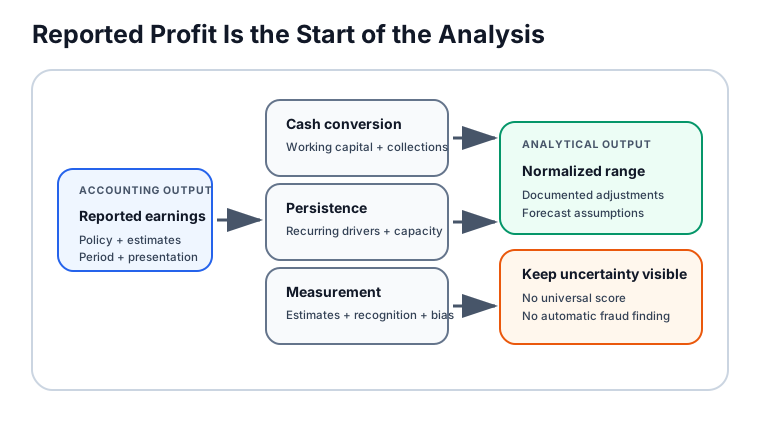
What Makes Earnings More Decision-Useful
| Dimension | Stronger evidence | Questions or warning signs |
|---|---|---|
| Persistence | Profit comes from repeat customers, normal margins, and sustainable capacity | Is growth driven by a disposal, temporary shortage, tax benefit, or unusually favorable price? |
| Cash conversion | Earnings convert to operating cash over a sensible business-cycle period | Are receivables, inventory, contract assets, or capitalized costs absorbing cash? |
| Measurement | Estimates use supportable assumptions and consistent methods | Did useful lives, reserves, impairments, or provisions change near a target? |
| Recognition | Revenue and expenses are recorded when the accounting criteria are met | Are shipment terms, returns, side agreements, cut-off, or collectibility unclear? |
| Comparability | Policies, segments, and adjusted measures can be compared over time | Did definitions or exclusions change without a recast or clear explanation? |
| Disclosure | Notes and management discussion explain important drivers and uncertainty | Does a headline metric omit the reason profit diverged from cash or prior guidance? |
No single dimension determines quality. A subscription business may report profit before collecting annual renewals, while a retailer may collect cash before recognizing all related revenue. The business model, seasonality, billing terms, and reporting period matter.
Reported, Sustainable, and Cash Earnings
These concepts overlap but are not interchangeable:
- Reported earnings follow the applicable accounting framework for the period.
- Normalized earnings remove or adjust specified items to create a more comparable analytical baseline.
- Sustainable earnings estimate the profit a business can plausibly repeat under stated operating assumptions.
- Operating cash flow reports cash generated or used by operations under the applicable cash-flow classification rules.
- Free cash flow is an analytical measure that usually deducts capital expenditure, but definitions differ.
A noncash expense can reduce reported earnings without reducing current-period cash, while working-capital investment can reduce current cash without reducing current-period earnings. The reconciliation, not a slogan such as “cash is real,” provides the useful information.
Worked Example: Profit Grows but Cash Conversion Weakens
Assume a distributor reports the following for the year, in USD millions:
| Item | Amount | Cash-flow effect in the illustration |
|---|---|---|
| Net income | 120 | 120 |
| Depreciation and other noncash expense | 30 | +30 |
| Increase in accounts receivable | 45 | -45 |
| Increase in inventory | 20 | -20 |
| Increase in accounts payable | 5 | +5 |
| Illustrative operating cash flow | 90 |
The simplified cash-conversion ratio is:
The 75% result is a prompt for investigation, not a pass/fail threshold. Receivables might have risen because sales accelerated late in the year under normal credit terms. Inventory might support a planned launch. Alternatively, collections could be deteriorating or products could be accumulating in the channel.
Suppose the USD 120 million of net income also includes an after-tax USD 18 million gain on selling a building. An analyst might present USD 102 million as one normalized starting point:
That adjustment does not prove USD 102 million is sustainable. The analyst must still assess replacement rent, tax effects, operating margins, recurring restructuring costs, capital needs, and whether the sale was part of the normal business model.
How to Evaluate Quality of Earnings
1. Reconcile profit to operating cash flow
Start with the cash-flow statement and explain material noncash expenses, working-capital movements, taxes, interest, provisions, and classification choices. Review several periods because billing and inventory cycles can reverse.
2. Test revenue against customer evidence
Compare revenue growth with receivables, cash collections, deferred revenue, contract assets, returns, allowances, and customer concentration. Read the revenue-recognition policy and look for changes in contract terms or estimates.
3. Separate operating performance from unusual items
Identify disposals, litigation, restructuring, impairments, insurance recoveries, tax effects, acquisition accounting, and discontinued operations. An item can be unusual in amount but still recur as part of management’s strategy.
4. Review estimates and capitalization
Examine bad-debt allowances, inventory obsolescence, warranty reserves, useful lives, impairments, provisions, pension assumptions, stock compensation, and costs recorded as assets. Estimate changes can be valid, but their timing and sensitivity should be explained.
5. Reconcile adjusted measures
For EBITDA, adjusted EPS, organic growth, or free cash flow, identify the nearest accounting measure, every adjustment, the tax treatment, and whether similar gains and losses are treated consistently. The SEC staff warns that inconsistent or individually tailored non-GAAP adjustments can be misleading.
6. Connect earnings to capital requirements
A company can report strong operating cash flow while underinvesting in maintenance, drawing down inventory, stretching suppliers, or selling receivables. Consider capital expenditure, leases, factoring, pension contributions, and other claims needed to sustain operations.
Useful Indicators and Their Limits
| Indicator | Useful signal | Important limitation |
|---|---|---|
| Operating cash flow / net income | Broad cash conversion | Volatile with working capital and classification |
| Receivables growth vs. revenue growth | Collection and cut-off pressure | Mix, acquisitions, and payment terms can explain divergence |
| Days sales outstanding | Collection speed relative to sales | Sensitive to seasonality and period-end balances |
| Inventory growth vs. sales | Demand, production, and obsolescence risk | Strategic builds and supply constraints may be legitimate |
| Accruals relative to assets or earnings | Dependence on noncash recognition | Formula choice and industry structure matter |
| Adjusted-to-reported profit gap | Scale of management exclusions | Some adjustments are economically informative |
| Effective tax rate | Sustainability of tax contribution | Jurisdiction mix and discrete items can cause valid swings |
Use trends, peers, footnotes, and management explanations. Mechanical screens can identify where to ask questions; they do not establish misstatement or intent.
Quality of Earnings in Mergers and Acquisitions
In transaction due diligence, a QoE analysis often builds a bridge from reported EBITDA or net income to a proposed normalized measure. It may test revenue cut-off, customer retention, gross margin, payroll, owner expenses, related parties, working-capital seasonality, and debt-like obligations.
The buyer and seller may disagree about adjustments. A recent cost reduction may be fully implemented, partly realized, or only planned. A customer loss may be known but absent from historical results. The analysis should label each adjustment, evidence source, period, tax effect, and degree of uncertainty rather than presenting one normalized number as audited fact.
Common Mistakes
Treating accounting profit as economic truth. Reported income is prepared under rules and estimates; valuation requires additional assumptions.
Using one cash-conversion ratio as a fraud test. Growth, seasonality, and working capital can produce legitimate divergence.
Removing every negative unusual item. Repeated “one-time” charges may be part of the business’s normal economics.
Ignoring favorable accounting effects. A balanced analysis tests gains, reserve releases, tax benefits, and optimistic assumptions as well as expenses.
Assuming audited means perfectly forecastable. An audit provides reasonable assurance about material misstatement, not a guarantee of future persistence or valuation.
Comparing adjusted measures without definitions. Similar labels can contain different exclusions across companies and periods.
Official Sources
- SEC: Statement on cash-flow information explains how investors use cash flows to understand differences between net income and cash receipts and payments.
- SEC: Non-GAAP Financial Measures interpretations discusses misleading, inconsistent, and individually tailored adjustments.
- SEC: Management’s Discussion and Analysis guidance addresses material trends, metrics, estimates, and assumptions.
- PCAOB: AS 2401, Consideration of Fraud in a Financial Statement Audit distinguishes fraud from error and explains the auditor’s reasonable-assurance role.
Related Terms
- Operating Cash Flow: Cash generated or used by operating activities under the applicable reporting framework.
- Earnings Management: Accounting or operating choices intended to influence reported performance.
- Channel Stuffing: Excessive channel shipments that require careful revenue, return, and demand analysis.
- Revenue Recognition: The principles governing when and how revenue is recorded.
- Days Sales Outstanding: A period-end measure of receivables relative to sales.
- Restatement: Revision of previously issued financial statements for specified errors or changes.
FAQs
What is a high-quality earnings report?
Does operating cash flow need to exceed net income?
Are non-GAAP earnings lower quality?
Can quality-of-earnings analysis detect fraud?
This article provides general financial-analysis and reporting education, not accounting, audit, legal, transaction, or investment advice. Apply the relevant accounting framework and obtain qualified advice for a specific company or transaction.