Book-to-Market Ratio
The book-to-market ratio compares book equity with market value and is a common value investing and factor-analysis signal.
The book-to-market ratio compares a company’s accounting book value of equity with its market value of equity. It is the inverse of the price-to-book ratio, so it asks how much book equity stands behind each dollar of market capitalization.
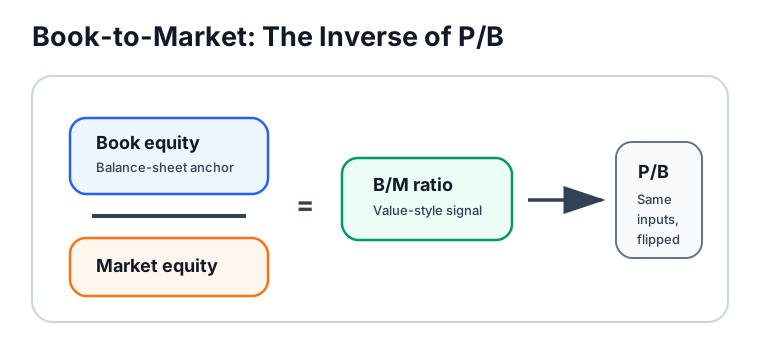
At a high level, a higher book-to-market ratio often points to a cheaper, more value-oriented, or more distressed stock. A lower book-to-market ratio often points to a company the market values at a larger premium to book equity.
Why It Matters
Book-to-market matters because it connects an accounting anchor with a market price signal:
- the numerator comes from the balance sheet
- the denominator comes from the stock market
- the ratio shows how much accounting equity is available for each dollar of market value
Investors use it in value screens, factor portfolios, academic research, asset-pricing models, bank and insurance comparisons, and relative-valuation work.
Basic Formula
Book-to-market can be calculated at the company level:
It can also be calculated per share:
The two forms should produce the same answer if the equity and share-count bases match.
How To Read The Ratio
| Reading | Possible Meaning | What To Check |
|---|---|---|
| High book-to-market | Market value is low relative to book equity | Distress risk, asset quality, profitability, write-down risk, and cyclicality |
| Middle-range book-to-market | Market price is closer to accounting book value | Peer set, industry norms, balance-sheet quality, and return on equity |
| Low book-to-market | Market value is high relative to book equity | Growth expectations, intangible value, durable profitability, or overvaluation |
The ratio is a signal, not a conclusion. A high book-to-market stock can be a value opportunity, but it can also be a value trap if book value is overstated or future profitability is poor.
Book-to-Market vs. Price-to-Book
Book-to-market and price-to-book describe the same relationship from opposite directions:
That means:
- high book-to-market equals low P/B
- low book-to-market equals high P/B
- the same input problem affects both ratios
The choice usually depends on the analytical frame. Equity valuation pages often use P/B, while factor research often uses book-to-market because high book-to-market stocks are treated as value stocks.
Factor Investing Context
Book-to-market is central to many value-factor definitions. In the Fama-French framework, high book-to-market stocks are often grouped separately from low book-to-market stocks to study the value premium. The ratio is therefore not just a single-company valuation shortcut; it is also a portfolio-sorting variable.
That does not mean high book-to-market is automatically attractive. Factor portfolios diversify across many companies. A single company still requires business-specific review of asset quality, earnings power, leverage, and management credibility.
Where It Works Best
Book-to-market tends to be more informative where book equity still has economic meaning:
- banks and insurers
- industrial companies
- mature asset-heavy firms
- commodity or cyclical firms with meaningful tangible assets
- value and factor-screening portfolios
It tends to be less informative for software, platform, brand, data, and other intangible-heavy businesses where accounting book value may miss much of the economic asset base.
Public Source Checks
Use source data before relying on book-to-market:
- SEC EDGAR Company Search: Annual and quarterly filings for common equity, goodwill, intangible assets, share count, buybacks, preferred equity, and risk factors.
- SEC Financial Statement Data Sets: Structured statement data that can help tie equity, assets, liabilities, net income, and share counts to filings.
- SEC Company Facts API: Company-level XBRL facts for validating equity, assets, liabilities, and per-share calculations.
- Kenneth French Data Library: Public factor and portfolio data commonly used in book-to-market and value-factor research.
- Fama/French Factor Description: Method notes for SMB and HML factor construction, including book-equity and market-equity data requirements.
For single-company work, tie the market capitalization date to the same reporting period used for book equity. A current price divided by stale book value can still be useful, but the timing mismatch should be explicit.
Quiz
When It Misleads
Book-to-market can mislead when:
- book value includes assets that may be impaired
- goodwill, intangibles, or acquisition accounting distort equity
- profitability is below the cost of equity
- leverage makes peer comparisons unstable
- share count, preferred equity, or minority interests are handled inconsistently
- accounting rules differ across industries or jurisdictions
- the company’s value comes mainly from assets not captured on the balance sheet
Review Checklist
Before relying on book-to-market, document:
- book-equity source, reporting period, and whether common equity or tangible equity is used
- market capitalization date, share class, currency, and market data source
- goodwill, intangibles, impairments, and asset-quality concerns
- preferred equity, minority interest, buybacks, and share-count treatment
- profitability, return on equity, leverage, and growth expectations
- peer set or factor universe used for comparison
- whether the conclusion changes if book value or market value is adjusted
Related Terms
- Price-to-Book Ratio: The inverse version of the same valuation relationship.
- Price to Tangible Book Value (PTBV): A stricter book multiple that removes many intangible assets.
- Book Value: The accounting equity figure used in the numerator.
- Book Value Per Share: The per-share version of the book-value input.
- Value Stock: A stock often associated with higher book-to-market readings.
- Return on Equity: A profitability measure that helps explain whether book-equity valuation is justified.
- Market Capitalization: The market value figure used in the denominator.
- Balance Sheet: The statement where equity and asset-quality clues are reported.