Post-Money Valuation
The implied company value immediately after a financing round, usually equal to pre-money valuation plus new investment.
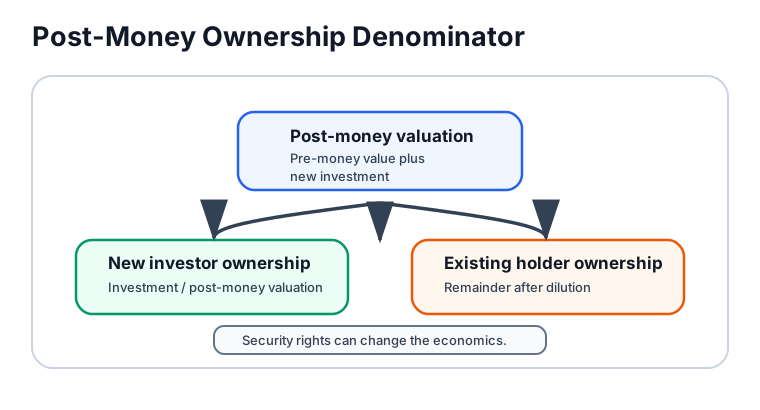
Post-money valuation is the implied equity value of a company immediately after a financing round. It equals the pre-money valuation plus the new investment, and it is the denominator used to calculate the new investor’s ownership percentage.
Post-money valuation is most common in venture capital, angel financing, growth equity, and other private-company rounds where new shares are issued.
What Post-Money Valuation Shows
Post-money valuation is the after-round ownership base. It tells investors and existing holders how the new financing changes the company’s implied value and ownership split.
| Question | Post-Money Valuation Helps Answer |
|---|---|
| How much is the company valued at after the round? | Add new investment to pre-money valuation. |
| What does the new investor own? | Divide investment amount by post-money valuation. |
| What do existing holders own after the round? | Subtract new investor ownership, then adjust for option pool and conversions. |
| What is the next round’s valuation reference point? | Future rounds often compare progress against the last post-money valuation. |
Post-money valuation does not by itself describe liquidation preferences, voting control, investor protections, or the quality of the underlying business.
Worked Example
Suppose a company raises $2 million at a $8 million pre-money valuation.
The post-money valuation is $10 million. The new investor ownership is:
Existing holders collectively own 80% after the round before any later grants, conversions, or future financing.
Ownership Bridge
| Step | Calculation | Result |
|---|---|---|
| Pre-money value | Negotiated before the round | $8 million |
| New investment | Cash invested in the round | $2 million |
| Post-money value | $8 million + $2 million | $10 million |
| Investor ownership | $2 million / $10 million | 20% |
| Existing holder ownership | 100% - 20% | 80% |
If the financing also requires a larger option pool, converts notes, or issues preferred stock with special rights, the economic impact can differ from the simple headline ownership split.
Post-Money vs. Pre-Money
| Item | Pre-Money Valuation | Post-Money Valuation |
|---|---|---|
| Timing | Before new investment | Immediately after new investment |
| Main use | Negotiating price and dilution | Calculating investor ownership and after-round value |
| Formula | Post-money - investment | Pre-money + investment |
| Common mistake | Dividing investment by pre-money value | Ignoring option pool, conversions, or preferred terms |
| Best evidence | Term sheet, cap table, financing documents | Closing cap table and investment amount |
A financing round can be quoted either way. Analysts should convert both terms to the same ownership math before comparing rounds.
Public Source Checks
Use public sources for financing-round context and securities-law framing:
- SEC Resources for Small Businesses: SEC overview of capital-raising resources for companies and investors.
- SEC Offering Pathways: Overview of exempt and registered offering pathways.
- SEC Ready to Raise Capital: Practical capital-raising readiness topics, including ownership records.
- SEC EDGAR Company Search: Filings for public-company financing, share count, offering documents, and risk disclosures.
For private rounds, the strongest evidence is usually not public. Review the final term sheet, stock purchase agreement, amended charter, investor rights agreement, capitalization table, option plan, and conversion schedules.
Scenario Question
An investor puts $5 million into a company at a $25 million post-money valuation.
Question: What ownership does the new investor receive before later dilution?
Answer: The investor receives $5 million / $25 million = 20%. The implied pre-money valuation is $20 million.
Quiz
When Post-Money Valuation Misleads
Post-money valuation can mislead when:
- it is quoted without the investment amount or ownership percentage
- option pool increases shift dilution to existing holders
- convertible notes, SAFEs, warrants, or preferred stock convert around the round
- liquidation preferences, participation rights, anti-dilution terms, or control rights change economics
- the financing is small, insider-led, distressed, or not representative of market value
- the round is structured with milestone closings or contingent tranches
- secondary share sales are mixed with primary capital without clear separation
- later financing rounds, down rounds, or recapitalizations change the effective ownership story
Headline post-money value is clean arithmetic. Financing economics are often less clean.
Review Checklist
Before relying on a post-money valuation, document:
- pre-money valuation, investment amount, post-money valuation, and investor ownership
- fully diluted share count and price per share at closing
- option pool before and after the round
- convertible notes, SAFEs, warrants, preferred stock, and other securities converting in the round
- liquidation preferences, participation rights, anti-dilution terms, and governance rights
- primary versus secondary capital and any contingent or milestone-based closing terms
- whether the valuation came from a signed round, indicative term sheet, internal estimate, or stale financing
Related Terms
- Pre-Money Valuation: The before-round valuation used with investment amount to calculate post-money value.
- Share Dilution: The ownership reduction from new share issuance.
- Cap Table: The ownership schedule updated after the financing closes.
- Fully Diluted Shares: The denominator that affects ownership and price-per-share math.
- Option Pool: A negotiated reserve that can change effective dilution.
- Venture Capital: The private-market financing context where post-money valuation is common.
- Convertible Note: A financing instrument that may convert into the round and affect ownership.
- Preferred Stock: The security class commonly issued in venture financing.