EV/EBITDA
EV/EBITDA compares enterprise value with operating earnings before depreciation and amortization to value businesses across capital structures.
EV/EBITDA is a valuation multiple that compares a company’s Enterprise Value (EV) to its EBITDA.
It is widely used because it relates the value of the whole operating business to an operating earnings measure before interest, taxes, depreciation, and amortization.
EV/EBITDA Formula
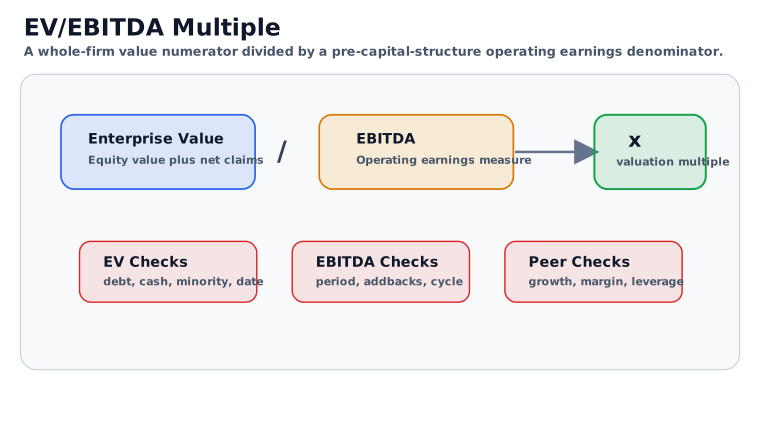
This framing matters:
- the numerator is firm-wide
- the denominator is operating and pre-capital-structure
That makes the multiple useful when comparing businesses with different financing mixes.
How Analysts Build The Multiple
The calculation is simple, but the support is not. Analysts should define each side of the ratio:
| Input | What To Check | Why It Matters |
|---|---|---|
| Enterprise value | Market cap, debt, cash, preferred stock, minority interest, valuation date | A stale share count or missing claim can distort the numerator |
| EBITDA | Reported, adjusted, forward, trailing, or normalized EBITDA | One-time addbacks and cycle effects can distort the denominator |
| Comparable set | Industry, growth, margin, leverage, geography, size, and accounting policy | A weak peer set makes the multiple look more objective than it is |
| Period | LTM, NTM, calendar-year estimate, or cycle-normalized period | A high-growth or cyclical company can screen differently across periods |
| Adjustment policy | Restructuring, stock-based compensation, leases, acquisitions, and synergies | Addbacks can make the multiple too flattering if not challenged |
Why Analysts Use It
EV/EBITDA is popular because it can help compare companies on a more apples-to-apples basis than equity-only multiples.
It is commonly used in:
- public-company comparables
- M&A analysis
- sector valuation screens
- sanity-checking a DCF output
What a Higher or Lower Multiple Can Mean
A higher EV/EBITDA multiple may suggest:
- stronger growth expectations
- higher margins
- better business quality
- lower perceived risk
A lower multiple may suggest:
- weaker growth
- lower quality or cyclicality
- higher risk
- market pessimism
But interpretation is never automatic. Cheap-looking multiples can reflect genuine problems.
Why EBITDA Is Used
EBITDA is often used because it tries to focus on operating earnings before financing structure and certain accounting choices.
That said, EBITDA is not cash flow. It ignores:
- capital expenditures
- working capital needs
- debt service
So EV/EBITDA is useful, but incomplete.
EV/EBITDA vs. P/E
Compared with a price-to-earnings multiple:
- EV/EBITDA is less distorted by leverage differences
- P/E is more directly tied to equity holders’ earnings
For capital-intensive or heavily leveraged businesses, EV/EBITDA can be especially informative.
Public Source Checks
Use public filings and market data before relying on the multiple:
- SEC EDGAR Company Search: Filings for debt, cash, EBITDA adjustments, segment disclosures, risk factors, acquisitions, and management discussion.
- SEC Financial Statement Data Sets: Structured statement data for historical revenue, operating income, depreciation, amortization, debt, and cash checks.
- SEC Company Facts API: XBRL company facts that can help verify reported financial-statement line items.
- Company earnings releases and reconciliations: adjusted EBITDA should tie to a clear reconciliation from GAAP or IFRS measures.
Market price, share count, debt, cash, and EBITDA period should be measured consistently. Do not mix a current enterprise value with stale EBITDA unless the analysis explicitly says so.
When EV/EBITDA Misleads
EV/EBITDA can be useful, but it can mislead when:
- capital expenditures are structurally high
- working-capital needs absorb cash
- lease costs or capitalized software obscure reinvestment needs
- EBITDA addbacks are aggressive or recurring
- companies have different tax, pension, or minority-interest structures
- cyclicality makes current EBITDA unusually high or low
- peer companies use different accounting or segment mixes
In those cases, pair EV/EBITDA with free cash flow, EBIT, DCF, leverage, and return-on-capital checks.
Review Checklist
Before relying on the multiple, document:
- the valuation date and share count used for market capitalization
- debt, cash, preferred stock, minority interest, and lease treatment in enterprise value
- whether EBITDA is reported, adjusted, forward, trailing, or cycle-normalized
- the source for each EBITDA adjustment and whether the adjustment is recurring
- the peer set and why each company belongs in it
- the valuation conclusion that changes if the multiple changes
Related Terms
- Enterprise Value (EV): The firm-wide numerator in the multiple.
- EBITDA: The operating earnings measure in the denominator.
- Terminal Value: Exit multiples are often used to estimate terminal value.
- Discounted Cash Flow (DCF): Often used alongside multiples to check valuation reasonableness.
- Free Cash Flow: A cash-flow measure that captures items EBITDA leaves out.
- Enterprise Value to Sales (EV/Sales): Another firm-value multiple used when EBITDA is weak or unstable.