Pre-Money Valuation
The implied company value before a new financing round, used to calculate investor ownership and dilution.
Pre-money valuation is the implied equity value of a company immediately before a new financing round. It is the valuation base used to negotiate how much ownership a new investor receives for a specific investment amount.
Pre-money valuation matters because it connects price, ownership, dilution, and control. In startup and private-company financing, small changes in pre-money valuation can materially change founder ownership and investor economics.
Core Relationship
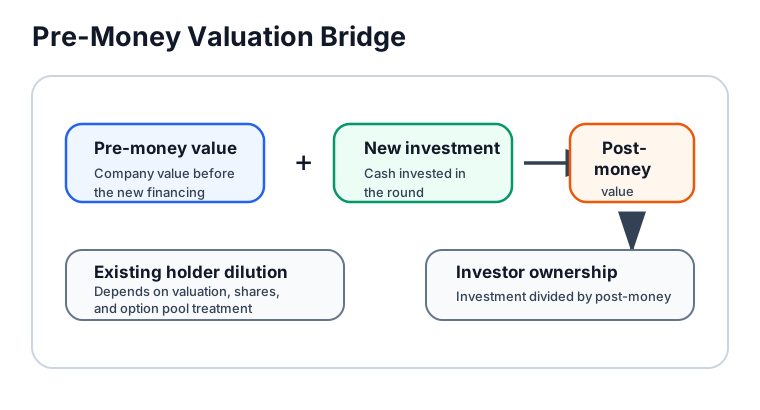
Pre-money and post-money valuation are two sides of the same financing round.
| Term | What It Measures | Formula |
|---|---|---|
| Pre-money valuation | Company value before the new money enters | Post-money valuation - new investment |
| New investment | Cash or consideration invested in the round | Negotiated financing amount |
| Post-money valuation | Company value immediately after the round | Pre-money valuation + new investment |
| Investor ownership | New investor’s round ownership before later dilution | Investment / post-money valuation |
The negotiation usually starts with either a pre-money valuation or an ownership target. The other numbers follow from the amount invested and the share count used.
Worked Example
Suppose a company raises $3 million at a $12 million pre-money valuation.
The post-money valuation is $15 million. The new investor’s ownership is:
Existing holders collectively own the remaining 80% after the round, before any later option grants, conversions, or future financings.
Cap-Table Effect
Pre-money valuation is not just a headline price. It changes the cap table.
| Negotiated Term | Effect If Higher | Effect If Lower |
|---|---|---|
| Pre-money valuation | Less dilution for existing holders | More dilution for existing holders |
| Investment amount | More cash but more investor ownership | Less cash and less new investor ownership |
| Option pool increase | Often dilutes existing holders before the round | May leave less room for hiring incentives |
| Fully diluted share count | Can lower the implied price per share | Can overstate ownership if options are ignored |
| Convertible note conversion | May add shares before or during the round | Can change effective pre-money ownership math |
Term sheets often define whether the pre-money valuation is calculated on a fully diluted basis and whether an option pool increase is included before the new money.
Price Per Share
For an equity round, pre-money valuation also determines the price per share:
If the company has 6 million fully diluted pre-money shares and a $12 million pre-money valuation, the implied price is $2.00 per share.
The share-count definition matters. Including options, warrants, convertible securities, or promised grants can change the effective price and ownership split.
Public Source Checks
Use public sources for financing-round context and securities-law framing:
- SEC Resources for Small Businesses: SEC capital-raising resources for private and public offering pathways.
- SEC Offering Pathways: Overview of exempt and registered offering paths.
- SEC Ready to Raise Capital: Capital-raising readiness topics, including ownership records and investor questions.
- SEC EDGAR Company Search: Public-company filings, financing disclosures, share-count data, and risk-factor context.
For a private transaction, the main evidence is usually the term sheet, capitalization table, financing documents, investor rights agreement, option plan, and convertible instrument schedule.
Scenario Question
A founder says, “We raised $2 million at an $8 million pre-money valuation, so the investor owns 25%.”
Answer: Not quite. The post-money valuation is $10 million, so the new investor owns $2 million / $10 million = 20% before later dilution. The 25% figure would be the investment divided by the pre-money valuation, which is not the ownership formula.
Quiz
When Pre-Money Valuation Misleads
Pre-money valuation can mislead when:
- the option pool increase is included in a way that dilutes founders before the round
- the calculation ignores fully diluted shares
- convertible notes, SAFEs, warrants, or preferred stock change the pre-round share count
- liquidation preferences, participation rights, or senior securities make headline valuation less comparable
- the company quotes valuation but not investment amount, ownership, or price per share
- a financing round is small, insider-led, or structured in a way that does not represent market-clearing value
- later down rounds, pay-to-play provisions, or anti-dilution features can change effective economics
The headline pre-money number is only useful when it is tied to the actual security, share count, ownership percentage, and investor rights.
Review Checklist
Before relying on a pre-money valuation, document:
- investment amount, pre-money valuation, post-money valuation, and implied investor ownership
- fully diluted share count and the securities included in that denominator
- option pool size before and after the financing
- convertible notes, SAFEs, warrants, preferred stock, and other instruments converting in the round
- liquidation preferences, participation rights, anti-dilution terms, and governance rights
- whether valuation is based on a lead investor term sheet, internal estimate, secondary trade, or stale round
- the ownership or dilution conclusion that would change if the pre-money valuation were different
Related Terms
- Post-Money Valuation: The company value after the new investment is included.
- Share Dilution: The ownership reduction existing holders experience when new shares are issued.
- Cap Table: The ownership record that shows how the round changes shareholder stakes.
- Option Pool: A common financing-round negotiation point that can shift dilution.
- Fully Diluted Shares: The share denominator often used in private financing math.
- Venture Capital: The financing context where pre-money valuation is most commonly negotiated.
- Convertible Note: A financing instrument that may convert into equity at a later round.
- Preferred Stock: The security class often issued to venture investors.