Capital Expenditure
Capital expenditure is investment in long-lived operating assets, with important differences between cash spending, accounting additions, and maintenance needs.
Capital expenditure (CapEx) is investment in acquiring, constructing, or improving assets expected to support operations beyond the current reporting period. It commonly includes property, plant, equipment, and qualifying software or other intangible assets. CapEx affects the balance sheet, cash flow, future depreciation or amortization, operating capacity, and valuation.
CapEx does not mean every payment associated with a long-lived asset is capitalized, and it is not always a cash purchase. Accounting recognition depends on the applicable reporting framework and facts. Analysts must also distinguish recorded asset additions from cash capital expenditure and from estimates of maintenance or growth CapEx.
Key Takeaways
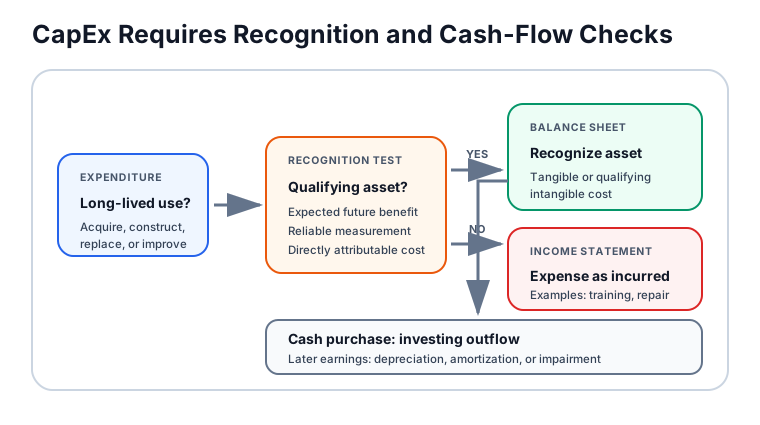
- A cost is capitalized only when it qualifies for recognition as an asset; routine repairs, training, and ordinary operating costs are generally expensed.
- Cash purchases of long-lived assets normally appear in investing activities, while noncash acquisitions are disclosed outside the cash flow statement.
- Depreciation applies to depreciable tangible assets when available for use; land is generally not depreciated, and intangible assets follow amortization and impairment rules.
- Maintenance and growth CapEx are useful analytical categories, but financial statements rarely provide a precise standardized split.
- High CapEx can represent productive reinvestment, required replacement, compliance spending, or poor capital allocation. Context determines which.
What Qualifies as Capital Expenditure?
For tangible assets, capitalized cost generally includes the purchase price and directly attributable costs needed to bring the asset to the location and condition required for its intended operation. Depending on the facts, that can include site preparation, delivery, installation, professional fees, testing, and an initial estimate of qualifying dismantling or restoration obligations.
Subsequent spending is capitalized when it qualifies as an addition, replacement, or improvement under the applicable accounting rules. Day-to-day servicing and repairs are generally expensed. The distinction depends on what the spending does, not whether management calls it an investment.
Qualifying intangible investment may also be capitalized. Purchased software, licenses, and patents are common examples. Internally generated spending is more restrictive: under IFRS, research expenditure is expensed, while development expenditure is capitalized only after specified recognition criteria are met. U.S. GAAP can produce different results for research, software, and other development costs.
CapEx Categories
| Category | Purpose | Analytical caution |
|---|---|---|
| Replacement or maintenance | Sustain existing capacity, reliability, or service level | The reported amount is rarely separated cleanly from growth spending. |
| Expansion | Add locations, production lines, networks, or capacity | Demand, utilization, and ramp timing determine the return. |
| Productivity | Reduce unit cost, errors, downtime, or working-capital needs | Savings may depend on execution and adoption. |
| Compliance or safety | Meet legal, environmental, safety, or operating requirements | May protect existing cash flows without directly increasing revenue. |
| Digital or intangible | Develop qualifying software, platforms, licenses, or systems | Recognition rules and useful lives differ from tangible assets. |
| Acquisition-related asset additions | Obtain assets directly or through a business combination | Purchase accounting and goodwill complicate comparisons with organic CapEx. |
These are economic descriptions, not universal financial-statement labels. A project can serve several purposes at once. For example, replacing an old production line may preserve existing capacity while also lowering energy use and increasing output.
Worked Example: Accounting Treatment
Assume a manufacturer incurs the following costs for a new machine:
- purchase price: $1,200,000;
- delivery and installation: $100,000;
- employee training: $40,000; and
- routine repair after production begins: $30,000.
Under the simplified assumptions, the machine and directly attributable installation cost are capitalized:
The $40,000 training cost and $30,000 routine repair are expensed because they do not form part of the machine’s qualifying cost in this example. The precise treatment depends on the reporting framework and facts.
If the machine has a six-year useful life and an estimated residual value of $100,000, annual straight-line depreciation is:
The $1.3 million cash purchase is generally an investing cash outflow. The training and routine repair payments are generally operating cash outflows in this simplified case. If the machine were acquired through a finance arrangement without an initial cash payment, the asset addition would not itself appear as a current investing cash outflow; the noncash transaction and later financing cash flows would need separate analysis.
How CapEx Flows Through the Statements
Balance Sheet
Qualifying expenditure increases a tangible or intangible asset. The carrying amount subsequently changes through depreciation, amortization, impairment, disposals, foreign-exchange effects, revaluation where permitted, and further additions.
Income Statement
Capitalizing a cost defers expense recognition; it does not eliminate the economic cost. A depreciable tangible asset is allocated over its useful life once it is available for use. A finite-lived intangible asset is amortized. Land normally is not depreciated, construction in progress normally is not depreciated before it is available for use, and indefinite-lived intangibles are generally tested for impairment rather than amortized.
Cash Flow Statement
Cash payments to acquire or construct long-term assets are generally classified as investing activities. Depreciation and amortization are noncash expenses and are added back when operating cash flow is presented using the indirect method. Investing and financing transactions that do not use cash are excluded from the cash flow statement and disclosed separately under IFRS.
This explains why CapEx can reduce cash while leaving current operating profit largely unaffected except for depreciation or amortization. It also explains why EBITDA does not capture the cost of replacing the asset base.
Finding CapEx in Financial Reports
The cash flow statement may show lines such as purchases of property and equipment, additions to software, or payments for intangible assets. The notes can provide gross additions, capital commitments, asset classes, construction in progress, useful lives, disposals, and acquisition effects.
A property-and-equipment roll-forward can be represented as:
“Other changes” may include currency translation, impairments, revaluations, transfers, acquisition accounting, and assets classified for sale. Therefore, the shortcut of ending net property and equipment minus beginning net property and equipment plus depreciation does not always equal cash CapEx. The asset note and cash flow statement are better starting points.
Maintenance CapEx vs. Growth CapEx
Maintenance CapEx is the estimated spending needed to preserve existing operating capacity or competitive position. Growth CapEx is spending intended to add capacity, enter markets, introduce products, or increase future cash flows. The distinction matters because cash remaining after true maintenance needs can be more informative than cash remaining after an arbitrary reported total.
There is no universal accounting rule that separates the two. Management estimates can be useful but should be tested against:
- depreciation and asset age;
- physical capacity and utilization;
- store, fleet, network, or production-unit counts;
- inflation in replacement cost;
- deferred maintenance and service quality;
- regulatory or environmental commitments; and
- multi-year capital plans.
Using depreciation as maintenance CapEx is a rough shortcut, not an identity. Depreciation reflects historical cost allocations and accounting lives. Replacement spending reflects current prices, technology, asset condition, and the capacity the business intends to maintain.
CapEx vs. OpEx
| Feature | Capital expenditure | Operating expenditure |
|---|---|---|
| Economic purpose | Acquire or improve a qualifying long-lived asset | Support current-period operations or maintain assets routinely |
| Initial accounting | Recognized as an asset when criteria are met | Usually recognized as expense when incurred |
| Later income effect | Depreciation, amortization, impairment, or disposal result | Current-period operating expense |
| Cash-flow classification | Commonly investing for cash asset purchases | Commonly operating, subject to applicable rules |
| Judgment risk | Useful life, residual value, directly attributable cost, impairment | Timing, accruals, classification, and recurring adjustments |
A company should not capitalize ordinary operating costs merely to improve current earnings. Analysts should examine changes in capitalization policy, capitalized internal labor, software development, interest, and other judgment-sensitive additions.
How Analysts Evaluate CapEx
CapEx becomes more informative when related to the business outcome it is intended to produce.
CapEx Intensity
This ratio helps compare reinvestment across periods, but business model, asset ownership, lease use, acquisition activity, and project timing can overwhelm simple peer comparisons.
Free Cash Flow
A common free cash flow convention subtracts capital expenditure from operating cash flow. Free cash flow is a non-GAAP or analyst-defined measure whose exact formula should be stated. Total CapEx may understate cash that is economically discretionary when much of the spending is required to maintain operations.
Returns on New Investment
CapEx should eventually support volume, price, margin, cost savings, resilience, or risk reduction. Analysts can compare changes in ROIC and Economic Value Added with the timing of major projects. Long construction and ramp periods require multi-year analysis.
Risks and Limitations
- Underinvestment: Low CapEx can temporarily increase free cash flow while equipment reliability, capacity, safety, or competitiveness deteriorates.
- Overinvestment: Large projects can destroy value if demand, pricing, costs, or execution fall short of the investment case.
- Project delay: Capital may sit in construction in progress without generating expected revenue.
- Cost overrun: Inflation, design changes, supply constraints, and weak controls can increase the required outlay.
- Impairment: A project whose expected benefits decline may require a write-down.
- Classification choice: Capitalizing more eligible cost raises current profit and assets but creates later depreciation or amortization.
- Acquisition and lease effects: Companies that buy, lease, or acquire businesses can show very different cash CapEx despite similar operating capacity.
- Tax mismatch: Tax depreciation, credits, deductions, and capital allowances vary by jurisdiction and can differ materially from financial reporting. Tax consequences require current local guidance and professional analysis.
Common Mistakes
- Treating every long-term project payment as a capitalizable cost.
- Assuming all capitalized assets are depreciated in the same way.
- Equating asset additions in the notes with cash CapEx.
- Assuming maintenance CapEx always equals depreciation.
- Praising low CapEx without checking asset condition and future commitments.
- Comparing peers without adjusting for leasing, outsourcing, acquisitions, and capitalization policies.
- Treating management’s growth-versus-maintenance split as audited or standardized when it may be an estimate.
Authority and Further Reading
- IFRS Foundation: IAS 16 Property, Plant and Equipment summarizes recognition, initial cost, depreciation, and impairment principles for tangible operating assets.
- IFRS Foundation: IAS 7 Statement of Cash Flows explains operating, investing, and financing classifications and separate disclosure of noncash transactions.
- IFRS Foundation: IAS 38 Intangible Assets summarizes recognition and subsequent measurement of purchased and internally generated intangible assets.
- SEC: Beginner’s Guide to Financial Statements shows how purchases of long-term assets appear in investing cash flows.
Related Terms
- Operating Expenditure: Current operating spending commonly contrasted with CapEx.
- Capitalization: Recognition of a qualifying cost as an asset rather than immediate expense.
- Depreciation: Allocation of a depreciable tangible asset’s amount over its useful life.
- Amortization: Allocation commonly applied to finite-lived intangible assets.
- Free Cash Flow: Analytical cash-flow measure that commonly deducts CapEx.
FAQs
Is capital expenditure always shown in investing cash flow?
Is all CapEx depreciated?
How can an investor estimate maintenance CapEx?
This page is general financial education, not accounting, tax, legal, or investment advice. Reporting and tax treatment depends on the entity’s facts, accounting framework, and jurisdiction.