Net-Net Valuation
A deep-value stock screen that compares market value with net current asset value after subtracting total liabilities.
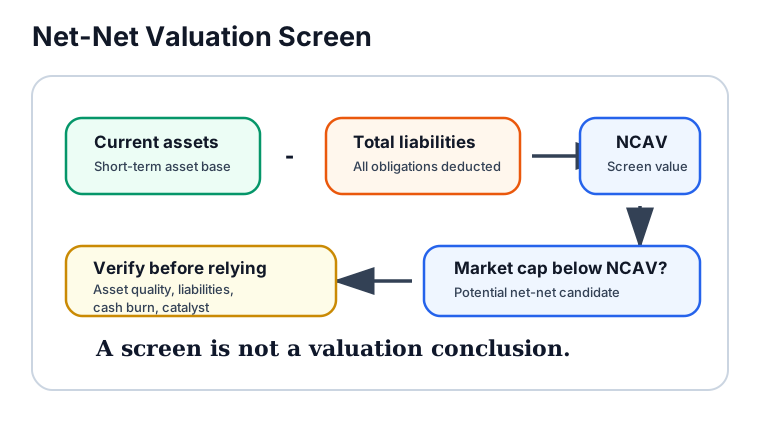
Net-net valuation is a deep-value approach that compares a company’s market value with its net current asset value (NCAV). The classic screen looks for stocks trading below current assets after all liabilities are subtracted.
The method is associated with Benjamin Graham-style deep value investing. It is a screening discipline, not a guarantee that a stock is cheap.
The Core Test
Net-net valuation asks whether investors can buy the company for less than a conservative balance-sheet measure:
| Test | Formula | Interpretation |
|---|---|---|
| Company-level screen | Market capitalization < NCAV | The whole equity market value is below current assets after total liabilities. |
| Per-share screen | Share price < NCAVPS | The stock price is below net current asset value per share. |
| Discount to NCAV | 1 - Market cap / NCAV | Estimates how large the discount is before due-diligence adjustments. |
| Adjusted screen | Market cap < Adjusted NCAV | Uses haircuts for weak receivables, inventory, restricted cash, or hidden liabilities. |
A passing screen means the stock deserves deeper review. It does not mean shareholders will actually realize NCAV.
Calculation Flow
| Step | What To Do | Practical Check |
|---|---|---|
| Identify current assets | Pull cash, receivables, inventory, and other current assets from the balance sheet. | Check whether assets are liquid, collectible, unrestricted, and current. |
| Subtract total liabilities | Deduct current and noncurrent liabilities. | Include debt, leases, provisions, deferred taxes, and other obligations. |
| Convert to per-share value | Divide NCAV by common shares outstanding when using a share-price screen. | Match the share count to the valuation date and share class. |
| Compare with market value | Compare NCAV with market capitalization or NCAVPS with share price. | Use a consistent price date and consider liquidity. |
| Run quality checks | Apply haircuts and review events after the reporting date. | Do not rely on stale assets if the company is burning cash. |
The strict use of total liabilities is what makes the screen conservative. It does not give credit to property, equipment, goodwill, brand value, or future earnings power.
Worked Example
Suppose a small public company reports:
- current assets of
$100 million - total liabilities of
$65 million - market capitalization of
$24 million 10 millioncommon shares outstanding
NCAV is:
NCAV is $35 million. Because market capitalization is $24 million, the stock trades below NCAV.
The per-share version is:
If the share price is $2.40, the stock trades at about 69% of NCAVPS. The screen is attractive only if the asset base survives diligence.
What Makes Net-Net Different
Net-net valuation is narrower than broad book value analysis. It gives little or no value to assets that may be valuable in normal operations but harder to realize quickly.
| Method | Main Anchor | Difference From Net-Net Valuation |
|---|---|---|
| Net-net valuation | Current assets minus total liabilities | Ignores most long-term assets and future earning power. |
| Price-to-book | Market price versus book value | Uses total book equity, including long-term assets and accounting equity effects. |
| Tangible book value | Equity after removing many intangibles | Still includes many long-term tangible assets. |
| Liquidation value | Estimated recoverable value in a wind-down | Requires asset-specific recovery estimates, not just book-value arithmetic. |
| Intrinsic value | Present value or economic value estimate | Looks at future cash flows, competitive position, and risk. |
Net-net screens are rare in large, healthy, actively followed companies. They are more common in small-cap, distressed, cyclical, neglected, or foreign listings where liquidity and governance risk may be significant.
Public Source Checks
Use public sources before treating a stock as a net-net candidate:
- SEC EDGAR Company Search: Review 10-K, 10-Q, 8-K, proxy statements, and amendments for balance-sheet data, share count, financing, risks, and subsequent events.
- SEC Financial Statement Data Sets: Pull structured financial-statement data for repeatable current-asset and liability screens.
- SEC Company Facts API: Validate XBRL facts when building systematic screens.
- Company investor relations materials: Compare management liquidity discussion, buybacks, financing, and asset-sale updates with filed statements.
Market data should be dated. A stock can look like a net-net using an old balance sheet but fail the test after cash burn, dilution, debt issuance, asset write-downs, or a price change.
Due-Diligence Questions
Before relying on a net-net screen, test the balance-sheet quality:
- Are receivables collectible, concentrated, insured, factored, or past due?
- Is inventory commodity-like and saleable, or obsolete and company-specific?
- Is cash unrestricted and accessible to common shareholders?
- Are liabilities complete, including leases, pensions, deferred taxes, legal claims, and guarantees?
- Does preferred equity, minority interest, or debt seniority absorb the apparent surplus?
- Is the company profitable, cash-flow neutral, or rapidly consuming current assets?
- Could governance, related-party transactions, delisting risk, or poor disclosure block value realization?
- Is there a credible catalyst such as liquidation, buyback, asset sale, restructuring, or improved profitability?
The point is not to force every candidate into a model. The point is to reject false bargains quickly.
Scenario Question
An analyst screens for stocks trading below NCAV and finds a company at 60% of NCAV. The company has large receivables from one customer, declining sales, and repeated related-party loans.
Question: Is the stock automatically attractive because it passes the net-net screen?
Answer: No. The screen is only the first pass. Customer concentration, collectability risk, operating losses, related-party exposure, and governance concerns may explain the discount.
Quiz
When Net-Net Valuation Misleads
Net-net valuation can mislead when:
- the company is burning cash faster than the balance sheet date suggests
- current assets are overstated or cannot be converted to cash near book value
- inventory is obsolete, seasonal, specialized, or tied to declining products
- receivables depend on weak customers, related parties, or disputed claims
- liabilities are understated or major contingencies are outside the simple screen
- preferred stock, debt covenants, minority interests, or liquidation preferences rank ahead of common equity
- the stock is illiquid and the quoted price does not represent executable market value
- management has no incentive to return capital or close the valuation gap
The lower the quality of current assets and governance, the larger the required discount should be.
Review Checklist
Before calling a company a net-net, document:
- current assets, total liabilities, share count, market cap, and source dates
- adjustments or haircuts applied to receivables, inventory, restricted cash, and other current assets
- full liability review, including leases, debt, taxes, legal claims, and off-balance-sheet exposures
- recent cash burn, financing activity, dilution, buybacks, or asset sales after the reporting date
- liquidity of the stock and whether the market cap is based on a reliable trading price
- governance, control shareholder, related-party, and capital-allocation risks
- catalyst or thesis for how the discount to adjusted NCAV could close
Related Terms
- Net Current Asset Value per Share (NCAVPS): The per-share version of the net-net balance-sheet test.
- Current Assets: The starting asset base for the NCAV calculation.
- Market Capitalization: The market value compared with NCAV.
- Liquidation Value: A more detailed recovery-value estimate for a wind-down scenario.
- Net Tangible Assets: A related conservative balance-sheet measure.
- Price-to-Book Ratio: A broader market-to-book comparison.
- Intrinsic Value: A wider estimate of economic value beyond current-asset backing.