Book Value Per Share
Per-share version of book equity used to compare accounting value with stock price.
Book value per share (BVPS) measures the accounting equity attributable to each common share. It converts total book equity into a per-share number that can be compared with stock price, price-to-book ratio, and other equity valuation measures.
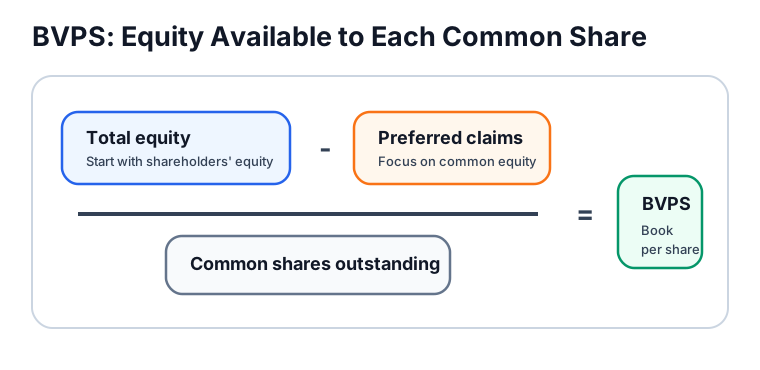
BVPS is an accounting measure, not a market price. It tells the analyst what the balance sheet says about net assets per common share.
Why BVPS Matters
BVPS matters because many equity valuation questions are asked per share:
- Is the stock trading above or below book value?
- Does a buyback increase or reduce book value per share?
- Are new shares diluting the accounting equity base?
- Is the market price reasonable relative to balance-sheet value?
- Does book value support a bank, insurer, or asset-heavy valuation argument?
It is most useful when the underlying book equity is meaningful and the share-count basis is clearly defined.
Formula Inputs
| Input | What To Check | Why It Matters |
|---|---|---|
| Total shareholders’ equity | Balance-sheet equity attributable to owners | Starting point for the accounting book-value base |
| Preferred equity | Preferred stock, preferred dividends, liquidation preference, and mezzanine claims | BVPS should focus on common shareholders |
| Common equity | Equity after subtracting preferred claims and other non-common interests when relevant | This is the numerator for common BVPS |
| Common shares outstanding | Period-end shares, weighted-average shares, basic shares, or diluted shares | The chosen denominator can change BVPS materially |
| Adjustments | Treasury stock, AOCI, goodwill, intangibles, impairments, and minority interests | Adjusted BVPS may differ from reported BVPS |
The share-count choice should match the use case. A period-end BVPS may be appropriate for balance-sheet comparison, while a weighted-average share count may be better for linking with earnings-per-share analysis.
Worked Example
Suppose a company reports:
- total shareholders’ equity of
$900 million - preferred equity of
$100 million 100 millioncommon shares outstanding
Common equity available to common shareholders is:
BVPS is:
BVPS is $8 per common share. If the stock trades at $16, the stock trades at 2.0x book value per share.
BVPS vs. Market Price
BVPS is based on accounting equity. Market price is based on what investors are willing to pay for future earnings, risk, growth, liquidity, and control.
That means a company can trade:
- above BVPS when investors expect strong returns, growth, or valuable intangible assets
- near BVPS when the business is asset-driven and expected returns are ordinary
- below BVPS when investors doubt asset quality, profitability, or solvency
A stock below BVPS is not automatically cheap. The market may be warning that reported book value is too optimistic.
How Buybacks And Issuance Affect BVPS
Share count matters. A company can increase BVPS through buybacks if it repurchases shares below book value per share. It can reduce BVPS if it repurchases shares above book value without enough earnings power to justify the premium.
New share issuance can dilute BVPS if shares are issued below book value, but it can increase BVPS if shares are issued at a premium and the capital is retained.
Where BVPS Works Best
BVPS tends to be more useful in:
- banks and insurers
- industrial and asset-heavy companies
- liquidation or downside analysis
- capital adequacy and tangible-equity review
- valuation screens that use book-based multiples
It is often less useful when economic value comes mainly from software, customer networks, brand, data, patents, or other intangible assets that accounting statements do not fully recognize.
Public Source Checks
Use source documents before relying on BVPS:
- SEC EDGAR Company Search: Annual and quarterly filings for shareholders’ equity, preferred stock, treasury stock, share count, goodwill, intangibles, and equity footnotes.
- SEC Financial Statement Data Sets: Structured statement data for equity, assets, liabilities, net income, and share-count checks.
- SEC Company Facts API: Company-level XBRL facts that can help verify equity, preferred stock, shares outstanding, and per-share values.
- Company earnings releases and investor supplements: useful when management reports adjusted BVPS, tangible BVPS, or bank and insurance capital metrics.
If a company reports adjusted BVPS, reconcile it to reported equity. Adjustments can be useful, but they should not hide preferred claims, treasury stock effects, goodwill, impairments, or accumulated other comprehensive income.
Quiz
When BVPS Misleads
BVPS can mislead when:
- goodwill or intangibles dominate book equity
- assets are impaired or not marked realistically
- preferred equity, minority interests, or treasury stock are mishandled
- diluted shares, period-end shares, and weighted-average shares are mixed
- buybacks or share issuance change the denominator quickly
- profitability is weak, so book value does not generate acceptable returns
- accounting rules make peer comparisons inconsistent
Review Checklist
Before relying on BVPS, document:
- total equity source, reporting period, currency, and statement date
- preferred equity, minority interest, treasury stock, and common-equity treatment
- share-count basis: basic, diluted, weighted average, or period-end
- goodwill, intangibles, impairments, AOCI, and other adjustments
- whether the number is reported, company-adjusted, or analyst-adjusted
- how BVPS changes P/B, book-to-market, buyback, or dilution analysis
- the valuation or risk conclusion that would change if BVPS changed
Related Terms
- Book Value: The total accounting net-worth concept from which BVPS is derived.
- Price-to-Book Ratio: Compares market price with BVPS.
- Book-to-Market Ratio: Uses book equity relative to market equity.
- Tangible Book Value: A stricter equity base that removes many intangible assets.
- Shareholder Equity: The balance-sheet equity base used in BVPS calculation.
- Earnings per Share: A per-share profitability metric often analyzed alongside BVPS.
- Book Value vs. Market Value: Explains why market price can diverge from book-based measures.
- Net Current Asset Value per Share (NCAVPS): A more conservative asset-based per-share measure.