Net Current Asset Value per Share (NCAVPS)
A conservative deep-value metric that subtracts total liabilities from current assets and divides the result by shares outstanding.
Net current asset value per share (NCAVPS) is a conservative asset-based valuation measure. It subtracts total liabilities from current assets, then divides the result by common shares outstanding.
Deep-value investors use NCAVPS to ask whether the market price is below a rough liquidation-style balance-sheet floor. It is not a full valuation of the business.
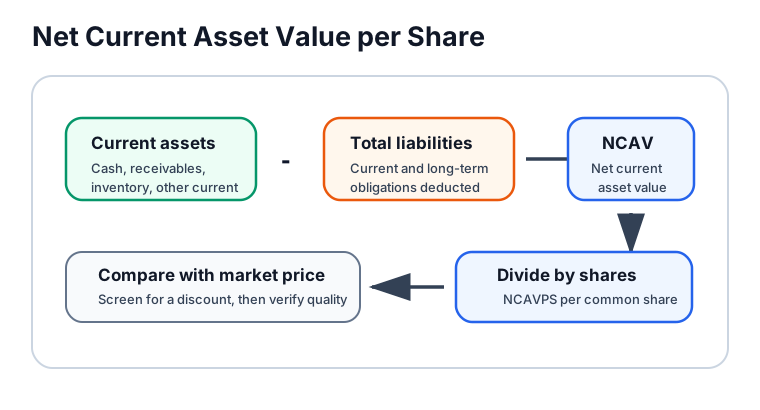
What NCAVPS Measures
NCAVPS focuses on balance-sheet resources that should convert to cash or be used within the operating cycle. It deliberately ignores long-term assets such as property, equipment, goodwill, and many other noncurrent assets.
| Component | Treatment In NCAVPS | Why It Matters |
|---|---|---|
| Current assets | Included | Cash, receivables, inventory, and other short-term assets form the gross asset base. |
| Total liabilities | Subtracted | The measure deducts both current and noncurrent liabilities, making it stricter than ordinary working capital. |
| Long-term assets | Excluded | The metric does not give credit for property, equipment, goodwill, or most noncurrent assets. |
| Shares outstanding | Used as divisor | Converts the company-level NCAV amount into a per-share benchmark. |
| Market price | Compared separately | A stock below NCAVPS may deserve deeper review, not automatic purchase. |
The strict deduction of total liabilities is the key difference. Net current assets often means current assets minus current liabilities. NCAV uses current assets minus total liabilities.
Formula Inputs
| Input | Source | Analyst Check |
|---|---|---|
| Current assets | Balance sheet | Separate cash, receivables, inventory, prepaid assets, and other current assets. |
| Total liabilities | Balance sheet | Include current liabilities, debt, lease liabilities, deferred tax liabilities, and other obligations. |
| Common shares outstanding | Filings and share table | Use the share count that matches the valuation date and common-equity claim. |
| Market price per share | Market data | Compare with the same share class and date used for the share count. |
Analysts may make adjustments when reported current assets are clearly overstated or not economically available to common shareholders. Common adjustments include obsolete inventory, doubtful receivables, restricted cash, off-balance-sheet commitments, preferred stock, minority interests, and post-period financing events.
Worked Example
Suppose a company reports:
- current assets of
$50 million - total liabilities of
$30 million 10 millioncommon shares outstanding- market price of
$1.50per share
NCAV is:
NCAV is $20 million. NCAVPS is:
The stock trades at $1.50, or 75% of NCAVPS. That discount is a screening signal. The next step is to test whether the current assets are collectible, saleable, and available after liabilities and other claims.
How Analysts Use NCAVPS
NCAVPS is most useful as a deep-value screen and balance-sheet stress test. It can help analysts identify companies whose market price implies little or no value for long-term assets or future earnings power.
| Use Case | What NCAVPS Helps Answer | Main Risk |
|---|---|---|
| Net-net screen | Is the stock trading below current assets after all liabilities? | The market may be pricing real distress, not hidden value. |
| Downside analysis | How much asset backing exists before giving credit to fixed assets? | Current assets may be overstated or hard to convert to cash. |
| Liquidation-style review | What might common shareholders recover after liabilities? | Liquidation costs, taxes, debt covenants, and timing can reduce recovery. |
| Balance-sheet quality check | Does the discount reflect poor asset quality? | Inventory, receivables, or related-party assets may not be worth book value. |
NCAVPS is usually more relevant for small, asset-heavy, neglected, or distressed companies than for high-growth businesses where most value comes from future cash flows or unrecorded intangibles.
Public Source Checks
Use public sources before relying on an NCAVPS comparison:
- SEC EDGAR Company Search: Pull the latest 10-K, 10-Q, and amendments for the balance sheet, notes, share count, debt, preferred stock, and risk factors.
- SEC Financial Statement Data Sets: Review structured statement data for current assets, liabilities, and share-count consistency.
- SEC Company Facts API: Validate XBRL facts when building repeatable NCAVPS screens.
- Company investor relations materials: Check share repurchases, financing events, updated liquidity disclosures, and management discussion, but reconcile adjusted figures back to filings.
The balance-sheet date, share-count date, and market-price date should be visible in the analysis. A stale balance sheet compared with a current price can still be useful, but the timing mismatch should be disclosed.
Scenario Question
An investor says, “A stock trading below NCAVPS must automatically be safe because current assets exceed the market price.”
Answer: No. A price below NCAVPS can indicate potential value, but it can also signal weak asset quality, cash burn, poor governance, litigation risk, financing stress, or a business that will consume current assets before shareholders can benefit.
Quiz
When NCAVPS Misleads
NCAVPS can mislead when:
- receivables may not be collectible
- inventory may be obsolete, specialized, seasonal, or slow-moving
- cash is restricted, offshore, or needed for operations
- debt, leases, litigation, pensions, or off-balance-sheet obligations are understated
- preferred equity or minority interests rank ahead of common shareholders
- the company is burning cash rapidly after the reporting date
- a controlling shareholder, governance problem, or delisting risk limits realization value
- liquidation costs, taxes, or severance costs would absorb much of the apparent surplus
The measure is intentionally conservative, but conservative arithmetic does not remove business risk.
Review Checklist
Before relying on NCAVPS, document:
- filing source, statement date, currency, and accounting basis
- current-asset composition and any haircut for receivables, inventory, or restricted cash
- total liabilities, including leases, debt, deferred taxes, provisions, and contingent exposures
- share count, share class, preferred equity, minority interests, and treasury stock treatment
- post-balance-sheet events, financing changes, buybacks, dilution, and cash burn
- market price date and whether the stock is liquid enough for a reliable comparison
- the conclusion that would change if NCAVPS were lower after conservative adjustments
Related Terms
- Current Assets: The starting asset base for NCAVPS.
- Net Current Assets: A related working-capital measure that usually subtracts current liabilities, not total liabilities.
- Outstanding Shares: The share-count denominator used in per-share analysis.
- Market Value per Share (MVPS): The market-price comparison for NCAVPS.
- Book Value Per Share: A broader per-share balance-sheet measure.
- Net Tangible Assets: Another conservative asset measure that removes many intangibles.
- Net-Net Valuation: The deep-value investing approach most closely associated with NCAV and NCAVPS.
- Liquidation Value: A related concept for estimating what assets might recover in a wind-down.