Tangible Book Value (TBV)
Tangible book value measures book equity after excluding intangible assets and goodwill.
Tangible book value (TBV) is book equity after removing goodwill and many intangible assets. It is a stricter version of book value because it focuses on the tangible asset base that remains after liabilities are deducted.
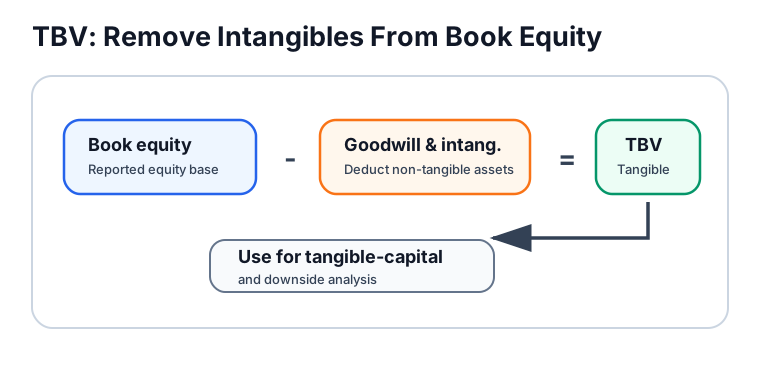
Analysts often use TBV when ordinary book value includes goodwill, acquired intangibles, or other non-physical assets that may not provide the same downside protection as tangible capital.
Why TBV Matters
TBV matters because book value can overstate the asset base available to common shareholders if a large portion of equity consists of goodwill or intangible assets. That distinction is especially important in:
- bank and insurance valuation
- acquisition-heavy companies with large goodwill balances
- distress, liquidation, or downside analysis
- price-to-tangible-book comparisons
- capital strength and asset-quality review
TBV is not a liquidation value by itself, but it gives analysts a more conservative equity base than ordinary book value.
What Gets Removed
| Item | Typical Treatment | Why It Matters |
|---|---|---|
| Goodwill | Usually deducted from book equity | Goodwill reflects acquisition premiums, not a separable hard asset |
| Acquired intangibles | Often deducted, depending on the measure | Customer relationships, trade names, and patents may be valuable but less tangible |
| Internally developed intangibles | Often not recorded as assets in the first place | Accounting can understate some intangible-heavy businesses |
| Deferred tax assets | Sometimes adjusted in bank or stress analysis | Recoverability depends on future taxable income |
| Preferred equity | Usually removed when calculating tangible common equity | Common-stock valuation should focus on common equity |
Because companies define adjusted TBV differently, the reconciliation matters as much as the headline number.
TBV vs. Book Value
Book value includes all recognized assets minus liabilities. TBV removes goodwill and many intangible assets from that equity base.
The difference is most important when a company has grown through acquisitions or carries large intangible balances. A company can look reasonably capitalized on book value but much thinner on tangible book value.
Where TBV Works Best
TBV tends to be more useful for:
- banks and insurers where tangible common equity is a key capital anchor
- asset-heavy companies where tangible assets drive earning power
- acquisition-heavy firms where goodwill can distort book value
- downside cases where asset quality and loss absorption matter
- price to tangible book value analysis
It is less useful for companies whose value comes mostly from internally developed software, brand, data, network effects, or human capital. In those cases, TBV may be conservative but not necessarily economically complete.
Public Source Checks
Use source documents before relying on TBV:
- SEC EDGAR Company Search: Annual and quarterly filings for assets, liabilities, shareholders’ equity, goodwill, intangible assets, preferred stock, and accounting policies.
- SEC Financial Statement Data Sets: Structured statement data for assets, liabilities, equity, goodwill, and intangible-asset checks.
- SEC Company Facts API: XBRL company facts that can help validate equity, goodwill, intangibles, and per-share data.
- Company earnings releases and investor supplements: often include tangible common equity, tangible book value per share, and return on tangible common equity, but management adjustments should reconcile to reported equity.
If TBV is company-adjusted, document every add-back and deduction. Do not treat an adjusted tangible-equity number as comparable unless the adjustment policy is consistent across peers.
Quiz
When TBV Misleads
TBV can mislead when:
- tangible assets are overstated or not marked realistically
- goodwill or intangibles still support real earning power
- deferred tax assets, AOCI, preferred equity, or minority interests are treated inconsistently
- reserves, credit losses, or impairments are delayed
- peer companies use different acquisition histories or accounting policies
- the company is asset-light and most economic value is not captured in tangible book
Review Checklist
Before relying on TBV, document:
- book equity source, balance-sheet date, currency, and accounting basis
- goodwill, acquired intangibles, deferred tax assets, and other deductions
- preferred equity, minority interest, treasury stock, and AOCI treatment
- whether the measure is total TBV, tangible common equity, or company-adjusted TBV
- asset-quality concerns, reserves, impairments, and fair-value marks
- whether the same TBV definition is used across peers
- the valuation or risk conclusion that changes if TBV changes
Related Terms
- Book Value: The broader accounting equity base before intangible deductions.
- Book Value Per Share: The per-share form of ordinary book value.
- Tangible Book Value Per Share (TBVPS): The per-share form of tangible book value.
- Price to Tangible Book Value (PTBV): Compares market value with tangible book value.
- Net Tangible Assets: A closely related tangible-asset measure.
- Goodwill: A major deduction in many TBV calculations.
- Shareholder Equity: The balance-sheet equity base from which TBV is often derived.