Discount
A discount is the amount by which a price is below a reference value, such as a bond's face value or a seller's stated price.
A discount is the amount by which a transaction price is below a stated reference value. In fixed income, a bond trades at a discount when its price is below face or par value. In commerce, a discount is a reduction from a stated price. The term does not, by itself, describe the return earned or prove that an asset is undervalued.
Discount is also different from discounting, the process of converting future cash flows into present value, and from a discount rate, the rate used in that calculation.
Key Takeaways
- A discount requires both a transaction price and a clearly defined reference amount.
- Discount amount and discount percentage measure a price difference, not total investment return.
- A bond can trade below par because of interest rates, credit risk, liquidity, time to maturity, or embedded terms.
- Treasury bill discount-rate conventions differ from ordinary investment-yield calculations.
- A low price relative to par, list price, or estimated value is not automatically a bargain.
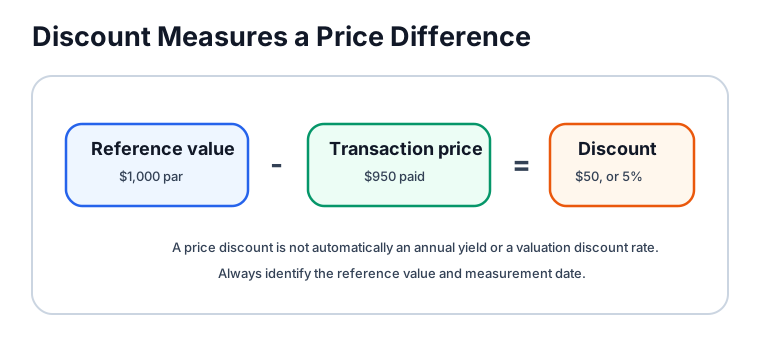
Core Discount Formulas
The discount amount is:
The discount percentage, measured against the reference value, is:
The denominator must be stated. A percentage measured against par value can differ from one measured against the transaction price or another benchmark.
Worked Example: Bond Trading Below Par
Assume a bond has:
- face value of
$1,000 - market price of
$950
The dollar discount is:
The discount as a percentage of face value is:
The bond trades at a 5% discount to par. That does not mean the investor’s annual return is 5%. Return also depends on coupon payments, time to maturity, reinvestment, credit performance, transaction costs, taxes, and the price received if the bond is sold before maturity.
Why Bonds Trade at a Discount
For a conventional fixed-rate bond, market price reflects the present value of remaining coupons and principal. Common reasons for a below-par price include:
- market yields have risen above the bond’s coupon rate
- the issuer’s credit risk has increased
- the bond is difficult to trade
- an embedded call, conversion, or other contractual term affects value
- the bond is approaching maturity under market-specific pricing conditions
- investors expect delayed, reduced, or restructured cash flows
| Relationship, all else equal | Typical bond price |
|---|---|
| Coupon rate below required market yield | Below par, or at a discount |
| Coupon rate near required market yield | Near par |
| Coupon rate above required market yield | Above par, or at a premium |
A discount can therefore be compensation for risk or an ordinary response to interest-rate changes. It is not evidence that the security is cheap relative to its economic risk.
Treasury Bills and Discount Rates
Treasury bills generally pay face value at maturity and may be issued below face value. TreasuryDirect presents the following bank-discount pricing convention:
Where:
- (d) is the annualized discount rate
- (t) is the number of days to maturity
Suppose a $10,000 bill has a 4% discount rate and 91 days to maturity:
The price discount is approximately $101.11. The quoted discount rate is not the investor’s effective annual yield because it uses face value, a 360-day convention, and simple annualization. Compare securities using consistent yield conventions.
Discount vs. Discounting vs. Discount Rate
These terms sound similar but answer different questions:
| Term | Meaning | Simple example |
|---|---|---|
| Discount | Price is below a stated reference value | A $1,000 par bond trades for $950 |
| Discounting | Converts future cash flows into present value | Finding today’s value of $1,000 received in five years |
| Discount rate | Rate used in present-value calculation | Using 7% to discount a future cash flow |
| Discount factor | Multiplier applied to a future cash flow | (1/(1+r)^n) |
A bond price below face value is a price discount. Calculating the present value of that bond’s cash flows is discounting. The required yield used in the calculation functions as a discount rate.
Other Financial Uses of Discount
Trade discount
A supplier reduces a catalog or standard price for a commercial customer. The invoice and accounting treatment depend on the actual transaction terms.
Cash or prompt-payment discount
A seller offers a lower amount if the customer pays within a specified period. The effective annual financing cost of declining the discount can be much larger than the stated percentage.
Quantity discount
The unit price falls when the buyer purchases a specified volume. Buyers should still evaluate storage, spoilage, financing, and demand risk.
Valuation discount
An appraiser may apply a discount for a specific characteristic, such as lack of marketability or lack of control. Such adjustments are purpose-specific and require evidence; they should not be treated as automatic percentages.
Original issue and market discount
Debt issued below its stated redemption amount or acquired below a tax-law reference amount can have accounting and tax consequences. These are defined concepts whose treatment depends on jurisdiction and instrument details. Professional advice may be required.
How to Evaluate a Discount
Before describing a price as discounted, ask:
- Reference value: Is the benchmark par value, list price, recent market price, book value, or appraised value?
- Measurement date: Is the benchmark current?
- Reason for the gap: Did risk, quality, liquidity, or contract terms change?
- Comparable terms: Are cash flows, maturity, seniority, currency, and restrictions equivalent?
- Total economics: Do coupons, fees, taxes, transaction costs, and timing change the apparent saving?
- Exit assumptions: Could the asset actually be sold at the expected price?
Common Mistakes
Calling every low price a bargain. A large discount may reflect a high probability of loss or weak liquidity.
Treating discount percentage as yield. A 5% discount to par is not automatically a 5% annual return.
Using an arbitrary reference price. A discount from an inflated list price may have little economic meaning.
Ignoring accrued interest. A bond’s quoted clean price and settlement amount can differ.
Confusing discount with present-value discounting. One describes a price relationship; the other is a valuation process.
Applying tax conclusions broadly. Original issue discount and market discount can have jurisdiction-specific rules.
Official Source Checks
- TreasuryDirect: Understanding Pricing and Interest Rates explains Treasury securities sold at face value, at a discount, or at a premium and provides bill-pricing conventions.
- TreasuryDirect Glossary defines a Treasury discount as the difference between par amount and price when price is below par.
- Investor.gov: What Are Corporate Bonds? explains why bonds may trade at a premium or discount to face value.
Related Terms
- Face Value: The stated amount used as the reference for a bond discount or premium.
- Bond Prices at Par, Premium, or Discount: Connects coupon rates, market yields, and bond prices.
- Present Value: The current value of future cash flows.
- Discounting: The process of translating future cash flows into present value.
- Discount Rate: The rate used in a present-value calculation.
- Yield to Maturity: An annualized bond-return measure based on price and assumed cash flows.
- Zero-Coupon Bond: A bond that generally provides return through the difference between purchase price and maturity value.
FAQs
What does it mean when a bond trades at a discount?
Is a discount the same as a discount rate?
Does buying below face value guarantee a gain?
How is discount percentage calculated?
This article is educational and does not provide investment, accounting, legal, or tax advice. Security documents and applicable rules control the treatment of a specific transaction.