Mark to Market
Mark to market revalues an asset, liability, or trading position using a current market-supported mark; in futures it also drives daily gains, losses, and margin cash flows.
Mark to market (MTM) means revaluing an asset, liability, or trading position using a current market-supported price or valuation rather than leaving it at an unchanged historical amount. In futures markets, the term also describes the daily cash-settlement process that credits gains and debits losses from margin accounts.
Those uses are related but not identical. Accounting rules determine which items are measured at fair value and how changes are reported. An exchange or clearinghouse determines the settlement mark and margin process for a futures contract.
Key Takeaways
- Mark to market updates a value for a specified measurement or settlement time; it does not mean the position was sold.
- A reliable mark may be an active-market quote, but less-liquid positions can require models, comparable instruments, or valuation adjustments.
- For futures, daily price changes create cash credits or debits through variation settlement.
- Mark-to-market losses can create liquidity pressure even when a position is intended as a long-term hedge.
- Mark to market, fair value, market value, and historical cost overlap in ordinary speech but are not interchangeable technical terms.
- A current mark is an estimate or specified reference price, not a guarantee of executable proceeds.
Where Mark to Market Is Used
| Context | What is marked | Main consequence |
|---|---|---|
| Futures clearing | Open contract against the daily settlement price | Gain or loss changes the margin account |
| Collateralized derivatives | Exposure against an agreed valuation process | Variation margin may become payable or receivable |
| Securities portfolios | Holdings under an applicable valuation policy | Reported value, NAV, performance, or risk changes |
| Financial reporting | Eligible assets or liabilities under the accounting framework | Carrying amount and reported gains or losses may change |
| Risk management | Positions under an internal market-data and model hierarchy | Exposure, limits, stress tests, and capital or liquidity decisions change |
The phrase should always be tied to a rulebook, accounting policy, contract, or valuation procedure. “We marked it to market” is incomplete unless the source, time, market, quantity, and method are known.
How a Mark Is Selected
For a directly quoted position, a simple current-value calculation is:
where (q) is the position quantity and (P_t) is the selected mark at time (t). In practice, both inputs need controls. Quantity can depend on contract multipliers or accrued amounts, while the price can be a bid, ask, midpoint, last trade, closing price, or official settlement price.
A valuation hierarchy commonly prefers:
- unadjusted quoted prices for identical instruments in active accessible markets
- observable inputs from similar instruments, yield curves, credit spreads, or corroborated quotations
- valuation models using significant unobservable assumptions when observable evidence is unavailable
The third category is still sometimes called marking to market in casual speech, but mark to model is often a clearer description. Accounting classification and disclosure must follow the applicable framework rather than the informal label.
Mark to Market in Futures
U.S. futures exchanges use mark to market as part of the daily cash-flow system. Each open position is compared with the new settlement price, and the resulting gain or loss is added to or subtracted from the margin account.
For a linear futures position, a simplified daily variation amount is:
where:
- (d) is
+1for a long position and-1for a short position - (N) is the number of contracts
- (M) is the contract multiplier
- (S_t) is the current settlement price
- (S_{t-1}) is the previous settlement price or opening trade price for the first settlement
The actual calculation follows the contract’s quotation convention, tick value, settlement rules, currency, and clearing procedures.
Worked Example: Daily Futures Settlement
Assume one long futures contract has a $100 multiplier. The position opens at 100, and the next three daily settlement prices are 101, 99, and 102.
| Day | Settlement price | Daily change | Margin cash flow | Cumulative gain or loss |
|---|---|---|---|---|
| Open | 100 | - | - | $0 |
| Day 1 | 101 | +1 | +$100 | +$100 |
| Day 2 | 99 | -2 | -$200 | -$100 |
| Day 3 | 102 | +3 | +$300 | +$200 |
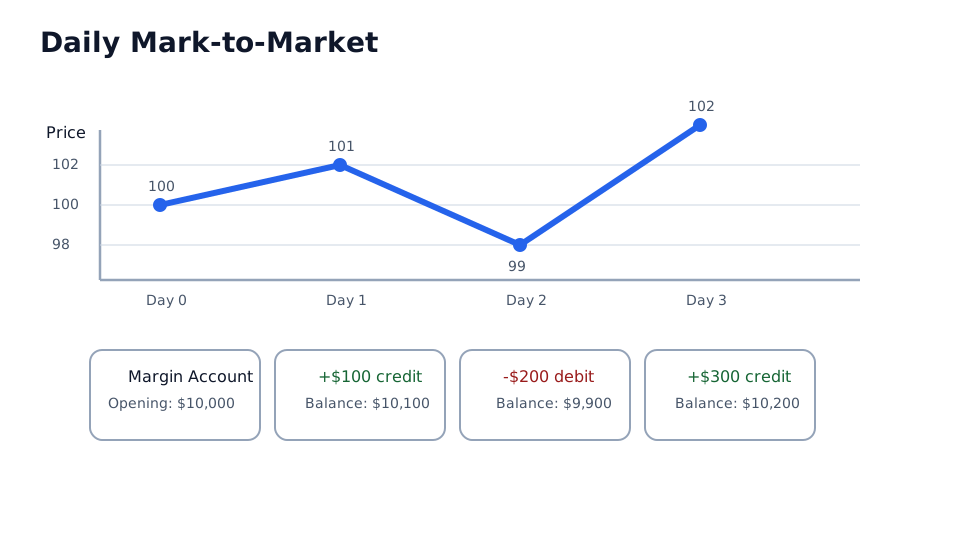
If the account began with $10,000, the simplified balances would be $10,100, $9,900, and $10,200. A real account can also reflect deposits, withdrawals, fees, interest, intraday calls, other positions, and broker requirements.
The cumulative $200 equals the move from 100 to 102 multiplied by $100. The path still matters because the Day 2 debit may require immediate liquidity even though the position later recovers.
From Market Loss to Liquidity Pressure
    flowchart LR
	    A["Market price moves"] --> B["Position is revalued"]
	    B --> C["Loss reduces account equity"]
	    C --> D["Variation margin or collateral call"]
	    D --> E["Post cash, borrow, hedge, or reduce position"]
	    E --> F["Possible asset sales and market impact"]
	    F --> A
This feedback loop is possible, not inevitable. Cash buffers, diversified collateral, committed funding, hedges, position limits, and deep markets can absorb losses. Conversely, leverage, concentrated positions, correlated collateral, and many sellers acting together can amplify pressure.
Mark to Market vs. Related Measures
| Term | Core idea | Important boundary |
|---|---|---|
| Mark to market | Update a position using a current market-supported mark | Informal umbrella term; policy determines the selected mark and consequence |
| Fair Value | Defined accounting measurement under the applicable framework | IFRS 13 uses a market-participant exit-price objective, not any convenient quote |
| Market Value | Current market price or market-supported estimate | Broader valuation term whose exact premise must be specified |
| Historical Cost | Measurement based initially on the transaction amount | Does not continuously update solely for market-price changes |
| Daily futures settlement | Cash transfer based on settlement-price change | Operational clearing process, not merely a reporting entry |
| Mark to model | Model-derived value when direct price evidence is insufficient | Sensitive to assumptions, calibration, data, and model risk |
Not every asset recorded at historical cost is “mispriced,” and not every current-value estimate is more reliable. Relevance and measurement uncertainty are separate questions.
When the Market Price Is Unclear
Marking becomes more judgmental when:
- there is no recent trade
- trading volume has fallen sharply
- the bid-ask spread is wide
- quotes are indicative rather than executable
- the position is larger than normal market depth
- an instrument is customized or contains embedded options
- the market is closed while related markets continue moving
- a transaction appears forced, distressed, or non-orderly
An analyst may need to compare multiple pricing services, evaluate broker quotes, calibrate a model to observable inputs, apply valuation adjustments, or disclose a range. The result should not be presented with more precision than the evidence supports.
Why Mark to Market Matters
Financial reporting
Current-value measurement can make changes in market conditions visible sooner than an unchanged cost amount. However, the applicable accounting standard determines recognition, presentation, and disclosure. A market-value change may affect profit or loss, other comprehensive income, equity, or disclosures differently depending on the instrument and classification.
Fund valuation
Portfolio marks feed into fund NAV. Incorrect or weakly controlled values can affect purchases, redemptions, fees, performance, and fairness between shareholders. For U.S. registered funds, SEC Rule 2a-5 addresses good-faith fair-value determinations when readily available market quotations are absent.
Margin and counterparty risk
Frequent revaluation limits the accumulation of unsettled exposure, but it shifts attention to liquidity. A party may be economically solvent over a longer horizon yet unable to meet a near-term cash or eligible-collateral call.
Risk management
Current marks affect position exposure, profit and loss, leverage, concentration, and limit usage. Risk managers still need stress tests because today’s mark does not describe the losses possible under a gap, default, volatility shock, or liquidity freeze.
How to Evaluate a Mark-to-Market Number
- Identify the instrument, legal entity, position quantity, currency, and valuation time.
- Determine the purpose: accounting, NAV, collateral, futures settlement, risk limits, or internal performance.
- Confirm the price source and whether it is a trade, firm quote, indicative quote, official settlement, pricing-service value, or model output.
- Check whether the market is active and whether the quote applies to the actual position size.
- Review accrued interest, contract multiplier, foreign-exchange conversion, netting, and valuation adjustments.
- Reconcile price changes to cash settlement, margin statements, general-ledger entries, or valuation reports.
- Test independent sources, model inputs, overrides, stale-price flags, and exception approvals.
- Examine liquidity under adverse marks rather than assuming collateral can always be posted or sold without price impact.
Common Mistakes
Assuming the last trade is the only valid mark. A stale or unusually small trade may not represent current value or the designated settlement procedure.
Equating an unrealized accounting change with cash settlement. A reporting gain or loss may not produce immediate cash, while futures variation settlement generally does.
Treating a model value as an observable price. A model can be appropriate, but its assumptions and uncertainty remain important.
Ignoring bid-ask and exit direction. The amount available to sell can differ from a midpoint or the amount required to buy.
Calling every current value fair value. Accounting fair value has a defined objective and framework-specific requirements.
Assuming daily settlement eliminates risk. It reduces accumulated counterparty exposure but does not remove gap risk, liquidity risk, model risk, operational risk, or default risk.
Official Resources
- CFTC Futures Glossary defines mark to market as part of the daily futures cash-flow system.
- CFTC: Economic Purpose of Futures Markets explains daily marking, margin-account credits and debits, and variation-margin calls.
- IFRS Foundation: IFRS 13 Fair Value Measurement explains the market-participant, orderly-transaction, measurement-date exit-price objective.
- SEC: Good Faith Determinations of Fair Value outlines valuation-risk assessment, methodology testing, pricing-service oversight, and recordkeeping for covered funds.
Related Terms
- Futures Contract: Standardized contract commonly subject to daily settlement.
- Margin Call: Demand for additional funds or collateral after account equity falls under applicable requirements.
- Collateral: Assets or cash supporting an exposure and subject to eligibility and valuation rules.
- Price Discovery: Process through which market information is incorporated into prices.
- Valuation Date: Date and time to which a value conclusion applies.
- Fire Sale: Rapid pressured sale that can transmit lower observed marks through leveraged markets.
FAQs
Does mark to market mean the asset was sold?
Is mark to market the same as fair value?
Why can a profitable hedge still create a margin problem?
Can a market mark be unreliable?
This article is educational and does not provide investment, trading, accounting, legal, or risk-management advice. Applicable standards, contracts, exchange rules, and professional judgment control.