Economic Value Added
Economic Value Added measures operating profit after tax minus a charge for the capital committed to the business.
Economic Value Added (EVA) is an estimate of the profit a business earns after charging for all capital committed to its operations. It starts with net operating profit after tax (NOPAT) and subtracts the dollar cost of invested capital. A positive result suggests the measured operations earned more than the assumed opportunity cost of their funding; a negative result suggests they did not.
EVA is also called economic profit in many valuation discussions. It is an analytical performance measure, not a standardized line item under U.S. GAAP or IFRS Accounting Standards. Two companies can therefore report different EVA figures from the same underlying economics if they define NOPAT, invested capital, or cost of capital differently.
Key Takeaways
- EVA converts the spread between operating return and cost of capital into a dollar amount.
- Accounting profit can increase while EVA decreases if new investment earns less than its capital cost.
- NOPAT, invested capital, and WACC must cover the same operations, risks, and measurement period.
- Adjustments for leases, acquisitions, research spending, excess cash, and unusual items can materially change the result.
- EVA complements cash-flow valuation and return ratios; it does not replace them.
EVA Formula
The capital-charge form is:
When the definitions are aligned, the same result can be expressed as a return spread:
The first formula asks whether operating profit covers a dollar capital charge. The second shows that EVA depends on both the return spread and the amount invested. A wide spread on a small capital base may create less EVA than a narrower spread on a much larger base.
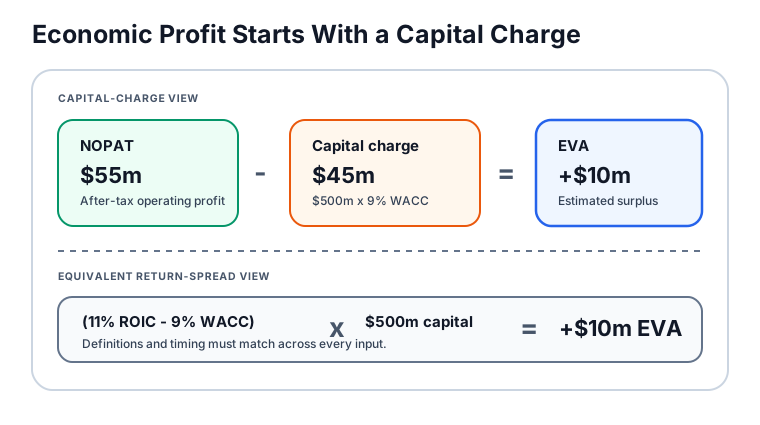
Components of EVA
| Component | What it represents | Main analytical question |
|---|---|---|
| NOPAT | After-tax operating profit before financing costs | Does profit include only the operations represented in the capital base? |
| Average invested capital | Operating assets funded by investors, net of qualifying operating liabilities | Were acquisitions, leases, goodwill, excess cash, and construction consistently treated? |
| WACC | Estimated required return of debt and equity providers | Does the rate reflect the risk, currency, financing mix, and tax basis of the measured operations? |
| Measurement period | Period over which profit is earned and capital is employed | Is an average balance more representative than one year-end balance? |
Average invested capital commonly uses beginning and ending balances:
Quarterly or monthly averages can be better when an acquisition, disposal, seasonal working-capital swing, or major capital project makes the two endpoints unrepresentative.
Worked Example
Assume a company has:
- NOPAT of $55 million;
- average invested capital of $500 million; and
- an estimated WACC of 9%.
The capital charge is:
EVA is:
The implied ROIC is 11%, so the spread form reaches the same answer:
Now suppose the company commits another $100 million to expansion and the investment produces $7 million of annual NOPAT, a 7% return. Accounting operating profit rises by $7 million, but incremental EVA is negative:
This is the central insight: growth in revenue or profit does not necessarily create economic value. The return on new capital must also be considered.
How to Calculate EVA Consistently
1. Define the Operating Perimeter
Decide whether the calculation covers the consolidated company, a division, a geography, or a project. The NOPAT, capital base, and discount rate must refer to that same perimeter. A divisional EVA calculation may require allocating shared assets, taxes, and corporate costs, which introduces judgment.
2. Build NOPAT
NOPAT usually begins with operating profit and applies taxes consistent with that profit. Financing income and expense are excluded because their cost is represented in WACC. Analysts may normalize unusual items, but recurring operating costs should not disappear merely because management labels them nonrecurring.
If an expense is analytically capitalized, the adjustment normally affects both sides of the formula: current NOPAT increases because the expense is reversed and replaced with amortization, while invested capital increases by the unamortized asset. Adjusting only profit would overstate EVA.
3. Define Invested Capital
Invested capital can be built from operating assets less non-interest-bearing operating liabilities, or from financing claims less nonoperating assets. The two approaches should reconcile after consistent adjustments. Common judgment areas include:
- whether cash is required for operations or is excess;
- whether goodwill is included when evaluating acquisition performance;
- how operating leases and pension balances are treated;
- whether capital under construction is included before it produces earnings; and
- whether selected internally funded investments are capitalized for analysis.
The related Capital Employed measure may use a broader or differently constructed denominator. The label is less important than a documented reconciliation.
4. Estimate WACC
WACC combines estimated required returns for equity and debt. It is not observable as a single accounting number. Beta, market risk premium, borrowing spread, tax rate, target leverage, currency, and business risk all affect the estimate. A project with materially different risk from the existing company may require a different rate.
EVA Compared With Other Measures
| Measure | Output | Capital cost included? | Best use |
|---|---|---|---|
| Net income | Accounting profit to equity holders | Equity cost is not an expense | Reporting profitability after financing and tax |
| ROIC | Percentage return on invested capital | Compared separately with WACC | Comparing capital efficiency across periods or peers |
| EVA | Dollar economic-profit estimate | Yes, through the capital charge | Measuring estimated value creation in a period |
| Residual income | Income after a charge on equity or capital, depending on model | Yes | Equity valuation or performance analysis |
| Free cash flow | Cash-flow measure after specified investment | Not directly | Liquidity, valuation, and funding analysis |
EVA and free cash flow can move in opposite directions during investment. A valuable new project may reduce current free cash flow because of its initial outlay while increasing expected future EVA. Conversely, cutting necessary investment may raise current cash flow but weaken future operating capacity.
Uses in Capital Allocation and Performance Review
EVA can help analysts and managers:
- compare a project’s expected operating return with its capital charge;
- assess whether an acquisition earns enough to justify the purchase price;
- identify divisions that grow profit by consuming capital at weak returns;
- connect operating forecasts with value-creation assumptions; and
- frame incentive plans around capital efficiency rather than profit alone.
These uses require safeguards. A one-year EVA target can encourage managers to delay maintenance, reduce research, reject projects with long ramp periods, or shrink productive assets to improve the current metric. Multi-year measurement, investment controls, and nonfinancial operating indicators can reduce those incentives but cannot eliminate judgment.
Limitations and Common Mistakes
- Treating EVA as standardized: Company-reported versions may use proprietary or adjusted definitions.
- Mixing timing conventions: Full-year NOPAT should not be divided by an unrepresentative year-end capital balance without analysis.
- Comparing unlike risk: A single corporate WACC may misstate the capital charge for a different country, currency, or business line.
- Ignoring accounting age: Accumulated depreciation can reduce book capital and mechanically improve EVA relative to a newer asset base.
- Excluding recurring costs: Removing ordinary cash operating expenses can create an overly favorable performance measure.
- Missing paired adjustments: Changing NOPAT without the related change to invested capital breaks the internal logic.
- Reading positive EVA as distributable cash: EVA is not cash in the bank and does not measure debt-service capacity.
- Assuming a current result determines value: Valuation depends on expected future EVA, its duration, risk, and the investment required to produce it.
Authority and Further Reading
- SEC: Non-GAAP Financial Measures explains why adjusted measures need clear labels, consistent definitions, and appropriate comparison with GAAP measures.
- Aswath Damodaran: Economic Value Added develops the return-spread and capital-charge forms and connects EVA with valuation.
Related Terms
- Net Operating Profit After Tax: After-tax operating profit used in many EVA calculations.
- Weighted Average Cost of Capital: Estimated blended required return used to calculate the capital charge.
- Return on Invested Capital: Percentage return that forms the operating spread over WACC.
- Capital Employed: Related capital-base concept whose exact construction should be reconciled.
- Shareholder Value Added: Another framework for evaluating value created for capital providers.
FAQs
Is Economic Value Added the same as net income?
Can a company have rising profit and falling EVA?
Should EVA always use average invested capital?
EVA is an educational analytical framework, not a guarantee of value creation or personalized investment advice. Review the underlying financial statements, calculation policy, and risk assumptions before relying on a reported figure.