Price-to-Book Ratio
Equity valuation multiple comparing market price with book value, often most useful in asset-heavy sectors.
The price-to-book ratio, often written P/B, compares a company’s market value with its accounting book value. It helps investors judge how highly the market is valuing the firm’s net assets.
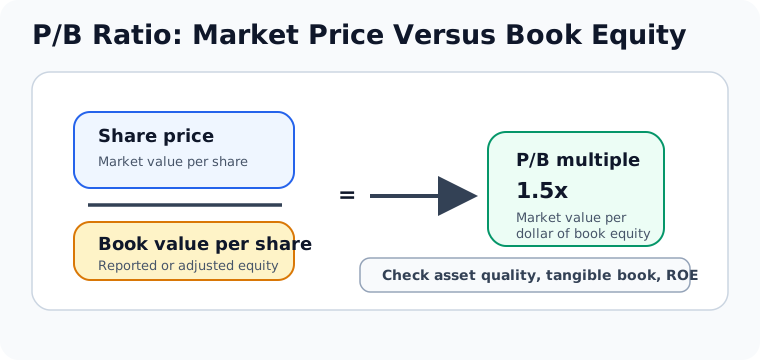
It can also be expressed as market capitalization divided by total book equity.
Why It Matters
P/B matters because it connects two different perspectives:
- what the market is willing to pay for the equity
- what the balance sheet says the net assets are worth in accounting terms
That makes it especially relevant in businesses where book value is a meaningful anchor, such as banks, insurers, and other asset-heavy firms.
How It Works in Finance Practice
Analysts use P/B when they want to know whether the market is pricing a company:
- below book value
- close to book value
- at a large premium to book value
Interpretation depends on profitability and business model.
A high P/B can reflect:
- strong expected returns on equity
- durable competitive advantages
- accounting values that understate true economics
A low P/B can reflect:
- distress
- poor expected profitability
- weak asset quality
- possible undervaluation
What Analysts Need To Define
The P/B ratio is simple, but the inputs are not automatic:
| Input | What To Check | Why It Matters |
|---|---|---|
| Market price | Price date, share class, market capitalization, and currency | A stale or mismatched price can distort the multiple |
| Book value | Common equity, total equity, tangible common equity, or adjusted book value | Different equity bases produce different conclusions |
| Per-share basis | Shares outstanding, diluted shares, buybacks, and preferred equity | Book value per share depends on both equity and share count |
| Asset quality | Credit losses, fair-value marks, goodwill, intangibles, reserves, and write-down risk | Book value can be overstated if assets are weak |
| Profitability | ROE, cost of equity, margins, and growth | A premium to book is more defensible when returns exceed the cost of equity |
Where P/B Works Better and Worse
| Situation | Why P/B can help | Why it can mislead |
|---|---|---|
| Banks, insurers, and other asset-heavy firms | Book equity is often closer to the economic engine being valued | Asset quality assumptions still matter a lot |
| Industrial businesses with meaningful tangible assets | Book value can anchor replacement-cost thinking | Intangibles and cyclicality can still distort the signal |
| Software, platform, or brand-heavy businesses | Sometimes useful as a rough floor reference | Accounting book value often misses most of the real economics |
That industry dependence is the main reason P/B should rarely be interpreted mechanically. The ratio says more when book value is actually tied to earning power.
Public Source Checks
Use public filings and structured data before relying on P/B:
- SEC EDGAR Company Search: Filings for balance sheets, equity notes, goodwill, asset quality, fair-value marks, buybacks, preferred stock, and management discussion.
- SEC Financial Statement Data Sets: Structured historical statement data for equity, assets, liabilities, net income, and share-count checks.
- SEC Company Facts API: Company-level XBRL facts that can help verify equity, assets, liabilities, and per-share data.
- Company earnings releases and investor supplements: useful for tangible book value, adjusted book value, credit metrics, and ROE bridges, but the adjustments should reconcile to reported equity.
The price date and book-value date should be explicit. A current market price divided by old book value may still be useful, but the timing mismatch should be labeled.
Quiz
When P/B Misleads
P/B can mislead when:
- book value includes goodwill or intangibles that may not support earning power
- loan losses, impairments, or fair-value marks are not fully reflected
- return on equity is weak or below the cost of equity
- leverage differs sharply across comparable companies
- accounting rules make book value less comparable across jurisdictions or industries
- buybacks, preferred stock, or minority interests distort common book value per share
- the business is intangible-heavy and book value omits much of the economic asset base
Practical Review
When reviewing Price-to-Book Ratio, ask whether the number changes peer ranking, target multiple, asset-quality concern, ROE conclusion, or margin of safety. If it changes the valuation conclusion, show whether the driver is market price, reported book value, tangible book value, profitability, or asset quality.
Review Checklist
Before relying on P/B, document:
- price date, share class, and market data source
- reported book value, tangible book value, or adjusted book value basis
- share count, preferred equity, minority interest, and common-equity treatment
- goodwill, intangibles, fair-value marks, reserves, and impairment risks
- ROE, cost of equity, and growth assumptions that justify the multiple
- peer set and why book value is comparable across companies
- the valuation conclusion that changes if book value or the selected multiple changes
Related Terms
- Book Value: The accounting net-worth concept behind the denominator.
- Tangible Book Value: A book-value measure that removes many intangible assets.
- Book Value Per Share: The per-share denominator in the P/B ratio.
- Balance Sheet: The statement where book equity is reported.
- Market Capitalization: The market-value side of the comparison.
- Price-to-Earnings Ratio: A valuation multiple based on earnings instead of book value.
- Return on Equity: A profitability metric that helps explain sustainable P/B levels.
- Book-to-Market Ratio: Related finance concept that helps compare P/B Ratio with nearby terms.