Market Value
Market value is the current price an asset can command, or a market-supported estimate when no directly observable price exists.
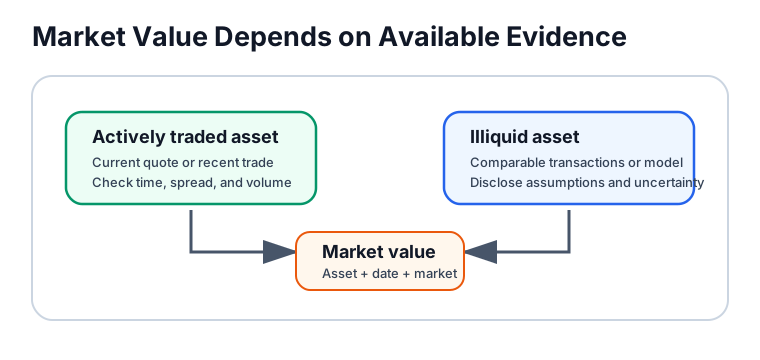
Market value is the current price an asset, security, or ownership interest can command in a market, or a market-supported estimate when no directly observable transaction price exists. For a frequently traded stock, market value may be observable from current quotes. For real estate, private companies, or illiquid securities, it usually requires valuation judgment.
Market value is date-specific and market-specific. It can change as information, interest rates, expected cash flows, liquidity, risk, and investor demand change.
An asset price is the per-unit market price or valuation assigned to an asset. A selling price is the amount agreed or executed in a particular sale. Both can provide evidence of market value, but neither term guarantees that the observed number represents an orderly, current, or repeatable market value for a different quantity or transaction.
Key Takeaways
- A quoted market price is strong evidence of market value only when the quote is current, relevant, and supported by an active market.
- Market value can mean a per-unit price, the value of a position, or the total market value of a company’s equity.
- Market value is not automatically the same as book value, fair value, fair market value, or intrinsic value.
- An observed transaction price can differ from market value because of timing, quantity, financing terms, related parties, distress, or transaction costs.
- Thin trading, bid-ask spreads, transaction size, control rights, and forced-sale conditions can make a displayed price an imperfect estimate.
- Every market-value figure should identify the asset, valuation date, currency, unit, market, and source.
How Market Value Is Determined
The method depends on the asset and available evidence.
Directly observed market value
For an exchange-traded security with active trading, analysts may use a current price, closing price, or another specified market quote. The measurement still needs a timestamp because prices can move continuously.
Market value derived from a quoted unit price
The value of a holding is often calculated as:
For public common equity:
Estimated market value
When the asset does not trade actively, valuation may rely on:
- recent orderly transactions in the same or a similar asset
- comparable-company or comparable-property evidence
- market multiples
- broker or dealer quotations
- discounted cash flow analysis using market-supported assumptions
- appraisal methods appropriate to the asset
An estimate should not be described as an observed price. The valuation method, key assumptions, and uncertainty should be disclosed.
For an asset expected to produce cash flows, a simplified present-value model is:
Here, (CF_t) is the expected cash flow in period (t), and (r) is a discount rate consistent with the cash-flow risk and measurement basis. The result is a model estimate, not an observed asset price. Changes in expected cash flows, rates, risk premia, or liquidity can change the estimate even when the asset itself has not changed physically.
Worked Example: Market Value of a Shareholding
Suppose an investor owns 25,000 shares of a listed company. The relevant market quote is $32.40 per share.
The indicated market value of the position is $810,000.
That arithmetic does not guarantee the investor could sell the entire position for exactly $810,000. A large order, limited trading volume, a wide bid-ask spread, market movement, fees, taxes, or trading restrictions could change the proceeds.
If the company has 50 million shares outstanding at the same price, its market capitalization is:
The investor’s position value and the company’s market capitalization answer different questions.
Market Value in Different Contexts
| Context | Typical meaning | Main evidence |
|---|---|---|
| Listed share | Current value per share | Exchange quote or recent transaction |
| Bond | Price per unit of par value | Dealer quotations, trades, yield curve, credit spreads |
| Public company equity | Aggregate value of outstanding common shares | Price times shares outstanding |
| Private company | Estimated value of an ownership interest | Transactions, multiples, or cash-flow valuation |
| Real estate | Estimated sale value in the relevant property market | Comparable sales, income, and appraisal evidence |
| Fund portfolio | Sum of valued holdings and other assets, less liabilities | Fund valuation policy and market data |
The relevant unit must be explicit. A stock’s $40 market price is not the same as the market value of all the company’s equity or the value of the operating business.
Asset Price vs. Selling Price vs. Market Value
| Term | What it normally describes | Main limitation |
|---|---|---|
| Asset price | Price or estimated value per unit of a security, property, commodity, or other asset | The quoted unit, market, and timestamp may be unclear |
| Selling price | Gross amount agreed or executed in a particular sale | May reflect unusual terms, pressure, fees, or a non-market relationship |
| Net sale proceeds | Selling price less commissions and other seller-paid transaction costs | Does not by itself measure gain because acquisition cost and interim cash flows also matter |
| Market value | Current market-supported value for a defined asset, interest, quantity, date, and market | Can require judgment when direct, orderly transaction evidence is unavailable |
A selling price is a historical fact once a transaction closes. Market value is a measurement conclusion for a specified date. If a property sells for $500,000, that amount is strong evidence for that transaction, but it may not establish the market value of a nearby property or even the same property six months later.
For traded assets, prices respond to more than current income. Analysts commonly examine:
- expected cash flows and growth
- market interest rates and discount rates
- credit, equity, term, and liquidity risk premia
- supply and demand for the asset and available substitutes
- contractual rights, seniority, restrictions, and optionality
- market depth, transaction size, and information quality
These are analytical drivers, not deterministic rules. For example, higher rates can put downward pressure on present values, but an asset price can still rise if expected cash flows improve by more than the discount-rate effect.
Market Value vs. Related Measures
| Measure | Core idea | Important distinction |
|---|---|---|
| Market value | Current market price or market-supported estimate | Broad term; method depends on available evidence |
| Market capitalization | Market value of outstanding common equity | Price multiplied by outstanding shares |
| Book value | Accounting value recorded in financial statements | Based on accounting measurement, not current trading alone |
| Fair value | Defined accounting measurement under the applicable framework | IFRS 13 uses an orderly market-participant exit-price objective |
| Fair market value | Willing-buyer and willing-seller standard used in legal, tax, and appraisal contexts | Exact definition depends on the governing authority |
| Intrinsic value | Analyst’s estimate based on expected economics | Can differ substantially from current market price |
The terms sometimes overlap in ordinary conversation but should not be substituted casually in accounting, tax, legal, or transaction work.
Market Value and Fair Value
Under IFRS 13, fair value is a market-based measurement: the price received to sell an asset or paid to transfer a liability in an orderly transaction between market participants at the measurement date. The standard provides a framework for using observable and unobservable inputs.
That defined accounting objective is more precise than casual use of “market value.” A current exchange quote may be a strong fair-value input, but a quoted price can require analysis of the principal market, measurement unit, market activity, and other framework rules. Accounting treatment should be confirmed under the applicable standards.
What Can Distort a Market-Value Estimate
Stale or thin trading
The last trade may be old, unusually small, or unrepresentative of current conditions.
Bid-ask spread
A displayed midpoint, bid, ask, and last transaction price are not interchangeable. The price available to a buyer may differ from the price available to a seller.
Position size
A quoted price for a small trade may not be achievable for a large block without moving the market.
Control and restrictions
A controlling interest, minority interest, lockup, transfer restriction, or contractual right may affect the value of the specific interest.
Forced or distressed transactions
A rushed sale may not represent an orderly market transaction. The reason for measuring value determines whether such evidence is relevant.
Different measurement dates
Comparing a current stock price with a balance sheet from months earlier can create a misleading book-to-market comparison.
How to Evaluate a Market-Value Figure
Before using the number, verify:
- Subject: What asset, liability, security class, or ownership interest is being valued?
- Unit: Is the figure per share, per bond, per
$100of par, or for the entire position? - Date and time: Is it live, delayed, closing, month-end, or transaction-date value?
- Market: Which exchange, dealer market, jurisdiction, or transaction setting applies?
- Source: Is the input an executed trade, firm quote, indicative quote, model, or appraisal?
- Liquidity: Could the measured quantity transact near the stated price?
- Currency: Are price and quantity expressed consistently?
- Purpose: Is the figure for trading, reporting, collateral, tax, litigation, or internal analysis?
Common Mistakes
Treating cost as current market value. Historical purchase price does not update automatically when market conditions change.
Calling market cap the value of the whole business. Market cap measures common equity, while enterprise value includes additional financing claims and cash adjustments.
Assuming the last trade is always representative. Liquidity and trade size can make the last price weak evidence.
Ignoring share-count changes. Issuance, buybacks, splits, and multiple share classes can alter total equity market value.
Equating market value with intrinsic value. Market price reflects current trading; intrinsic value is an analytical estimate and may be wrong.
Using undefined valuation language in high-stakes work. Accounting, tax, legal, and regulatory contexts can assign specific meanings to similar terms.
Treating gross selling price as economic proceeds. Brokerage fees, transfer taxes, concessions, closing costs, and other transaction terms can make net proceeds different from the headline price.
Official Source Checks
- Investor.gov: Market Capitalization provides the standard price-times-outstanding-shares calculation.
- IFRS Foundation: IFRS 13 Fair Value Measurement explains the market-participant, orderly-transaction, measurement-date exit-price objective used for IFRS fair value.
- SEC EDGAR Company Search provides issuer filings that can be used to verify outstanding shares, security classes, restrictions, and reporting dates.
Related Terms
- Market Capitalization: The market value of a public company’s outstanding common equity.
- Book Value: An accounting net-asset measure often compared with market value.
- Fair Value: A defined accounting measurement under applicable reporting standards.
- Fair Market Value: A market-based standard used in appraisal, tax, legal, and transaction contexts.
- Intrinsic Value: An analytical estimate based on expected economics rather than current price alone.
- Face Value: A stated contractual amount that can differ from a security’s current market value.
- Enterprise Value: A broader business-value measure that adjusts equity value for debt, cash, and other claims.
- Purchase Price: The transaction amount paid to acquire an asset, security, or business interest.
- Liquidity Discount: A value adjustment associated with limited marketability or costly conversion to cash.
FAQs
Is market value the same as market price?
Is market value the same as book value?
Can market value be negative?
Does market value show whether an investment is attractive?
Is the selling price always the market value?
This article is educational and does not provide investment, valuation, accounting, legal, or tax advice. Market values can change quickly and should be verified for the relevant date and purpose.