Present Value
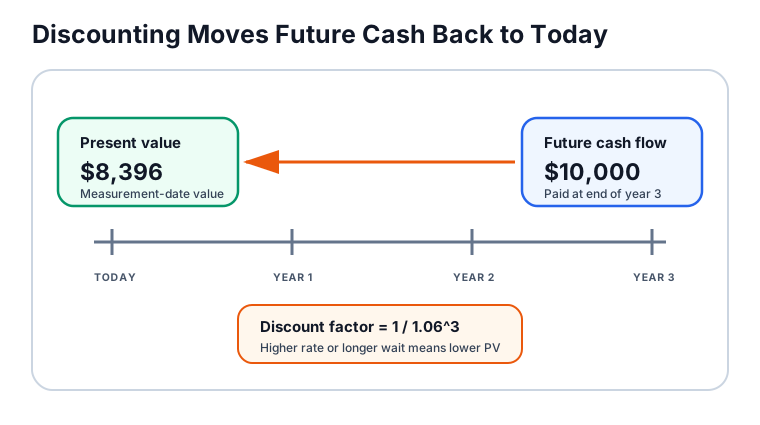
Present value converts a future cash flow into today's equivalent using a discount rate matched to timing, risk, inflation, and currency.
Present value (PV) is the amount today that is financially equivalent to one or more future cash flows under a stated discount rate. Discounting recognizes that receiving cash later is not the same as receiving the same amount now because time, opportunity cost, inflation, and uncertainty affect value.
Present value is a calculated amount, not automatically a market price or a guaranteed payment. Its usefulness depends on the cash-flow estimate, timing convention, and discount rate.
Key Takeaways
- Present value is the reverse of compounding: it moves a future amount backward to a valuation date.
- A higher discount rate or a later payment produces a lower PV, all else equal.
- The rate period must match the cash-flow period, such as monthly with monthly or annual with annual.
- Nominal cash flows require a nominal rate, while real cash flows require a real rate.
- Risk should be reflected consistently in expected cash flows, the discount rate, or a documented combination without careless double counting.
Present Value Formula
For one future cash flow:
Where:
- \(PV\) is value at the measurement date;
- \(FV_n\) is the cash flow expected at time \(n\);
- \(r\) is the discount rate per period; and
- \(n\) is the number of periods.
The discount factor for time \(n\) is:
Present value equals the future cash flow multiplied by that factor.
Worked Example: One Future Payment
Suppose a contract calls for a $25,000 payment four years from today and the appropriate annual discount rate is 7%:
Under those assumptions, $25,000 in four years has a present value of about $19,072. This does not mean the future payment is certain or that every buyer would pay that amount. A different assessment of credit risk, liquidity, timing, taxes, or opportunity cost could support a different rate and PV.
Present Value of Multiple Cash Flows
For a stream of cash flows:
The formula allows a different rate for each maturity when a yield curve or changing risk profile matters. A simplified constant-rate example uses an 8% annual rate:
| Year | Expected cash flow | Discount factor | Present value |
|---|---|---|---|
| 1 | $5,000 | 0.9259 | $4,629.63 |
| 2 | $7,000 | 0.8573 | $6,001.37 |
| 3 | $9,000 | 0.7938 | $7,144.49 |
| Total | $21,000 | $17,775.49 |
Adding the undiscounted cash flows would overstate their value at the measurement date. Each amount must be discounted for its own timing before the present values are added.
Why the Discount Rate Matters
The discount rate translates time and required return into value. Depending on the application, it may reflect:
- a market yield for cash flows with similar maturity and credit risk;
- a borrowing or lending rate appropriate to the contract;
- a risk-adjusted required return for an investment;
- the cost of capital matched to business or project cash flow;
- a spot-rate curve for payments at different maturities; or
- a rate prescribed by an accounting, actuarial, regulatory, or legal framework.
The right rate is application-specific. A government bond, an uncertain startup cash flow, a pension liability, and a contractual lease payment do not share one universal discount rate.
Rate Sensitivity
For a $10,000 payment due in five years:
| Annual discount rate | Present value |
|---|---|
| 3% | $8,626.09 |
| 6% | $7,472.58 |
| 10% | $6,209.21 |
The table shows the inverse relationship between rate and PV. It does not say the highest or lowest rate is correct; that depends on the cash flow and purpose.
Matching Cash Flows and Rates
Periodicity
If cash flows occur monthly, either use an effective monthly rate or convert both cash flows and rate to a consistent annual basis. Dividing an annual effective rate by 12 is not always identical to deriving the effective monthly rate.
Nominal and Real Values
Nominal cash flows include expected inflation and should be discounted with a nominal rate. Real cash flows exclude inflation and should be discounted with a real rate. Mixing real cash flow with a nominal rate generally understates PV.
Currency
Cash flows and discount rates should be in the same currency. Currency risk belongs in the cash-flow scenarios, rate, or a consistent valuation framework; simply converting the final PV at an unrelated spot rate can conceal mismatched assumptions.
Tax Basis
Pre-tax cash flows should not be combined mechanically with an after-tax rate. Tax effects can depend on the owner, jurisdiction, timing, and type of payment.
Risk
Riskier cash flows generally require more adjustment than contractually certain cash flows. Analysts may reduce expected cash flows, increase the discount rate, use certainty-equivalent cash flows, or model scenarios. Applying severe downside adjustments to the cash flows and then adding a discount-rate premium for the same risk can double count it.
Present Value vs. Related Measures
| Measure | Direction or calculation | Main use |
|---|---|---|
| Present value | Future cash flow moved to today | Compare amounts occurring at different dates |
| Future value | Current amount compounded forward | Estimate what current money may grow to |
| Net present value | PV of benefits minus PV of costs | Evaluate project value after required return |
| Bond price | PV of contractual coupons and principal under market yield assumptions | Value fixed-income cash flows |
| Annuity PV | PV of a regular series of payments | Value loans, leases, pensions, or structured payments |
Present value can be positive even when net present value is negative. PV measures the value of specified future cash flows; NPV nets those benefits against the required investment or other costs.
Where Present Value Is Used
- Capital budgeting: compare discounted project benefits with initial and later investment outlays.
- Fixed income: value coupon and principal payments under market yields and credit assumptions.
- Loans and leases: determine an equivalent current principal for scheduled payments.
- Business valuation: discount expected free cash flows and terminal value.
- Accounting: measure certain obligations, leases, impairments, and fair-value inputs under the applicable standards.
- Retirement and settlements: compare a future payment stream with a lump-sum alternative.
These applications can follow different mandatory rules. A valuation rate selected for an investment analysis may not be appropriate for financial reporting, tax, pension, or legal calculations.
Timing Conventions
Basic formulas assume each cash flow occurs at the end of its stated period. Real models may use:
- beginning-of-period payments;
- midyear discounting for cash earned throughout a year;
- exact day counts;
- monthly or quarterly periods;
- continuously compounded rates; or
- separate spot rates for each payment date.
A half-year timing shift can be material for large or distant cash flows. Document the valuation date and payment convention instead of relying on spreadsheet defaults.
Common Mistakes and Limitations
- Comparing future amounts without placing them on the same valuation date.
- Mixing annual rates with monthly periods.
- Using a nominal rate for real cash flows or the reverse.
- Applying a current levered equity return to cash flows owed to all capital providers.
- Treating a forecast cash flow as contractually certain.
- Double counting risk in both pessimistic cash flows and the discount rate.
- Omitting terminal, residual, working-capital, or decommissioning cash flows when relevant.
- Rounding discount factors too early in a multi-period calculation.
- Treating calculated PV as an observable market price or guaranteed sale value.
- Using a prescribed accounting or regulatory rate for a different economic decision without reconciliation.
Authority and Further Reading
- Investor.gov: Pension or Settlement Income Streams explains how a discount rate converts future payments into today’s value and why a higher rate lowers the lump-sum amount.
- TreasuryDirect: Understanding Pricing and Interest Rates illustrates how time and discount or yield measures affect prices of U.S. Treasury marketable securities.
- Aswath Damodaran: Introduction to Valuation explains the need to match expected cash flows with discount rates appropriate to their risk and claimant level.
Related Terms
- Time Value of Money: Principle that comparable amounts at different dates have different financial value.
- Future Value: Amount produced by compounding a current value forward.
- Discount Rate: Rate used to convert future cash flows to a measurement-date value.
- Net Present Value: Present value of benefits less present value of costs.
- Present Value of Annuity: Current equivalent of a regular payment stream.
FAQs
Why does present value fall when the discount rate rises?
Is present value the same as market value?
Can present value be calculated for uncertain cash flows?
This page is general financial education, not a personalized recommendation or a substitute for accounting, actuarial, tax, legal, or valuation advice.