Return on Average Capital Employed (ROACE)
ROACE compares operating profit with average capital employed, helping analysts separate profit growth from capital efficiency.
Return on average capital employed (ROACE) measures operating profit earned during a period as a percentage of the average capital committed to the business. Using an average denominator helps match a flow measured over a year, such as EBIT, with balance-sheet capital that can change between the beginning and end of that year.
ROACE is useful for capital-intensive businesses and for periods with substantial investment, acquisitions, or disposals. It is not a standardized U.S. GAAP or IFRS ratio, so the stated formula and a reconciliation of both profit and capital are essential.
Key Takeaways
- A common ROACE formula divides EBIT by average capital employed.
- Average capital usually means the average of opening and closing balances, but more frequent averages may be better when capital changes sharply.
- A rising EBIT figure does not prove improving performance if the required capital grows faster.
- ROACE is commonly pre-tax, while ROIC is commonly after tax; neither should be compared mechanically with WACC unless the measurement bases align.
- Asset age, acquisitions, leases, impairments, and inconsistent treatment of cash can distort comparisons.
ROACE Formula
The common pre-tax form is:
Average capital employed is often calculated as:
The numerator is often EBIT, operating profit, or an adjusted operating result. The analyst should not assume those labels are interchangeable. For example, EBIT reconstructed from net income may include nonoperating gains that reported operating profit excludes.
What Counts as Capital Employed?
There are two common approaches.
Operating Approach
This approach can include working capital, property and equipment, recognized right-of-use assets, and operating intangibles, less accounts payable and qualifying operating accruals.
Financing Approach
Analysts often subtract excess cash and nonoperating investments. Other financing claims, such as lease liabilities or certain pension obligations, may also be included if the corresponding assets and expenses receive consistent treatment.
The two approaches should reconcile after all classifications and adjustments. If they do not, the analyst may have omitted a financing claim, double-counted an asset, or treated an operating liability inconsistently. See Capital Employed for a fuller denominator discussion.
Worked Example
Assume a manufacturer reports:
- opening capital employed of $400 million;
- closing capital employed of $500 million;
- revenue of $600 million; and
- EBIT of $54 million.
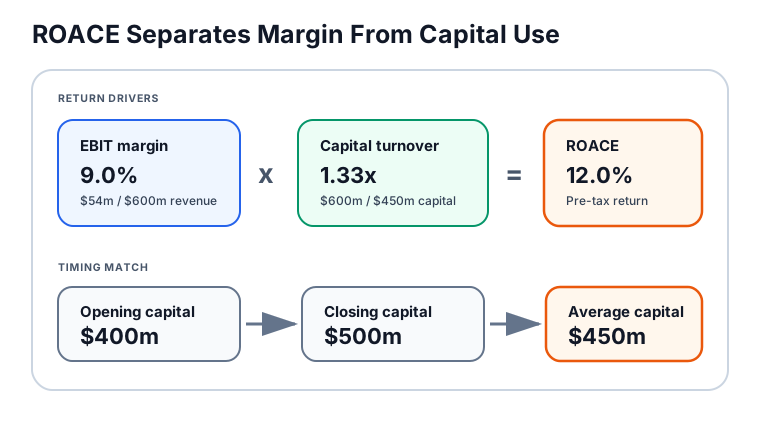
Average capital employed is:
ROACE is:
Suppose the prior year produced EBIT of $48 million on average capital employed of $350 million:
EBIT increased by $6 million, but ROACE declined from 13.7% to 12.0% because the capital base expanded faster than operating profit. That result is a prompt for investigation, not an automatic verdict. A new plant may require capital before reaching normal production, or the investment may simply be earning an inadequate return.
The Margin and Turnover Drivers
ROACE can be separated into operating margin and capital turnover:
In the example:
- EBIT margin is $54 million divided by $600 million, or 9.0%;
- capital turnover is $600 million divided by $450 million, or 1.33 times; and
- 9.0% multiplied by 1.33 equals approximately 12.0%.
This breakdown shows whether the return is driven by pricing and operating cost control, efficient use of capital, or both. A low-margin retailer may achieve an acceptable return through rapid turnover, while an infrastructure business may require higher margins because its assets turn slowly.
ROACE vs. ROCE, ROIC, ROE, and ROA
| Metric | Common numerator | Common denominator | Main distinction |
|---|---|---|---|
| ROACE | EBIT or operating profit | Average capital employed | Explicitly averages the capital base |
| ROCE | EBIT or operating profit | Capital employed, sometimes ending or average | Label does not always reveal timing convention |
| ROIC | NOPAT | Average invested operating capital | Commonly after tax and designed to exclude financing effects |
| Return on equity | Net income attributable to common equity | Average common equity | Measures accounting return to equity after financing effects |
| Return on assets | Net income or operating profit | Average total assets | Uses a broader asset base; formula varies |
ROIC does not typically use net income. A common ROIC numerator is NOPAT, which removes financing effects and applies tax to operating profit. This is why ROIC is often paired with an after-tax WACC.
By contrast, an EBIT-based ROACE is pre-tax. Directly subtracting an after-tax WACC from that pre-tax return mixes measurement bases. An analyst can instead calculate a consistently after-tax operating return or compare ROACE with a suitable pre-tax hurdle, clearly disclosing the assumptions.
Choosing the Averaging Method
The simple opening-and-closing average works when capital changes gradually. It can be misleading when:
- a major acquisition closes near year-end;
- a plant enters service late in the period;
- working capital is strongly seasonal;
- a disposal removes capital partway through the year; or
- exchange rates materially change translated balances.
Monthly or quarterly averages can better reflect capital actually available during the profit period. For a specific transaction, a time-weighted denominator can isolate the portion of the year that acquired or disposed assets contributed to earnings.
How to Interpret ROACE
A higher ROACE can indicate stronger operating margins, more productive assets, or better working-capital discipline. It can also result from a smaller denominator after depreciation, impairment, or asset sales. The direction of change must be connected to its operating drivers.
Useful review questions include:
- Did revenue, margin, or capital turnover cause the change?
- Is the company investing ahead of demand, harvesting old assets, or operating at normal capacity?
- Are maintenance needs visible in capital expenditure and depreciation?
- Were acquisitions, goodwill, leases, restructuring, or impairments treated consistently?
- Is the peer comparison based on the same profit, tax, and capital definitions?
Trend analysis is often more useful than a single number. Compare several years, examine incremental returns on new investment, and read the balance-sheet and cash-flow notes behind material changes.
Adjustments and Comparability Risks
- Old assets: Accumulated depreciation lowers net book value and can raise ROACE even if replacement economics have weakened.
- New projects: Capital may enter the denominator before a plant, store, or platform reaches normal earnings.
- Acquisitions: Goodwill inclusion tests the purchase price; exclusion focuses more narrowly on post-acquisition operating assets.
- Impairments: A write-down lowers future capital employed and can mechanically improve the ratio despite a prior investment loss.
- Leases: Excluding lease liabilities while including related operating profit or assets can break consistency.
- Excess cash: Including surplus cash in capital employed reduces the ratio even though that cash may not support operations.
- Inflation and currency: Historical-cost assets and translated balances can weaken comparisons across age, country, and period.
- Negative capital: Businesses funded heavily by customer advances or supplier credit can produce extremely high or negative denominators that make the ratio hard to interpret.
Common Mistakes
- Assuming a higher ratio is always better without checking underinvestment or asset age.
- Using ending capital against full-year EBIT after a large late-period transaction.
- Comparing company-reported figures without reconciling definitions.
- Including nonoperating income in EBIT while excluding the related assets from capital.
- Treating ROACE as a cash return or debt-service measure.
- Comparing pre-tax ROACE directly with after-tax WACC.
- Ignoring the absolute value created or destroyed by a large capital base.
Authority and Further Reading
- SEC: Non-GAAP Financial Measures explains why adjusted performance measures require clear labels, consistent calculations, and appropriate comparison with GAAP measures.
- Aswath Damodaran: Financial measures and ratios provides definitions for return-on-capital and economic-profit measures used in valuation analysis.
Related Terms
- Return on Capital Employed: Closely related return ratio whose denominator may use ending or average capital.
- Return on Invested Capital: After-tax operating return on invested operating capital.
- Capital Employed: The denominator that must be defined before interpreting ROACE.
- Asset Turnover Ratio: Revenue relative to assets, one lens on capital efficiency.
- Economic Value Added: Dollar performance measure after an estimated capital charge.
FAQs
Why does ROACE use average capital employed?
Is ROACE the same as ROIC?
Can ROACE fall even when profit rises?
ROACE is an educational analytical measure, not a forecast, valuation conclusion, or personalized investment recommendation.