Enterprise Value
Whole-business valuation measure combining equity value with net debt and other claims on the firm.
Enterprise value, usually shortened to EV, measures the value of a company’s operating business for all capital providers, not just common shareholders.
A common simplified version is:
In fuller valuation work, analysts may also adjust for preferred stock, minority interest, unfunded obligations, or other financing claims when the situation requires it.
Why It Matters
Enterprise value matters because market capitalization only captures the value of common equity. Two companies can have the same market cap and still have very different total business value if one carries far more debt or cash.
That makes EV especially useful in:
- mergers and acquisitions
- company comparisons across different capital structures
- valuation multiples such as EV/EBITDA
How It Works in Finance Practice
When analysts want a whole-firm value rather than an equity-only value, they use EV as the numerator and pair it with an operating metric such as EBITDA.
The logic is simple:
- EV is a firm-wide value measure
- EBITDA is a firm-wide operating earnings measure
That pairing helps compare businesses without letting debt levels distort the comparison too much.
Enterprise Value Bridge
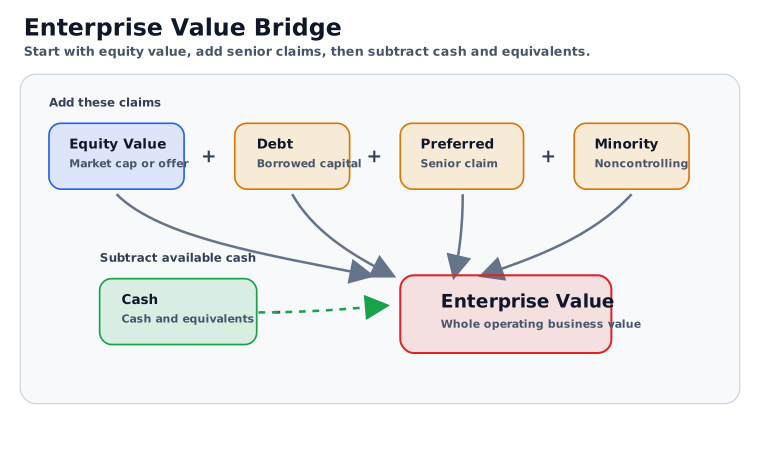
The expanded bridge is:
The bridge is useful because it separates the shareholder price from the financing claims a buyer or analyst must consider.
| Component | Direction | Why It Matters |
|---|---|---|
| Market capitalization or equity value | Add | Captures the common equity slice of the business. |
| Debt and debt-like obligations | Add | A buyer usually assumes or refinances these claims. |
| Preferred stock | Add | Preferred holders often have a senior claim compared with common shareholders. |
| Minority interest | Add | Consolidated EBITDA may include earnings not fully owned by common shareholders. |
| Cash and cash equivalents | Subtract | Excess cash reduces the net cost of acquiring the operating business. |
Enterprise Value vs. Equity Value
| Measure | What it is trying to value | Common pairing | Main blind spot |
|---|---|---|---|
| Market Capitalization | Common equity only | Earnings per Share, Price-to-Earnings Ratio | Ignores debt and excess cash |
| Enterprise Value | Whole operating business for all capital providers | EBITDA, operating cash flow, firm-wide DCF | Still needs judgment on non-core cash and financing claims |
That is why EV is usually the better numerator when analysts want to compare businesses with different leverage rather than compare only the shareholder slice.
Public Source Checks
Use public filings and market data before relying on an enterprise-value calculation:
- SEC EDGAR Company Search: Annual and quarterly filings for debt, cash, preferred stock, minority interest, segment notes, and acquisition disclosures.
- SEC Financial Statement Data Sets: Structured public-company statement data for historical cross-checks.
- SEC Company Facts API: XBRL company facts that can help verify reported statement line items.
- Company investor relations filings: share count, market price date, debt schedules, noncontrolling interests, and non-operating assets should tie back to dated source records.
Market price and share count must use the same measurement date. Debt, cash, preferred stock, and minority-interest inputs should tie to the same reporting period or be bridged to the valuation date.
What To Adjust Carefully
Enterprise value can be distorted if the analyst mechanically uses headline debt and cash. Review:
- restricted cash that may not be available to reduce purchase cost
- operating leases, pensions, earnouts, and other debt-like claims
- noncontrolling interests when EBITDA includes consolidated subsidiaries
- preferred stock and convertible securities that can change the claim structure
- non-operating assets that should be valued separately
- stale share counts, especially after buybacks, options, or new issuance
Quiz
Related Terms
- Market Capitalization: The equity-only value that EV adjusts.
- Total Debt: Debt and borrowed capital that often increase enterprise value.
- Cash and Cash Equivalents: Cash balances often subtracted when moving from equity value to enterprise value.
- Minority Interest: A consolidation-related claim that may need to be added to EV.
- Preferred Stock: A senior equity-like claim that may be added to EV.
- EBITDA: A common operating metric paired with EV in valuation multiples.
- EV/EBITDA: A common whole-firm valuation multiple.
- Discounted Cash Flow: An intrinsic valuation framework that can estimate firm value.
- Weighted Average Cost of Capital: Often used when valuing the firm as a whole.
- Enterprise-Value-to-Revenue (EV/R) Multiple: Related finance concept that helps place Enterprise Value in context.