Compound Interest
Compound interest is interest calculated on principal and accumulated interest, with the outcome shaped by rate, frequency, time, cash flows, and terms.
Compound interest is interest calculated on a balance that includes principal and prior interest added to that balance. On a deposit, interest can earn later interest after it is credited or compounded. On a debt, unpaid interest can increase later interest when the agreement adds it to the calculation balance. The rate, frequency, timing, payments, and governing terms determine the actual result.
Key Takeaways
- Compound interest includes prior interest in the base for later interest calculations.
- Simple interest excludes prior interest from that base.
- The standard formula assumes a constant nominal rate, equal periods, no cash flows, and a stated compounding frequency.
- More frequent compounding raises the effective annual result only when the same positive nominal rate and all other terms remain unchanged.
- Accrual, compounding, crediting, and payment frequencies can differ.
- Deposits, bonds, credit cards, and installment loans do not all compound in the same way.
- Fees, taxes, withdrawals, payments, variable rates, defaults, and inflation can outweigh the modeled interest-on-interest effect.
- Compound-growth projections do not guarantee investment returns, liquidity, safety, or purchasing power.
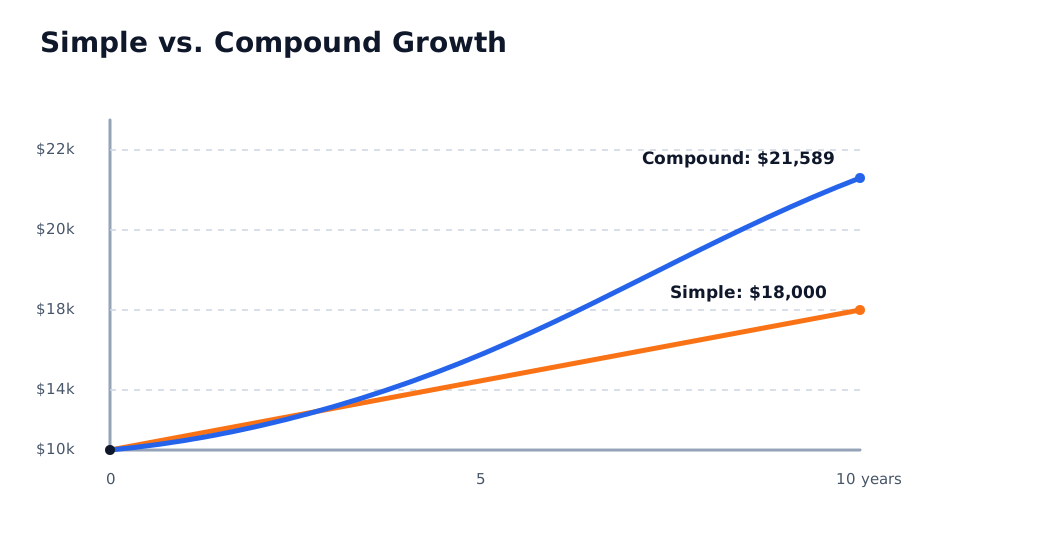
At a constant 8% annual rate, simple interest adds the same amount each year while compound interest applies 8% to a growing balance.
Compound Interest Formula
For principal (P), nominal annual rate (j), (m) equal compounding periods per year, and (t) years:
where:
- (A) is the ending amount;
- (P) is starting principal;
- (j) is the nominal annual rate as a decimal;
- (m) is the number of compounding periods per year; and
- (t) is time in years.
Compound interest earned or charged over the period is:
The formula does not accommodate deposits, withdrawals, debt payments, fees, or rate changes. Those require a period-by-period or dated cash-flow model.
Worked Example: Simple, Annual, and Monthly Interest
Assume a constant 10,000 balance is subject to an 8% annual rate for 10 years, with no cash flows, fees, taxes, or defaults.
Simple Interest
Under Simple Interest, the annual amount is always 8% of the original principal:
Annual Compounding
Monthly Compounding
If 8% is a nominal annual rate compounded monthly:
| Year | Simple-interest balance | Annually compounded balance |
|---|---|---|
| 0 | 10,000.00 | 10,000.00 |
| 1 | 10,800.00 | 10,800.00 |
| 2 | 11,600.00 | 11,664.00 |
| 5 | 14,000.00 | 14,693.28 |
| 10 | 18,000.00 | 21,589.25 |
The annual compound balance exceeds the simple-interest balance by 3,589.25 after ten years. Monthly compounding adds another 607.15 relative to annual compounding under the same nominal rate. A real product comparison must also hold fees, risk, access, taxes, and rate stability constant.
How the Balance Changes Each Period
For an effective periodic rate (i):
The period’s interest is:
At 8% annual compounding, first-year interest is 800 on 10,000. Second-year interest is 864 on 10,800. The extra 64 is interest on prior interest.
If cash flows occur, a simplified end-of-period model might be:
where contributions (C_t), withdrawals or payments (W_t), and fees (F_t) must be placed according to their actual timing. Moving a cash flow from period-start to period-end changes the result.
Compound Interest vs. Compound Return
Compound interest usually describes contractual or credited interest. Compound return describes how investment gains and losses combine across periods.
| Feature | Compound interest | Compound investment return |
|---|---|---|
| Rate source | Contract, account terms, or stated model | Realized or expected market performance |
| Balance changes | Interest, deposits, withdrawals, payments, fees | Income, price changes, distributions, cash flows, fees |
| Predictability | May be fixed or variable under a contract | Generally uncertain |
| Main calculation | Apply stated periodic interest to eligible balance | Multiply periodic growth factors |
For variable investment returns:
A 20% gain followed by a 20% loss leaves 96% of the starting value. Market returns do not arrive as smooth credited interest, and a constant expected return is not a contractual yield.
Accrual, Compounding, and Crediting
The words describe different events:
- Accrual: interest is calculated or recognized for elapsed time.
- Compounding: accumulated interest enters the base used for later interest.
- Crediting: interest is posted to an account or instrument value.
- Payment: cash is distributed or collected.
For example, U.S. TreasuryDirect explains that current Series I savings bonds earn interest from the first day of the issue month and compound semiannually. A credit-card agreement may instead calculate interest using a daily periodic rate and daily balance. The product’s terms control; the generic formula does not establish the treatment.
Compounding Frequency and Effective Rate
The Compounding Frequency changes the effective annual rate produced by one nominal rate:
At a 12% nominal annual rate:
| Frequency | Effective annual rate |
|---|---|
| Annual | 12.0000% |
| Quarterly | 12.5509% |
| Monthly | 12.6825% |
| Daily, using 365 days | 12.7475% |
The incremental increase becomes smaller as frequency rises. A lower nominal rate compounded more frequently can still produce a lower effective rate than a higher nominal rate compounded less frequently.
APY, APR, and Stated Interest
| Measure | Typical purpose | How compounding enters |
|---|---|---|
| Stated or nominal interest rate | Contractual rate input | Frequency must be specified separately |
| APY | U.S. consumer-deposit yield disclosure | Reflects interest and compounding under prescribed rules |
| Effective Annual Rate | General annual rate conversion | Converts periodic compounding into a one-year rate |
| APR | Consumer-credit cost disclosure | Follows product- and jurisdiction-specific rules and can include specified charges |
APR and APY are not opposites generated by one universal formula. They serve different products and disclosure purposes. A borrower or depositor should use the required disclosure and underlying agreement rather than infer cost or yield from the word “compound.”
Compound Interest on Debt
Interest on debt compounds only when prior interest becomes part of the balance used to calculate later interest. Relevant facts include:
- daily or periodic balance method;
- annual and periodic rates;
- payment dates and allocation;
- grace periods;
- capitalization events;
- fees and penalties;
- promotional and default rates; and
- applicable law.
An amortizing loan with scheduled payments does not follow (A=P(1+j/m)^{mt}) because principal changes after each payment. Some loans use simple interest on outstanding principal. Others capitalize unpaid interest only after specified events. “Compound interest” should not be assumed from APR alone.
Fees, Taxes, Inflation, and Reinvestment
Compound growth occurs on the balance that remains available. Fees and taxes can reduce that balance before later periods. Withdrawn interest cannot earn the account’s later rate unless it is returned or reinvested.
Nominal interest also does not measure purchasing-power growth. The exact real-rate relationship is:
where (\pi) is the matching inflation rate. A positive nominal balance increase can coexist with a negative real return after inflation, taxes, and fees.
How to Evaluate a Compound-Interest Claim
- Identify the principal or eligible balance.
- Determine whether the rate is nominal, periodic, effective, APR, or APY.
- Separate accrual, compounding, crediting, payment, and statement frequencies.
- Confirm when prior interest enters the calculation base.
- Place deposits, withdrawals, payments, and fees on a timeline.
- Check whether the rate is fixed, variable, tiered, or promotional.
- Review day-count, rounding, minimum-balance, and posting rules.
- Distinguish contractual interest from expected investment return.
- Compare net outcomes after relevant fees, taxes, and inflation.
- Use a period-by-period schedule when balances or rates change.
Common Mistakes and Limitations
- Assuming compounding guarantees growth: Losses, fees, defaults, and withdrawals can reduce value.
- Using a nominal annual rate as a periodic rate: Rate and time units must match.
- Comparing frequency without holding the rate constant: Frequency alone does not determine the better product.
- Treating accrual and compounding as synonyms: Interest can accrue before it enters the compounding balance.
- Applying a lump-sum formula to recurring cash flows: Contributions and payments require dated calculations.
- Assuming every debt compounds daily: The agreement and applicable law determine the method.
- Equating APR with effective annual balance growth: APR follows disclosure rules and may include specified charges.
- Ignoring reinvestment: Paid interest or distributions compound only if retained or reinvested.
- Presenting expected return as credited interest: Investment performance is uncertain and can be negative.
Public Source Checks
- The FDIC’s Compound Interest chapter explains how credited interest becomes part of the balance that earns later interest.
- The Consumer Financial Protection Bureau explains daily periodic rates and how some credit-card issuers add daily interest to the prior balance.
- The CFPB’s credit-card contract definitions distinguishes daily balance methods with and without compounding.
- TreasuryDirect’s I bond interest explanation explains that accumulated interest is added to principal every six months for semiannual compounding.
- The SEC’s Investor.gov Compound Interest Calculator models initial balance, contributions or withdrawals, rate, variation, time, and compounding frequency.
Related Terms
- Simple Interest: Interest calculated without adding prior interest to the calculation base.
- Compounding: The broader process of applying returns, charges, and cash flows to an updated balance.
- Compounding Frequency: How often accumulated interest enters the balance used for later interest.
- Future Value: The amount a balance or cash-flow stream reaches at a target date.
- Annual Percentage Yield: A U.S. consumer-deposit yield disclosure that reflects compounding.
- Time Value of Money: The framework for comparing cash flows at different dates.
FAQs
What is interest on interest?
Is monthly compounding always better than annual compounding?
Do all loans charge compound interest?
Does compound interest apply to stock returns?
This article is educational only and does not provide individualized investment, deposit, borrowing, tax, accounting, or legal advice.