Marketability
The degree to which an asset, security, or ownership interest can be sold without excessive delay, restriction, or discount.
Marketability is the practical ability to sell an asset, security, or ownership interest. In valuation work, it matters because a position that cannot be sold quickly or freely may be worth less than an otherwise similar marketable position.
Marketability is related to liquidity, but the terms are not identical. Marketability asks whether a sale can happen without major restrictions or process barriers. Liquidity asks how quickly the position can be converted to cash without a meaningful price concession.
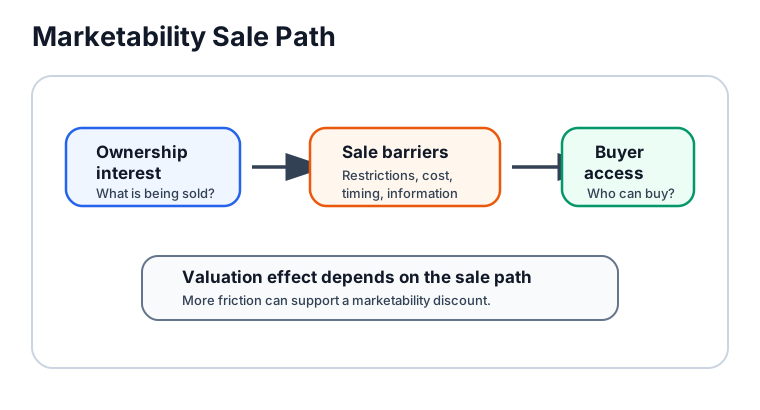
Marketability vs. Liquidity
| Question | Marketability | Liquidity |
|---|---|---|
| Main focus | Can the position be sold in practice? | Can it be sold quickly near expected value? |
| Main barrier | Legal restrictions, transfer limits, buyer access, approval rights, private-market process | Thin trading, bid-ask spread, market depth, price impact |
| Common evidence | Transfer documents, lockups, shareholder agreements, resale rules, buyer universe | Trading volume, order book depth, spreads, execution history |
| Valuation effect | May support a marketability discount | May support a liquidity premium or discount |
| Typical context | Private company stock, restricted securities, partnership interests, real estate, specialized assets | Public securities, bonds, funds, commodities, active markets |
An asset can be marketable but not very liquid, or liquid in normal size but hard to market in a large block.
What Drives Marketability
| Driver | Higher Marketability | Lower Marketability |
|---|---|---|
| Transferability | Freely transferable ownership | Consent rights, lockups, right of first refusal, restricted legend |
| Buyer universe | Many informed buyers | Few qualified or interested buyers |
| Information access | Reliable financials and disclosures | Limited data, stale statements, weak reporting |
| Transaction process | Standardized sale process and intermediaries | Negotiated private sale with long diligence period |
| Position size | Small relative to market demand | Large block or controlling stake needing a custom buyer |
| Legal and tax friction | Clear title and simple tax treatment | Complex restrictions, approvals, or tax effects |
Marketability is not just a property of the asset. It also depends on the owner, the size of the position, the available buyers, and the expected sale process.
Valuation Use
Marketability becomes important when the valuation subject is not comparable to actively traded public securities. Analysts may need to adjust value when a hypothetical buyer would require compensation for delay, uncertainty, transaction cost, or legal restrictions.
Common valuation contexts include:
- closely held company shares
- minority interests in private companies
- restricted stock or control securities
- partnership and LLC interests
- private fund interests
- real estate or specialized assets with a narrow buyer pool
- large public-company blocks that cannot be sold without price impact
The marketability question should be tied to a specific valuation date and interest being valued. A controlling interest with a likely sale process can have different marketability than a small minority interest subject to transfer restrictions.
Public Source Checks
Use public sources to frame marketability evidence:
- SEC Rule 144 overview: Useful background on restricted and control securities and resale conditions.
- Investor.gov Rule 144 glossary: Investor-facing explanation of restricted and control securities.
- SEC EDGAR Company Search: Public filings for lockups, resale registration statements, shareholder agreements, risk factors, and trading-history context.
- IRS Valuation of Assets: IRS valuation resources, including material relevant to marketability discounts.
For private interests, also review the shareholder agreement, operating agreement, partnership agreement, buy-sell agreement, transfer restrictions, option agreements, and any recent transaction documents.
Scenario Question
An analyst values a minority stake in a private company using public-company multiples and says no adjustment is needed because the company is profitable.
Answer: Profitability does not eliminate marketability risk. If the stake cannot be freely sold, lacks a clear buyer universe, or is subject to transfer restrictions, the valuation should explicitly address marketability before relying on public-company comparables.
Quiz
When Marketability Misleads
Marketability analysis can mislead when:
- liquidity evidence from a public peer is applied to a private minority interest without adjustment
- a small trade is used to value a large block
- legal restrictions are ignored because a buyer might eventually exist
- the analysis treats control and minority interests as equally marketable
- stale transactions are used without checking market conditions
- expected sale costs, diligence time, approvals, or lockups are omitted
- the analyst double-counts the same restriction in both cash-flow assumptions and discount rates
The key is to identify the exact barrier to sale and show where it affects value.
Review Checklist
Before relying on a marketability conclusion, document:
- the exact ownership interest or asset being valued
- valuation date, expected sale process, and likely buyer universe
- transfer restrictions, lockups, approval rights, and right-of-first-refusal provisions
- whether the interest is controlling or noncontrolling
- trading volume, market depth, bid-ask spread, or transaction evidence where relevant
- estimated sale costs, diligence period, and tax or legal friction
- whether any marketability effect is already captured elsewhere in the valuation
Related Terms
- Discounts for Lack of Marketability: A valuation adjustment for reduced saleability.
- Liquidity: The ability to convert a position to cash with limited price impact.
- Market Depth: Trading capacity available at quoted prices.
- Transaction Cost: Explicit and implicit costs of completing a trade or sale.
- Market Access: Ability to reach trading venues or buyers.
- Preferred Stock: A security class that may have transfer, control, and liquidation features affecting marketability.
- Cap Table: Ownership schedule that helps identify the interest being valued.