Book Value vs. Market Value
Comparison between accounting net worth and market pricing, and why the two can diverge sharply.
Book value and market value answer different finance questions. Book value asks what the accounting records say equity is worth after liabilities. Market value asks what investors are willing to pay today.
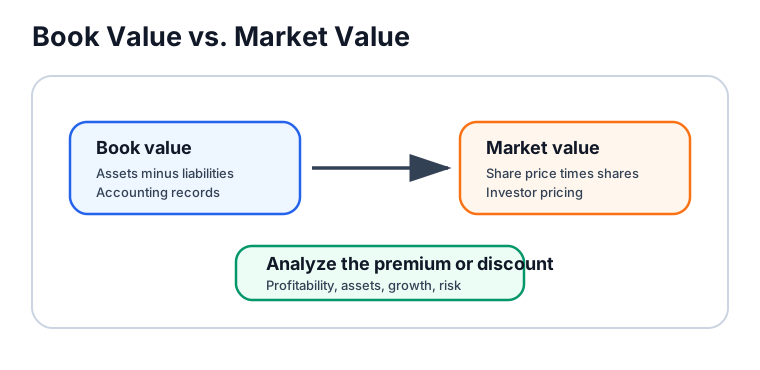
Because accounting value and market pricing come from different systems, the two numbers can diverge sharply.
Core Difference
| Question | Book Value | Market Value |
|---|---|---|
| What does it measure? | Accounting net worth on the balance sheet | Current investor pricing of equity |
| Main source | Financial statements | Stock price and shares outstanding |
| Time perspective | Historical and accounting-based | Forward-looking market expectation |
| Sensitive to | Asset measurement, liabilities, impairments, accounting rules | Earnings expectations, growth, risk, liquidity, sentiment |
| Common ratio | Book value per share | Market capitalization |
The comparison is useful because it shows whether the market is assigning a premium or discount to the accounting equity base.
Book Value
Book value is based on recorded assets and liabilities. It is usually tied to shareholders’ equity:
Book value can be useful when balance-sheet assets are economically meaningful, but it may miss internally generated intangibles or overstate assets that should be impaired.
Market Value
Market value reflects the price investors place on the company today. For a public company, equity market value is usually market capitalization:
Market value changes continuously as investors update expectations about cash flows, risk, growth, interest rates, liquidity, and competitive position.
Why They Differ
Book value and market value differ because:
- accounting rules do not recognize every economic asset
- many assets are carried at historical cost or amortized amounts
- markets price expected future cash flows, not just recorded assets
- asset quality, leverage, and profitability can change investor confidence
- intangible value may come from software, brand, data, networks, or people
- distressed companies may trade below book value if investors doubt asset recovery
A company trading far above book value may have strong expected profitability or valuable intangible assets. A company trading below book value may be undervalued, but it may also have weak returns or overstated assets.
When The Gap Matters
| Pattern | Possible Interpretation | What To Check |
|---|---|---|
| Market value above book value | Investors expect strong returns, growth, or intangible value | ROE, margins, growth durability, competitive advantages |
| Market value near book value | Assets may be central to valuation | Asset quality, peer multiples, and return on equity |
| Market value below book value | Market may doubt assets or profitability | Impairments, credit losses, leverage, distress risk, and expected returns |
The gap is especially meaningful in banks, insurers, real estate, industrials, and other asset-heavy sectors. It is often less meaningful in businesses where book value omits most of the true economic asset base.
Public Source Checks
Use public sources before relying on a book-versus-market comparison:
- SEC EDGAR Company Search: Filings for assets, liabilities, equity, goodwill, intangible assets, risks, and share-count data.
- SEC Financial Statement Data Sets: Structured statement data for assets, liabilities, equity, net income, and share-count checks.
- SEC Company Facts API: XBRL company facts that can help validate statement values and per-share data.
- Company investor relations materials: useful for current shares, buybacks, adjusted book value, tangible book value, and management discussion, but adjustments should reconcile to filings.
The book-value date and market-value date should be explicit. A current market cap compared with stale book value can still be useful, but the timing mismatch should be labeled.
Quiz
When The Comparison Misleads
Book value versus market value can mislead when:
- book value includes overstated or impaired assets
- market value reflects temporary panic or speculative enthusiasm
- share count, preferred equity, or minority interests are treated inconsistently
- goodwill and intangibles distort book value
- internally generated intangibles are economically important but not recorded
- the comparison mixes stale book value with current market value without disclosure
- the company is in a sector where book value has little relationship to earning power
Review Checklist
Before relying on the comparison, document:
- book-value source, balance-sheet date, currency, and accounting basis
- market capitalization date, share price source, share count, and share class
- whether total equity, common equity, or tangible book value is used
- goodwill, intangibles, impairments, reserves, and asset-quality issues
- preferred equity, minority interests, treasury stock, and buyback effects
- profitability and return-on-equity evidence explaining the premium or discount
- the valuation conclusion that would change if book value or market value changed
Related Terms
- Book Value: The accounting net-worth side of the comparison.
- Market Capitalization: The market-value side of the comparison.
- Book Value Per Share: Per-share version of book equity used in stock analysis.
- Price-to-Book Ratio: A direct way to compare market price with book value.
- Book-to-Market Ratio: The inverse-style comparison between book equity and market equity.
- Tangible Book Value: A stricter book-value base that removes many intangible assets.
- Return on Equity: Profitability metric often used to explain premiums or discounts to book value.
- Intrinsic Value: A broader estimate of economic worth that may differ from both book value and market value.