Market Capitalization
Market capitalization measures common equity market value from share prices and outstanding shares, including separate calculations for traded share classes.
Market capitalization, or market cap, is the total market value of a public company’s outstanding common equity. It equals the current share price multiplied by the number of shares outstanding. In most company-valuation discussions, market value of equity means the same thing.
Key Takeaways
- Market cap measures the market value of common equity, not the value of the entire business.
- A high share price does not necessarily mean a large company; the share count matters too.
- Standard market cap generally uses actual shares outstanding. A fully diluted equity value is a separate analytical measure.
- Market cap changes with the share price and with genuine changes in outstanding shares.
- Size labels such as large-cap and small-cap use market cap, but their cutoffs vary by index provider and market.
Market Capitalization Formula
Use a price and share count for the same security, company, currency, and measurement date. If a company has several publicly traded share classes, a company-level calculation may require valuing each class separately and adding the results.
Worked Example
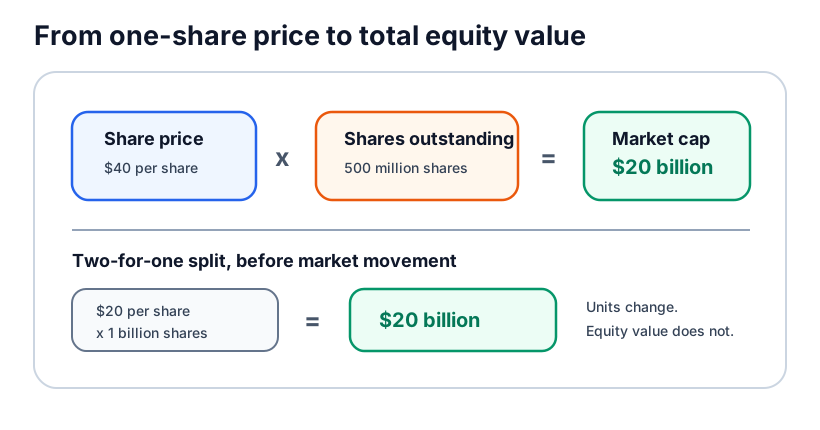
Suppose a company has:
- a share price of
$40 500 millionshares outstanding
Its market cap is:
Now assume the company completes a two-for-one stock split. Immediately after the split, before any market movement, the share count doubles to 1 billion and the price adjusts to about $20. Market cap remains approximately $20 billion because the split changes the units, not the underlying ownership value.
Example: Two Traded Share Classes
Suppose a different fictional company has two publicly traded common share classes and no other common shares. Both prices below are in U.S. dollars at the same measurement time, and the outstanding share counts are current.
| Common share class | Outstanding shares | Price per share | Class market value |
|---|---|---|---|
| Class A | 50 million | $20 | $1,000 million |
| Class B | 10 million | $18 | $180 million |
| Total common equity | 60 million | Not one uniform price | $1,180 million |
The company’s common equity market cap is $1.18 billion. Multiplying all 60 million shares by Class A’s $20 quote would produce $1.20 billion, overstating the total by $20 million. Reporting only Class A’s $1 billion value would omit Class B’s $180 million.
This example uses observable prices for both classes. A class without a traded price needs an explicitly stated valuation method; the example does not establish that every class should receive another class’s price.
Why Market Cap Matters
Market cap gives investors, analysts, and index providers a common way to compare the equity scale of listed companies. It is used to:
- group companies into large-, mid-, small-, and micro-cap segments
- weight constituents in many market indexes
- define the eligible universe for funds and portfolio mandates
- convert per-share market prices into total equity values
- bridge from equity value to enterprise value
Market cap is a size measure, not an investment rating. Companies of similar market cap can have very different profitability, leverage, liquidity, growth prospects, and risk.
Market Cap vs. Related Measures
| Measure | What it measures | Main calculation or source |
|---|---|---|
| Share price | The market price of one share | Current quote or transaction price |
| Market capitalization | Total market value of outstanding common equity | Share price times outstanding shares |
| Float-adjusted market cap | Market value available to public investors under an index methodology | Price times shares included in public float |
| Book value of equity | Accounting net assets attributable to equity holders | Assets minus liabilities, subject to accounting presentation |
| Enterprise value | Value assigned to the operating business across capital providers | Equity value plus debt and other claims, less cash adjustments |
The distinctions matter. Book value is based on accounting measurements, while market cap reflects current investor pricing. Enterprise value goes beyond common equity by incorporating debt and other financing claims and deducting cash or cash-like items according to the analyst’s definition.
Full-market capitalization is index-provider language for ordinary market capitalization before a float adjustment. It is not a separate valuation measure. By contrast, float-adjusted market capitalization intentionally excludes shares that a benchmark methodology does not consider available to public investors.
Outstanding Shares, Float, and Dilution
The share-count input requires care:
- Shares outstanding are issued shares currently held by investors, excluding treasury shares.
- Stock float is the subset considered available for public trading.
- Fully diluted shares estimate the potential share count after specified options, warrants, restricted units, or convertible instruments are reflected.
Published market cap usually uses current shares outstanding, not a hypothetical diluted count. In transaction or valuation work, an analyst may instead calculate fully diluted equity value. That calculation should be labeled clearly because it can require exercise proceeds, conversion terms, vesting assumptions, and instrument-specific treatment.
How Corporate Actions Affect Market Cap
Corporate actions do not all work the same way:
- Stock split: price and share count adjust in opposite directions, so the split alone does not change market cap.
- New share issuance: outstanding shares increase, but market cap does not necessarily rise by the exact proceeds because the market price may also change.
- Share repurchase: outstanding shares decrease, while the price response and cash used can affect equity and enterprise-value analysis.
- Merger or share conversion: the relevant share classes, exchange ratios, and measurement date must be reconciled.
The U.S. Securities and Exchange Commission’s stock split explanation illustrates why a split changes the number and price of shares without changing a shareholder’s total value solely because of the split.
Market-Cap Size Categories
Investors often describe companies as large-cap, mid-cap, small-cap, or micro-cap. These are conventions rather than permanent legal definitions. Cutoffs can differ among data providers, indexes, funds, markets, and dates.
Many indexes also use float-adjusted market cap rather than total market cap. S&P Dow Jones Indices explains in its Equity Indices Benchmark Statement that many of its equity indexes weight stocks by float-adjusted market value. That index weight can therefore differ from a company’s share of total market capitalization.
How to Verify a Market-Cap Figure
Before relying on a quoted market cap, check:
- Valuation time: Is the price live, delayed, previous-close, or period-end?
- Share count date: Does the source reflect a recent issuance, buyback, conversion, or split?
- Security scope: Is the calculation for one listed class or the whole company’s common equity?
- Share-count basis: Does the source use outstanding, float-adjusted, or fully diluted shares?
- Currency and listing: Are the quote currency, exchange, and depositary-share ratio consistent?
- Source quality: Can the share count be reconciled to the issuer’s latest filing and subsequent corporate actions?
The Investor.gov market-capitalization glossary gives the standard price-times-shares definition. A data vendor’s displayed figure can still differ from another source because of timing, share-class coverage, float adjustments, or stale share data.
Common Mistakes and Limitations
- Comparing share prices instead of market caps. A
$200stock can represent a smaller company than a$20stock. - Calling market cap the purchase price of the whole business. An acquirer must also consider debt, cash, preferred claims, noncontrolling interests, and transaction terms.
- Treating size as quality. Market cap does not establish profitability, solvency, liquidity, or investment merit.
- Mixing basic and diluted equity value. Potential dilution belongs in a clearly defined fully diluted calculation.
- Ignoring multiple share classes. One listed class may not capture every equity claim.
- Using stale data. Market prices move continuously, while reported share counts update less frequently.
Market cap is observable but not necessarily an estimate of intrinsic value. It records the market’s current aggregate price for the included equity, which can change rapidly and can be less reliable when trading is thin.
Knowledge Check
Related Terms
- Outstanding Shares: The share count used in the market-cap calculation.
- Share Price: The per-share market quote used in the formula.
- Stock Float: Shares considered available for public trading.
- Float-Adjusted Market Capitalization: Equity market value after applying benchmark investability rules.
- Enterprise Value: A whole-firm measure that adjusts equity value for financing claims and cash.
- Book Value: An accounting measure of net assets rather than a market price.
- Price-to-Book Ratio: A comparison of market equity value with accounting book equity.
- Stock-Market-Cap-to-GDP Ratio: A market-wide comparison whose security coverage and economic-output denominator need separate checks.
FAQs
Is market capitalization the same as company value?
Is market value of equity the same as market cap?
Does a stock split change market capitalization?
Does market cap include debt?
This article is educational and does not provide investment, valuation, accounting, legal, or tax advice. Market data and share counts can change, so verify the measurement date and source before using a figure.