Capital Asset Pricing Model
The capital asset pricing model links expected return to systematic risk through beta and the market risk premium.
The capital asset pricing model (CAPM) is a finance model that links an asset’s expected return to its exposure to systematic market risk.
The central idea is that investors should be compensated for time value of money and for bearing market-related risk that cannot be diversified away.
Core Formula
In its standard form:
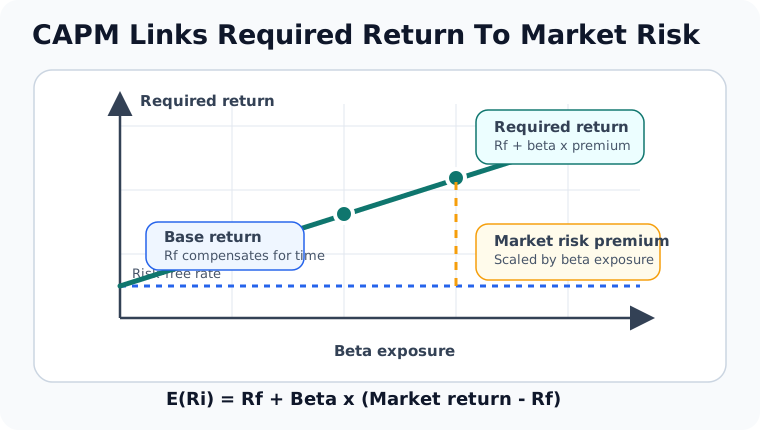
Where:
- \(R_f\) is the risk-free rate
- \(\beta\) measures sensitivity to market movements
- \(E(R_m) - R_f\) is the market risk premium
Why It Matters
CAPM is often used to estimate a cost of equity, benchmark expected return, or compare whether an asset’s return looks adequate given its systematic risk.
It is especially useful when analysts need a disciplined way to connect required return with beta.
Worked Example
Suppose the risk-free rate is 3%, the market risk premium is 5%, and a stock’s beta is 1.2.
Under CAPM, the expected return would be:
That 9% becomes a candidate required return for valuation work.
Input Support
CAPM is simple, but the inputs need discipline:
| Input | What To Check | Why It Matters |
|---|---|---|
| Risk-free rate | Currency, maturity, valuation date, and whether the rate is spot or normalized | A U.S. dollar valuation usually needs a U.S. dollar risk-free base |
| Beta | Raw beta, adjusted beta, peer beta, relevering method, and observation period | Beta can change materially with leverage, index choice, and lookback window |
| Market risk premium | Long-run assumption, current implied assumption, country risk adjustment, and source version | A stale or unexplained premium can move the entire cost-of-equity estimate |
| Capital structure | Current leverage, target leverage, cash, debt, preferred stock, and minority interest | Relevered beta should match the capital structure used in valuation |
| Sensitivity range | Low/base/high cases for beta and market risk premium | Small discount-rate changes can have a large effect on terminal value |
The output should be labeled as a required return estimate, not a guaranteed return forecast.
Public Source Checks
Public sources can support parts of the model:
- U.S. Treasury Daily Treasury Rates: Treasury yield observations often used as U.S. dollar risk-free-rate inputs.
- Federal Reserve H.15 Selected Interest Rates: Public interest-rate series for checking rate levels and maturities.
- FRED 10-Year Treasury Constant Maturity Rate: A stable long-rate time series often used as a reference point in valuation support.
- SEC EDGAR Company Search: Filings for business mix, leverage, risk factors, share count, and segment changes that may affect beta comparability.
- SEC Financial Statement Data Sets: Structured financial-statement data that can help check debt, equity, tax, and operating inputs used when levering or unlevering beta.
Beta and market risk premium often come from market-data vendors, academic datasets, internal policy files, or valuation-firm assumptions. The key control is not just the number; it is whether the source, date, currency, index, and adjustment method are documented.
Scenario Question
An investor says, “A higher-beta stock should always outperform in every short period.”
Answer: No. CAPM is an expected-return framework, not a guarantee about short-run realized performance.
Practical Use
Valuation analysts use CAPM to estimate cost of equity, compare required returns, support WACC assumptions, and explain why riskier equity cash flows need a higher discount rate.
Practical Example
A valuation review should tie CAPM to the model tab that uses it. If a change in beta or market risk premium changes WACC, terminal value, or the investment recommendation, the reviewer should show that sensitivity explicitly.
Decision Check
Ask whether CAPM changes the cost of equity, WACC, terminal value, impairment support, deal price, or margin of safety.
Watch For
- CAPM is an expected-return model, not a promise of realized performance.
- Beta estimates can be unstable for thinly traded, recently restructured, or highly cyclical companies.
- A peer beta is only useful if the peer set has similar business risk.
- Risk-free rate, market risk premium, and beta should be measured as of a consistent valuation date.
- CAPM may understate risk when company-specific risks cannot be diversified away by the investor base being considered.
When CAPM Misleads
CAPM can be weak when:
- the company has negative or highly volatile earnings
- peer companies have different segment mixes or leverage
- historical beta no longer reflects the business after a transaction or restructuring
- country, currency, liquidity, or size risk is material but excluded
- a single point estimate is used without sensitivity analysis
- the analysis needs a project-specific hurdle rate rather than a public-equity required return
Where It Shows Up
You will see CAPM in DCF models, fairness opinions, impairment support, acquisition models, equity research, investment committee materials, and WACC support files.
Analyst Takeaway
Treat CAPM as a structured cost-of-equity estimate. The most useful review asks whether the inputs match the currency, business risk, leverage, valuation date, and cash flows being discounted.
Review Checklist
Before relying on CAPM, document:
- the risk-free rate source, currency, maturity, and date
- the beta source, index, lookback period, and adjustment method
- whether beta was unlevered and relevered, and with which tax and debt assumptions
- the market risk premium source and date
- any country, size, liquidity, or company-specific risk adjustments
- the model cell where CAPM flows into cost of equity, WACC, or terminal value
- the sensitivity range used for beta and market risk premium
Related Terms
- Beta: Beta is the risk measure at the center of CAPM.
- Risk-Free Rate: The baseline return in the model.
- Market Risk Premium (MRP): The compensation investors require for taking market risk.
- Equity Risk Premium: Closely related to the return premium used in equity valuation.
- Cost of Equity: The required return estimate CAPM is often used to support.
- Weighted Average Cost of Capital (WACC): CAPM is often used to estimate the cost of equity input inside WACC.