Discounts for Lack of Marketability
Valuation discounts applied to ownership interests that cannot be readily sold in an active market.
Discounts for lack of marketability (DLOM) are valuation discounts applied when an ownership interest cannot be sold as readily as a comparable marketable interest. DLOM is common in private-company valuation, restricted stock analysis, estate and gift tax valuation, and minority-interest appraisal.
The discount should reflect the specific barrier to sale, not a generic private-company haircut.
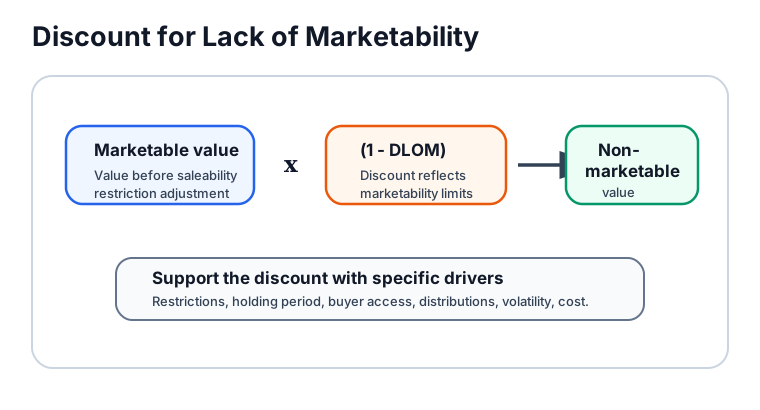
What DLOM Adjusts
DLOM adjusts a value indication for reduced saleability. It is usually applied after the analyst has estimated a marketable value for the same economic interest.
| Issue | Why It Can Support DLOM |
|---|---|
| Transfer restrictions | The owner may need consent, registration, or a permitted exemption before selling. |
| Expected holding period | A longer forced holding period increases uncertainty and opportunity cost. |
| Limited buyer pool | Fewer qualified buyers can reduce competitive tension. |
| Information gap | Private-company buyers may require more diligence or a higher return. |
| Transaction cost | Legal, advisory, tax, and diligence costs reduce net proceeds. |
| Dividend or distribution policy | Cash distributions can reduce the cost of waiting to sell. |
| Volatility and risk | Higher uncertainty can increase the value of marketability. |
DLOM is distinct from a lack-of-control or minority discount. A noncontrolling interest may also lack marketability, but the reasons and evidence should be separated.
Worked Example
Suppose an analyst estimates a marketable minority interest value of $10 million and supports a 20% DLOM.
The nonmarketable value is $8 million. The discount is not the conclusion by itself; the key support is why a buyer would require a 20% price reduction for the specific interest and valuation date.
Evidence Methods
Analysts use several evidence sources to support DLOM. No single method is automatically correct.
| Method | What It Uses | Main Limitation |
|---|---|---|
| Restricted stock studies | Price differences between restricted shares and freely traded shares | Study periods, company quality, holding-period rules, and sample selection may differ from the subject. |
| Pre-IPO studies | Private transaction prices before a later IPO | IPO timing and selection bias can be material. |
| Option or protective-put models | Cost of price protection during a holding period | Sensitive to volatility, holding period, dividends, and assumptions. |
| Transaction evidence | Actual sales of similar interests | Comparable private transactions may be scarce or stale. |
| Factor analysis | Transfer limits, distributions, risk, buyer pool, expected exit | Requires disciplined weighting and support. |
The strongest DLOM support usually triangulates more than one method and explains why the selected discount fits the actual interest being valued.
Public Source Checks
Use public sources for rule, restriction, and valuation context:
- IRS Valuation of Assets: IRS valuation resources, including DLOM-related job-aid material.
- SEC Rule 144 overview: Background on restricted and control securities resale conditions.
- Investor.gov Rule 144 glossary: Investor-facing explanation of Rule 144.
- SEC EDGAR Company Search: Filings for lockups, resale registration rights, restricted securities, and offering documents.
For a private-company interest, also review the shareholder agreement, operating agreement, buy-sell agreement, option plan, capitalization table, prior transactions, and any appraisal or tax valuation report.
Scenario Question
An appraiser applies a 30% DLOM because the company is private, but does not identify transfer restrictions, expected holding period, buyer universe, dividend policy, or supporting studies.
Answer: The conclusion is weak. DLOM should be supported by the specific marketability limits of the interest being valued and the evidence used to translate those limits into a discount.
Quiz
When DLOM Misleads
DLOM can mislead when:
- the discount is selected from a study without matching the subject interest
- marketability and minority-control effects are double-counted
- the holding period assumption is unsupported
- transfer restrictions have expired or are easier to remove than assumed
- the company pays distributions that reduce the cost of waiting
- a likely near-term sale, IPO, redemption, or buy-sell event is ignored
- the analyst uses public-market liquidity evidence without adjusting for the specific interest
- tax, legal, or reporting context requires a different valuation premise
The discount should be reproducible: another reviewer should be able to trace the selected DLOM to facts, assumptions, and evidence.
Review Checklist
Before relying on a DLOM, document:
- valuation premise, standard of value, valuation date, and interest being valued
- whether the base value is controlling, noncontrolling, marketable, or nonmarketable
- transfer restrictions, lockups, rights of first refusal, and approval requirements
- expected holding period and evidence supporting it
- dividends, distributions, redemption rights, or expected liquidity events
- restricted stock, pre-IPO, option-model, or transaction evidence used
- how the analysis avoids double-counting liquidity, marketability, and control adjustments
Related Terms
- Marketability: The saleability attribute that DLOM adjusts for.
- Liquidity: Related but distinct ability to convert to cash with limited price impact.
- Transaction Cost: Costs that can reduce net sale proceeds.
- Preferred Stock: Security rights can affect transferability and economic value.
- Cap Table: Ownership schedule used to identify the interest and rights being valued.
- Pre-Money Valuation: Private financing valuation context where transfer rights and security terms matter.
- Post-Money Valuation: After-round valuation that may still need marketability analysis for private securities.