Tangible Book Value Per Share (TBVPS)
Tangible book value per share divides tangible common equity by shares outstanding to estimate hard asset value per share.
Tangible book value per share (TBVPS) converts tangible book value into a per-share measure. It estimates the tangible equity base available to each common share after removing goodwill, many intangible assets, and non-common claims when relevant.
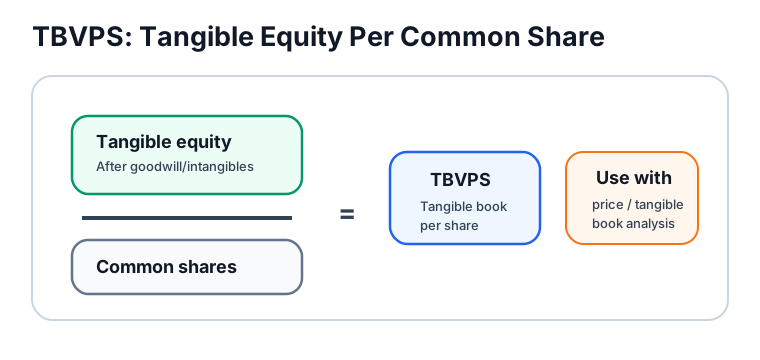
TBVPS is commonly used in bank, insurance, and asset-heavy company valuation because it gives analysts a stricter per-share asset anchor than ordinary book value per share.
Why TBVPS Matters
TBVPS matters when investors want to compare stock price with a tangible-capital base. It helps answer questions such as:
- How much tangible common equity supports each share?
- Is the stock trading above or below tangible book?
- Is a buyback accretive or dilutive to tangible book value per share?
- Does reported book value depend heavily on goodwill or intangible assets?
- Does a bank or insurer have enough tangible capital relative to market value?
It is not a full valuation model, but it is a useful denominator for price to tangible book value analysis.
Formula Inputs
| Input | What To Check | Why It Matters |
|---|---|---|
| Common equity | Starting equity attributable to common shareholders | Preferred or minority claims should not inflate common TBVPS |
| Goodwill | Deduct from common equity | Goodwill is not tangible capital |
| Other intangibles | Deduct acquired intangibles, software, trade names, or customer relationships when appropriate | Different companies define tangible equity differently |
| Adjustments | AOCI, deferred tax assets, reserves, or company-specific items | Adjusted TBVPS must be reconciled to reported equity |
| Shares outstanding | Period-end, basic, diluted, or adjusted shares | The denominator controls the per-share result |
The numerator and denominator must match. A tangible common equity numerator should be divided by common shares, not by total shares that include non-common claims.
TBVPS vs. BVPS
BVPS uses ordinary book equity. TBVPS uses tangible common equity.
| Measure | Numerator | Common Use |
|---|---|---|
| BVPS | Common book equity | Broad accounting value per common share |
| TBVPS | Common equity less goodwill and many intangibles | Stricter asset-backed value per common share |
| Price/TBVPS | Market price divided by TBVPS | Bank, insurance, and tangible-capital valuation |
TBVPS is usually lower than BVPS when a company carries goodwill or intangible assets.
Where TBVPS Works Best
TBVPS tends to be useful in:
- bank valuation and tangible common equity analysis
- insurance company valuation
- acquisition-heavy companies with large goodwill balances
- asset-quality and downside scenarios
- buyback accretion or dilution analysis
- comparisons of price to tangible book value
It is less useful for companies whose economic value is mostly intangible and internally generated.
Public Source Checks
Use source documents before relying on TBVPS:
- SEC EDGAR Company Search: Annual and quarterly filings for equity, goodwill, intangible assets, preferred stock, treasury stock, and share counts.
- SEC Financial Statement Data Sets: Structured data for assets, liabilities, equity, goodwill, and share-count checks.
- SEC Company Facts API: XBRL facts that can help verify equity, goodwill, intangibles, and shares outstanding.
- Company earnings releases and investor supplements: often include tangible book value per share, tangible common equity, and return on tangible common equity.
Management-reported TBVPS should reconcile to reported equity. If the reconciliation is missing, treat the measure as a company-defined non-GAAP-style adjustment rather than a clean comparable input.
Quiz
When TBVPS Misleads
TBVPS can mislead when:
- tangible assets are overstated or credit losses are under-reserved
- goodwill or intangibles still support meaningful earnings power
- preferred equity, minority interests, AOCI, or deferred tax assets are treated inconsistently
- basic, diluted, period-end, and weighted-average shares are mixed
- buybacks or issuances rapidly change the share count
- peer companies use different definitions of tangible common equity
- the business is asset-light and tangible book value is not the main economic base
Review Checklist
Before relying on TBVPS, document:
- common equity source, balance-sheet date, and accounting basis
- goodwill, acquired intangibles, deferred tax assets, and other deductions
- preferred equity, minority interest, treasury stock, and AOCI treatment
- share-count basis and whether it matches the numerator
- whether TBVPS is reported, company-adjusted, or analyst-adjusted
- how TBVPS changes price-to-tangible-book, buyback, or downside analysis
- the conclusion that would change if tangible equity or share count changed
Related Terms
- Tangible Book Value: The total tangible equity base behind TBVPS.
- Book Value Per Share: The broader per-share book-value measure.
- Book Value: The ordinary accounting equity base before tangible deductions.
- Price to Tangible Book Value (PTBV): Compares stock price with TBVPS.
- Price-to-Book Ratio: Compares stock price with ordinary book value per share.
- Net Tangible Assets: Related tangible asset-base measure.
- Goodwill: A major deduction in many TBVPS calculations.