Book Value
Accounting net worth from the balance sheet, often compared with market value in equity analysis.
Book value is the accounting value of a company’s net assets. In equity analysis, it usually means the value of assets left for owners after liabilities are deducted on the balance sheet.
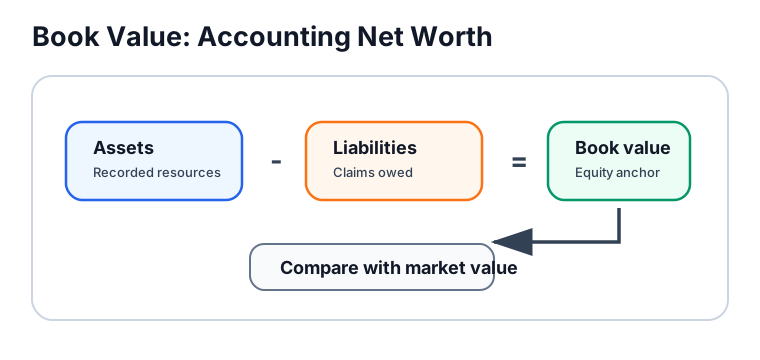
For equity valuation, book value is closely related to shareholder equity. Analysts often use book value of equity as shorthand for accounting net worth attributable to owners.
Why Book Value Matters
Book value gives analysts an accounting anchor for the business. It helps answer questions such as:
- How much net asset value does the balance sheet report?
- Is market value far above or below accounting equity?
- Does the company have meaningful tangible capital?
- Is a valuation multiple such as price-to-book grounded in a reliable denominator?
- Does book value support downside, liquidation, or capital-strength analysis?
Book value is not intrinsic value, but it can be a useful starting point when assets and liabilities are economically meaningful.
Where Book Value Comes From
Book value is drawn from the balance sheet, where assets, liabilities, and equity are reported under accounting rules. That means book value depends on:
- historical cost and fair-value measurement
- depreciation and amortization
- impairment testing
- goodwill and intangible-asset recognition
- reserves, allowances, and credit marks
- share issuance, buybacks, dividends, and retained earnings
Because accounting rules shape book value, the number must be interpreted with the company’s industry and reporting basis in mind.
What Analysts Need To Define
The phrase “book value” can mean different things:
| Term | Common Meaning | Why The Distinction Matters |
|---|---|---|
| Total book value | Total assets minus total liabilities | Broad accounting net worth before common-equity refinements |
| Book value of equity | Shareholders’ equity attributable to owners | Common basis for P/B and book-to-market analysis |
| Common book value | Equity available to common shareholders after preferred claims | Better denominator for common-stock valuation |
| Tangible book value | Book equity after removing goodwill and many intangible assets | Useful when asset quality and loss absorption matter |
| Carrying amount | Book value of a specific asset or liability | Used in accounting and impairment contexts, not always equity valuation |
For valuation work, state whether the analysis uses total equity, common equity, or tangible common equity.
Book Value vs. Market Value
Book value reflects accounting records. Market value reflects what investors are willing to pay today for future earnings, growth, risk, liquidity, and control.
A company may trade:
- above book value when investors expect strong profitability, growth, or intangible value
- near book value when assets are central and expected returns are ordinary
- below book value when investors question asset quality, earnings power, or solvency
The gap between book value and market value is often more important than either number alone.
Where Book Value Works Best
Book value tends to be more informative in:
- banks and insurers
- capital-intensive industrial companies
- real estate and asset-heavy businesses
- liquidation or downside analysis
- valuation screens based on P/B or book-to-market
It is often less informative for companies where the main economic assets are software, brand, data, network effects, internally developed intellectual property, or human capital that may not appear fully on the balance sheet.
Public Source Checks
Use source documents before relying on book value:
- SEC EDGAR Company Search: Annual and quarterly filings for assets, liabilities, shareholders’ equity, goodwill, intangible assets, share repurchases, and accounting policies.
- SEC Financial Statement Data Sets: Structured statement data that can help tie assets, liabilities, equity, and net income to filings.
- SEC Company Facts API: Company-level XBRL facts for validating reported assets, liabilities, equity, goodwill, and per-share values.
- Company earnings releases and investor supplements: useful for adjusted book value, tangible book value, regulatory capital, and asset-quality bridges, but adjustments should reconcile to reported equity.
The source period matters. Book value is a balance-sheet point-in-time measure, while market value can change every trading day.
Quiz
When Book Value Misleads
Book value can mislead when:
- assets are impaired, stale, or not marked realistically
- goodwill and intangibles dominate equity
- important internally generated assets are missing from the balance sheet
- reserves, allowances, or credit marks are too optimistic
- preferred equity or minority interests are not separated from common equity
- accounting rules differ across peer companies
- profitability is too weak to earn an acceptable return on book equity
Review Checklist
Before relying on book value, document:
- balance-sheet date, currency, accounting basis, and source filing
- assets, liabilities, shareholders’ equity, and common-equity basis
- goodwill, intangibles, impairments, reserves, allowances, and fair-value marks
- preferred equity, minority interest, treasury stock, and AOCI treatment
- whether the analysis uses total book value, common book value, or tangible book value
- market value date if book value is compared with price
- the valuation or risk conclusion that would change if book value changed
Related Terms
- Shareholder Equity: The balance-sheet measure most closely tied to book value.
- Balance Sheet: The financial statement from which book value is derived.
- Book Value Per Share: Expresses book value on a per-share basis for equity analysis.
- Book Value vs. Market Value: Explains why accounting value and market pricing can diverge.
- Tangible Book Value: A stricter equity measure that removes many intangible assets.
- Price-to-Book Ratio: Compares market price with accounting book value.
- Book-to-Market Ratio: Compares book equity with market equity.
- Intrinsic Value: A broader valuation concept that can differ greatly from book value.