Time Value of Money
Time value of money compares cash flows at different dates using compounding, discounting, cash-flow timing, and a rate suited to the decision.
The time value of money (TVM) is the principle that cash flows at different dates are not directly comparable. Finance moves them to a common date through compounding or discounting, using a rate that reflects the relevant opportunity cost, inflation basis, timing, and risk. Money today is often more valuable than the same nominal amount later, but the conclusion depends on the cash flow and rate assumptions.
Key Takeaways
- Compounding moves a present amount forward; discounting moves a future amount backward.
- A rate and its number of periods must use consistent units and compounding conventions.
- Each cash flow in a multi-period problem should be placed on a timeline and valued separately.
- Higher discount rates reduce present value when amount and timing are unchanged.
- Nominal cash flows should generally use nominal rates, while real cash flows use real rates.
- The discount rate is decision-specific; a deposit, loan, bond, project, and uncertain equity cash flow need not use the same rate.
- TVM calculations are only as reliable as their cash-flow, timing, rate, tax, fee, and risk assumptions.
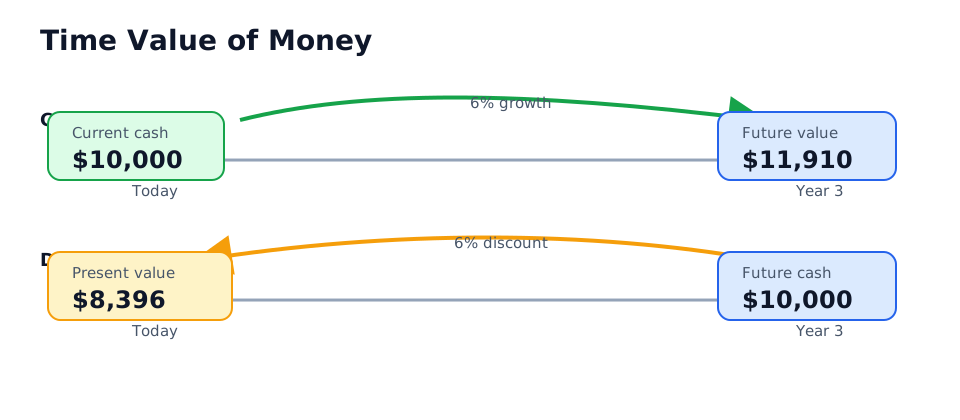
Compounding asks what today’s amount could become; discounting asks what a future amount is worth at the valuation date.
Why Timing Changes Financial Value
Receiving 10,000 today rather than the same nominal amount three years from now can matter because today’s cash can be saved, invested, spent, or used to reduce debt. A future payment may also be exposed to inflation, default, delay, and uncertainty.
TVM does not mean every immediate payment is automatically preferable. A future amount may be larger, contractually protected, tax-advantaged, or linked to another benefit. The correct comparison converts all relevant cash flows to the same date and accounts for their terms and risks.
Compounding to Future Value
For one amount compounded at constant effective periodic rate (r) for (n) periods:
where:
- (PV) is value at the starting date;
- (FV) is value after (n) periods;
- (r) is the effective rate per period; and
- (n) is the number of matching periods.
If 10,000 earns 6% annually for three years, with no cash flows, fees, or taxes:
The result is a contractual calculation only if the rate and terms are contractually available. For an investment, a constant 6% return is a scenario rather than a guarantee.
Discounting to Present Value
Rearranging the formula gives the present value of one future amount:
At a 6% annual discount rate, the present value of 10,000 due in three years is:
The two calculations are mirror images. 8,396.19 compounded at 6% for three years becomes 10,000; 10,000 discounted three years at 6% becomes 8,396.19.
Discount Factors
The present-value factor for period (t) is:
For one 10,000 payment due in five years:
| Annual discount rate | Five-year discount factor | Present value |
|---|---|---|
| 3% | 0.8626 | 8,626.09 |
| 6% | 0.7473 | 7,472.58 |
| 10% | 0.6209 | 6,209.21 |
The payment and date are unchanged. Only the rate changes, yet the present-value range exceeds 2,400. This sensitivity is why the discount rate needs economic support rather than being selected to produce a preferred value.
Multiple Cash Flows
When cash flows occur on several dates, discount each one separately:
If an initial cash outflow occurs today, Net Present Value is:
Different rates can be used by period when the term structure or risk changes, but the model should disclose the convention.
Worked Example: Three Uneven Cash Flows
Assume a project costs 10,500 today and is expected to produce 3,000 after year one, 4,000 after year two, and 5,000 after year three. At a hypothetical 7% annual discount rate:
| Cash flow | Date | Discount factor | Present value |
|---|---|---|---|
| 3,000 | Year 1 | 0.9346 | 2,803.74 |
| 4,000 | Year 2 | 0.8734 | 3,493.75 |
| 5,000 | Year 3 | 0.8163 | 4,081.49 |
| Total inflows | 10,378.98 |
The resulting NPV is:
Under these assumptions, the discounted inflows fall short of the initial cost by 121.02. That conclusion changes if cash flows, timing, discount rate, taxes, terminal value, or project risk change. The example illustrates the method, not whether any real project should be accepted.
Beginning vs. End-of-Period Timing
Cash received earlier has less time to discount and more time to compound. A payment at the start of a period is therefore more valuable than an otherwise identical payment at the end, when the rate is positive.
This distinction appears in:
- ordinary annuities, with payments at period-end;
- annuities due, with payments at period-start;
- lease payments made in advance;
- deposits made at the start or end of a month; and
- project cash flows approximated at year-end, midyear, or exact dates.
Using a year-end convention for cash earned throughout the year can understate value. A midyear convention may be more representative, but it should be applied consistently.
Compounding Frequency and Quoted Rates
For nominal annual rate (j), compounded (m) times per year for (t) years:
The Effective Annual Rate converts the periodic convention into a one-year growth rate:
Do not divide an effective annual rate by 12 and call the result an equivalent monthly rate. The correct conversion solves ((1+r_m)^{12}=1+EAR).
Nominal and Real Cash Flows
The exact relationship among nominal return, real return, and inflation is:
where (\pi) is the matching inflation rate. Subtracting inflation from a nominal rate is an approximation.
A model should either:
- forecast cash flows including expected inflation and discount at a nominal rate; or
- forecast purchasing-power cash flows and discount at a real rate.
Mixing real cash flows with a nominal discount rate generally understates value. Mixing nominal cash flows with a real rate generally overstates value.
Choosing a Relevant Rate
| Decision | Rate considerations |
|---|---|
| Deposit growth | Contractual rate, compounding frequency, APY, fees, and rate changes |
| Loan or lease | Contract rate, payment schedule, fees, APR rules, and default terms |
| Bond cash flows | Market yield, credit risk, options, liquidity, settlement, and tax treatment |
| Capital project | Opportunity cost, project risk, financing consistency, taxes, and cash-flow definition |
| Business valuation | Cost of equity or capital matched to equity or enterprise cash flow |
| Pension or accounting liability | Governing accounting standard and liability characteristics |
The rate is not merely “what could be earned elsewhere.” It may need to reflect risk, market evidence, term, currency, liquidity, embedded options, and the purpose of the measurement.
Where TVM Is Used
- Investing: pricing bonds, comparing yields, and valuing expected distributions.
- Corporate finance: comparing project costs with discounted operating cash flows.
- Credit: calculating payment schedules, balances, and borrowing costs.
- Retirement planning: projecting contributions and discounting future spending needs.
- Financial reporting: measuring certain assets, liabilities, leases, provisions, and impairment amounts under applicable standards.
- Public finance: comparing long-term obligations, infrastructure costs, and funding alternatives.
Each use can apply different definitions and regulations. A calculation valid for a classroom example may not satisfy consumer disclosure, accounting, tax, actuarial, or legal requirements.
How to Build a TVM Calculation
- Set the valuation date.
- Draw a timeline with every cash inflow and outflow.
- Label whether cash flows occur at period-start, period-end, or exact dates.
- Identify whether rates are nominal, periodic, effective, real, or continuous.
- Match rate and cash-flow periods.
- Choose a rate appropriate to the cash flow, risk, currency, and purpose.
- Keep inflation, tax, fee, and cash-flow definitions consistent.
- Discount each cash flow to one date before adding or comparing amounts.
- Reconcile the result by reversing the calculation where possible.
- Test timing, rate, and cash-flow assumptions with scenarios or sensitivity analysis.
Common Mistakes and Limitations
- Comparing cash flows at different dates directly: Move them to one date first.
- Mixing annual and monthly units: Rates and periods must align.
- Confusing nominal and effective rates: Compounding frequency changes the annual growth factor.
- Using the wrong timing convention: Beginning, end, midyear, and exact-date cash flows differ.
- Applying one rate to cash flows with different risk: The discount rate should match the economics being valued.
- Mixing nominal and real inputs: Treat inflation consistently.
- Ignoring fees and taxes: Gross value can differ materially from net value.
- Treating forecast cash flows as certain: Scenario precision does not remove business, credit, or market risk.
- Using TVM as the only decision test: Liquidity, flexibility, legal terms, nonfinancial effects, and estimation risk can also matter.
Public Source Checks
- The Federal Reserve Bank of St. Louis Time Value of Money module connects opportunity cost, interest, inflation, present value, and future value.
- The SEC’s Investor.gov Compound Interest Calculator models initial investment, contributions or withdrawals, time, estimated rate, rate variation, and compounding frequency.
- The Consumer Financial Protection Bureau’s compound-interest explanation identifies principal, interest rate, and compounding frequency as distinct calculation inputs.
- New York University professor Aswath Damodaran’s present-value primer explains discounting, compounding, simple cash flows, annuities, perpetuities, and growing cash flows.
Related Terms
- Present Value: A future cash flow translated to the valuation date using a stated discount rate.
- Future Value: A current balance compounded to a specified future date.
- Compounding: Applying each period’s return, charge, and cash flow to an updated balance.
- Discount Rate: The rate used to convert future amounts into present value.
- Net Present Value: Present value of inflows minus present value of outflows.
- Perpetuity: An indefinite level or growing cash-flow stream.
FAQs
Why is money today usually worth more than the same amount later?
What happens to present value when the discount rate rises?
Can one discount rate be used for every cash flow?
Is a TVM result a forecast?
This article is educational only and does not provide individualized investment, borrowing, retirement, valuation, accounting, tax, or legal advice.