Fiscal Union
A fiscal union combines shared budget capacity, revenue, borrowing, transfers, or fiscal governance across participating governments.
A fiscal union is an arrangement in which participating jurisdictions share meaningful authority or institutions for taxation, spending, borrowing, fiscal transfers, or budget oversight. It can range from limited risk-sharing funds and common fiscal rules to a federal system with a central budget, own-source revenue, debt issuance, and stabilization responsibilities.
Fiscal union is not a binary label. Two regions can share a currency yet retain mostly separate budgets, while a federal country can combine a large central budget with substantial state or provincial fiscal autonomy.
Key Takeaways
- Fiscal union can include shared revenue, spending, borrowing, transfers, guarantees, fiscal rules, and democratic oversight.
- A monetary union does not automatically create a fiscal union.
- Central fiscal capacity can help absorb region-specific or common shocks, but its effectiveness depends on scale, timing, design, and governance.
- Risk sharing can create moral-hazard concerns if transfers are predictable but fiscal responsibility and oversight are weak.
- Shared borrowing does not automatically lower every member’s financing cost; liability, seniority, guarantees, and market confidence matter.
- A durable fiscal union requires rules for who decides, who pays, who receives, and who bears losses.
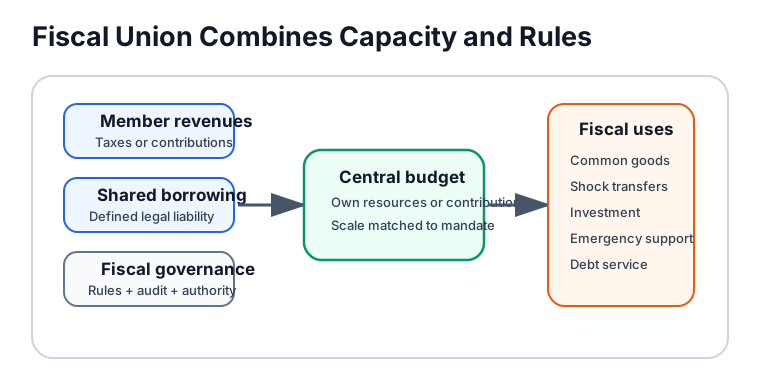
Core Elements of a Fiscal Union
| Element | Function | Design question |
|---|---|---|
| Central budget | Finances common goods and programs | How large and which responsibilities? |
| Own-source revenue | Gives the center recurring funding | Which tax base and who sets rates? |
| Transfers | Redistributes revenue or responds to shocks | Formula-based, discretionary, temporary, or permanent? |
| Shared borrowing | Funds central programs or emergencies | Who is legally liable and what limits apply? |
| Fiscal rules | Constrains deficits, debt, or spending | How are rules measured, enforced, and suspended? |
| Stabilization capacity | Supports members during downturns | Which shocks qualify and how quickly are funds delivered? |
| Oversight | Authorizes budgets and monitors use | Which legislature, audit body, and court have authority? |
No single element is sufficient. A transfer mechanism without reliable revenue may be too small to stabilize a severe shock. Common debt without clear governance can blur responsibility. Strict rules without emergency flexibility can amplify recessions.
Fiscal Union vs. Monetary Union
A monetary union shares a currency or monetary authority. A fiscal union shares meaningful budgetary capacity or governance.
| Feature | Monetary union | Fiscal union |
|---|---|---|
| Main policy | Interest rates, currency, monetary conditions | Taxes, spending, transfers, and public borrowing |
| Central institution | Central bank | Treasury, finance ministry, budget authority, or shared fiscal facility |
| Shock response | Monetary policy for the union as a whole | Targeted transfers, spending, or borrowing |
| Distribution | Indirect through financial and economic channels | Can transfer resources explicitly among members |
The distinction matters when one member experiences a downturn that is not shared by the others. A common central bank may not tailor interest rates to that member alone. Fiscal transfers, local budget buffers, labor mobility, and private financial markets become possible adjustment channels.
Worked Example: Regional Shock Insurance
Assume a union has three member regions. Each contributes 0.5% of annual income to a central stabilization fund during normal years.
Region A later experiences a severe local downturn. Its income falls by $20 billion, while Regions B and C remain stable. Under a pre-agreed formula, the central fund transfers $3 billion temporarily to support unemployment benefits and essential services in Region A.
The simple offset ratio is:
The transfer does not eliminate the recession. It absorbs part of the local income shock and reduces the immediate need for spending cuts or tax increases.
The design still raises questions:
- Was the shock outside Region A’s control?
- Does the formula respond quickly enough?
- Is support temporary or permanent?
- Can the fund borrow if accumulated contributions are insufficient?
- What prevents underfunding or manipulation?
- How are disputes audited and resolved?
Types and Degrees of Fiscal Integration
Coordination only
Members retain their own budgets but agree on reporting standards, deficit limits, or consultation. This is fiscal coordination, not necessarily a full fiscal union.
Limited central capacity
A shared fund finances specified common goods, emergency support, or temporary shock absorption. Revenue may come from member contributions rather than independent central taxes.
Shared borrowing and programs
The center issues debt and finances union-wide investment, defense, unemployment support, disaster response, or other agreed programs. Liability and repayment sources must be explicit.
Federal fiscal system
A central government has substantial taxing, spending, transfer, and borrowing authority while regional governments retain defined responsibilities. Equalization and grant systems may address differences in revenue capacity or service costs.
These categories overlap. Real systems evolve through treaties, constitutions, legislation, crises, and political bargaining.
Potential Benefits
Shock absorption
Transfers or central spending can support a region hit by a severe downturn without forcing immediate procyclical cuts.
Common public goods
Joint financing can support infrastructure, defense, research, border systems, environmental protection, or other services with cross-border benefits.
Risk pooling
Members can share some disaster, unemployment, banking-resolution, or refinancing risk. Pooling works best when shocks are not perfectly correlated and rules are credible.
Financing capacity
A central issuer with reliable revenue and strong governance may access capital markets differently from individual members. The outcome is not guaranteed and depends on legal structure and credit quality.
Policy coordination
Common definitions, budget calendars, audits, and fiscal rules can reduce spillovers and improve transparency.
Risks and Tradeoffs
Moral hazard
If members expect unconditional support, they may have weaker incentives to build buffers, enforce taxes, or control spending. Rules can mitigate but not eliminate this problem.
Permanent transfers
A temporary insurance mechanism can become persistent redistribution if economic differences do not converge or formulas are poorly designed.
Democratic legitimacy
Central taxation and spending require accountable decision-making. A system that transfers fiscal power without transparent representation can lose political support.
One-size-fits-all rules
Uniform deficit or debt limits can affect members differently. Measurement errors and economic cycles can make rigid rules procyclical.
Joint-liability ambiguity
Markets need to know whether debt is backed by the center, members jointly, members severally, a dedicated revenue stream, or only project assets.
Common shocks
Risk pooling is harder when all members are hit simultaneously. A central fund may need borrowing authority or outside support.
How to Evaluate a Proposed Fiscal Union
Document:
- Scope: Which taxes, programs, debts, guarantees, and emergencies are shared?
- Revenue: Does the center have own-source revenue or depend on member contributions?
- Liability: Who must repay shared borrowing?
- Transfer rule: Is support formula-based, conditional, temporary, and auditable?
- Scale: Is the budget large enough for its stated purpose?
- Governance: Which bodies authorize, execute, audit, and adjudicate?
- Incentives: How are fiscal discipline and local responsibility preserved?
- Exit and default: What happens if a member refuses obligations or leaves?
- Distribution: Which members are expected net contributors or recipients under different scenarios?
Common Mistakes
Calling every grant system a fiscal union. Limited intergovernmental transfers may exist without broad shared fiscal authority.
Assuming a monetary union already has sufficient fiscal risk sharing. Monetary and fiscal institutions perform different functions.
Promising automatic borrowing-cost reductions. Shared debt can lower, raise, or redistribute financing costs depending on design and credibility.
Ignoring political authority. Fiscal capacity requires legitimate control over revenue and expenditure.
Treating temporary insurance as permanent equalization. The objectives, triggers, and duration should be distinguished.
Official Source Checks
- ECB: Towards a Consistent, Coherent and Complete Economic and Monetary Union distinguishes limited shock-absorption capacity from broader versions of fiscal union.
- ECB: Fiscal Rules in the Euro Area and Lessons from Other Monetary Unions discusses fiscal rules, spillovers, buffers, and central risk sharing.
- ECB: A Fiscal Capacity for the Euro Area compares stabilization capacity with features of existing fiscal-federal systems.
These sources focus on Europe and monetary unions. Fiscal arrangements elsewhere depend on their constitutions, statutes, revenue systems, and political institutions.
Related Terms
- Fiscal Federalism: The allocation of tax and spending responsibilities across levels of government.
- Monetary Union: A shared currency or monetary authority that may exist without central fiscal capacity.
- Local Government Finance: Revenue, spending, borrowing, and transfers at subnational level.
- Formula Grant: Funding allocated through a stated rule rather than discretionary negotiation.
- Matching Funds: Transfers that require a recipient contribution.
- Stabilization Fund: A reserve designed to smooth revenue or economic shocks.
- Sovereign Debt: Government obligations whose treatment becomes important when borrowing or liability is shared.
FAQs
Is the European Union a full fiscal union?
Is fiscal union the same as fiscal federalism?
Does fiscal union require permanent transfers?
This article is educational and does not provide fiscal, legal, sovereign-credit, or investment advice. Institutional conclusions depend on the specific governing framework.