Foreign Exchange Intervention
Foreign exchange intervention is an official FX transaction intended to affect currency-market conditions, an exchange-rate policy, or financial stability.
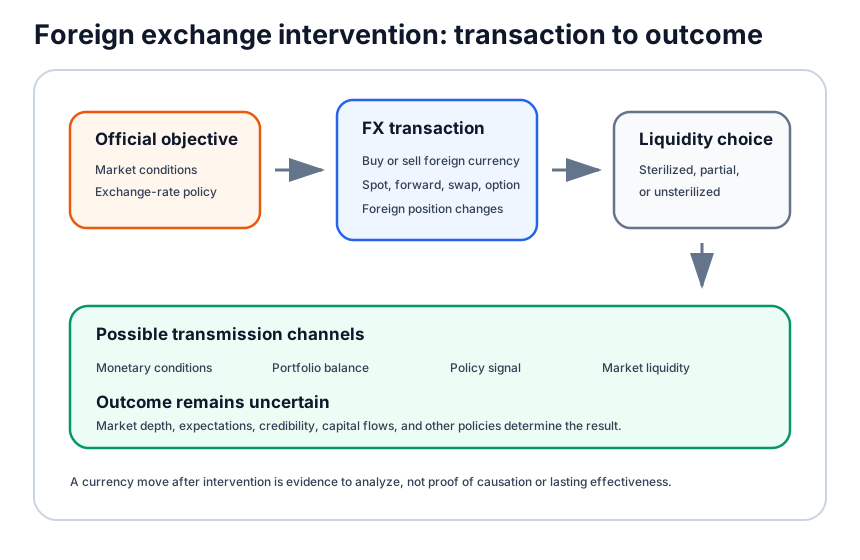
Foreign exchange intervention (FXI) is a purchase or sale of foreign currency by a central bank or government with the potential to affect foreign exchange market conditions. The transaction may target disorderly trading, support an exchange-rate arrangement, build or use reserves, or address a policy concern, but it does not guarantee a particular currency outcome.
Key Takeaways
- FX intervention is an official transaction, not merely a speech or forecast about a currency.
- Buying foreign currency generally increases official foreign assets; selling foreign currency generally reduces them.
- The domestic-liquidity effect depends on settlement and whether the central bank sterilizes the transaction.
- Intervention can use spot trades, forwards, swaps, or other instruments, so reported reserves may not show the full position immediately.
- Analysts should separate transaction evidence, valuation effects, policy signals, and the currency movement that followed.
What Counts as FX Intervention?
The IMF’s Integrated Policy Framework note defines FX intervention around transactions between the central bank or government and the private sector that can affect FX market conditions.
Common instruments include:
- spot purchases or sales of foreign currency
- deliverable FX forwards and swaps
- non-deliverable forwards
- options and other FX derivatives
- agency transactions timed or structured to influence the market
Official communication can also move exchange rates, but it is better described as verbal intervention or policy communication unless an FX transaction occurs. Likewise, routine government currency conversion is not automatically policy intervention. Purpose, timing, counterparty, and market effect matter.
Buying vs. Selling Foreign Currency
| Official action | Immediate FX transaction | Typical reserve effect | Directional pressure, all else equal |
|---|---|---|---|
| Buy foreign currency | Authority supplies domestic currency and receives foreign currency | Foreign assets rise | Domestic currency may weaken |
| Sell foreign currency | Authority supplies foreign currency and receives domestic currency | Foreign assets fall | Domestic currency may strengthen |
The last column is not a forecast. Private capital flows, expectations, market depth, interest rates, and confidence can dominate the transaction.
Sterilized and Unsterilized Intervention
An FX trade can change both the central bank’s foreign assets and domestic reserve balances.
- Unsterilized intervention: The domestic reserve-money effect is not fully offset. An FX purchase normally adds bank reserves, while an FX sale normally drains them.
- Sterilized intervention: A separate operation is used to offset or accommodate the reserve-money effect so short-term monetary conditions remain aligned with the central bank’s operating target.
- Partially sterilized intervention: Only part of the reserve-balance effect is offset.
See Sterilization and Unsterilized Foreign Exchange Intervention for the balance-sheet mechanics.
Sterilization does not make the FX transaction economically invisible. It can still change the currency composition of assets held by the private sector, affect risk premiums, or signal future policy.
Why Authorities Intervene
Possible objectives include:
- maintaining a peg, band, or other exchange-rate commitment
- addressing disorderly or illiquid market conditions
- accumulating International Reserves
- supplying foreign-currency liquidity during market stress
- leaning against rapid appreciation or depreciation
- reducing financial-stability risks from currency mismatches
- supporting price-stability objectives where exchange-rate pass-through is material
An objective should be verified from the authority’s mandate, announcement, operating framework, and transaction record. The same FX purchase can be reserve accumulation, exchange-rate management, a government agency conversion, or routine portfolio activity depending on context.
Intervention at the Margin vs. Intramarginal Intervention
In a formal exchange-rate band, the location of an official trade relative to the boundary can affect its purpose, procedures, and financing.
| Term | Where intervention occurs | Typical policy context |
|---|---|---|
| Intervention at the margin | At an officially agreed upper or lower intervention rate | Supporting the boundary of a formal band under its operating agreement |
| Intramarginal intervention | Inside the permitted band, before the boundary is reached | Smoothing pressure, reinforcing policy signals, or supporting the credible operation of the arrangement |
Intramarginal intervention is not a separate asset or monetary-policy instrument. It is an FX intervention classified by where the exchange rate is inside the band when the trade occurs. The transaction may still be unilateral or coordinated, sterilized or unsterilized, and executed in spot or another eligible instrument.
Under ERM II procedures, the ECB and a participating non-euro-area national central bank may agree on coordinated intramarginal intervention. Unilateral intramarginal trades can also be subject to notification, prior-agreement, amount, and financing procedures. Those rules are specific to the governing arrangement and should not be generalized to every exchange-rate band.
The distinction does not prove why authorities traded or whether intervention succeeded. Analysts still need the execution record, official statement, applicable band, and evidence of domestic-liquidity offsets.
Worked Example
Assume a central bank buys 2 billion units of foreign currency from domestic banks because market liquidity has deteriorated.
- The central bank receives foreign-currency assets.
- It credits domestic banks’ reserve accounts with the domestic-currency equivalent.
- Gross foreign assets and bank reserves rise at settlement.
- The central bank then sells domestic bills that absorb the added reserve balances.
The first transaction is FX intervention. The bill sale sterilizes its initial domestic-liquidity effect. To evaluate the operation, an analyst would check:
- the execution date and exchange rate
- whether
2 billionis gross or net of other FX transactions - the maturity and settlement date of any forward or swap
- the change in reserve assets after valuation adjustments
- the amount and timing of the domestic bill sale
- money-market rates and liquidity before and after settlement
- the authority’s stated purpose
A later currency move does not prove the intervention caused it. Other news and order flow may have arrived at the same time.
Spot, Forward, and Derivative Intervention
Spot Intervention
A spot transaction settles promptly and usually appears more directly in reserve assets and domestic liquidity. Even then, reporting frequency and valuation can obscure the amount.
Forward or Swap Intervention
A forward commits the authority to exchange currencies later. An FX swap combines near- and far-leg currency exchanges. These instruments can affect expectations and forward pricing while changing reserves on a different schedule from a spot trade.
Non-Deliverable Intervention
A non-deliverable forward is settled in cash rather than through delivery of the reference currency. It can influence market conditions without the same immediate gross-reserve movement as a deliverable sale.
The instrument matters because reserve data alone may miss off-balance-sheet commitments or future foreign-currency drains.
How Intervention Can Affect Markets
Monetary Channel
If the transaction is unsterilized, it changes reserve money and may alter short-term monetary conditions. The effect depends on the central bank’s operating framework.
Portfolio-Balance Channel
Sterilized intervention changes the relative supply of domestic- and foreign-currency assets held outside the central bank. It may affect risk premiums when those assets are not perfect substitutes.
Signaling Channel
The trade may reveal information about the authority’s policy preferences, future monetary stance, or tolerance for exchange-rate movement.
Market-Liquidity Channel
An official participant can temporarily provide foreign currency, absorb one-sided order flow, or restore trading when private liquidity is impaired.
None of these channels guarantees persistence. Effectiveness can differ by market depth, capital mobility, credibility, coordination, instrument, and consistency with other policies.
Evidence to Review
Use several sources rather than one reserve number:
- official transaction or intervention disclosure
- central-bank and government balance sheets
- reserve-assets and foreign-currency-liquidity data
- spot, forward, swap, and options market data
- bank reserve balances and money-market rates
- domestic liquidity operations around settlement
- policy statements and exchange-rate regime documentation
- valuation reconciliation for reserve changes
If intervention is not disclosed, any estimate should be labeled as an inference. A decline in reserves can reflect intervention, debt payment, valuation, collateral movement, or another transaction.
Risks and Limitations
- Limited effectiveness: The market can be much larger than the official transaction.
- Reserve loss: Repeated FX sales can reduce readily available external liquidity.
- Monetary conflict: Unsterilized action can move domestic liquidity away from another policy objective.
- Balance-sheet exposure: Reserve accumulation can add currency, duration, credit, and sterilization-cost risks.
- One-way expectations: A visible defense can invite further pressure if markets doubt its sustainability.
- Data opacity: Delayed disclosure and derivatives can make the position difficult to measure.
- Policy confusion: Frequent intervention can blur the monetary-policy signal or exchange-rate regime.
- Distributional effects: Currency changes affect importers, exporters, borrowers, and households differently.
Common Mistakes
- Calling every official currency conversion an intervention.
- Treating verbal intervention as identical to an executed FX transaction.
- Assuming reserve changes equal intervention amounts.
- Ignoring forwards, swaps, options, and settlement dates.
- Treating sterilized intervention as guaranteed to leave all interest rates unchanged.
- Concluding that the intervention succeeded because the currency moved in the intended direction.
- Inferring a permanent exchange-rate target from a single operation.
Related Terms
- Sterilization: Operations that offset or accommodate the domestic-liquidity effect of an FX transaction.
- Unsterilized Foreign Exchange Intervention: Intervention whose reserve-money effect is not fully offset.
- Foreign Exchange Reserve: Convertible foreign-currency assets within official reserves.
- Managed Floating Exchange Rate: A market-determined rate subject to discretionary official influence.
- Exchange Equalization Account: An official account used for reserve and exchange operations.
- Exchange Rate Mechanism: European framework in which intervention rates and intramarginal procedures have formal meanings.
FAQs
Does foreign exchange intervention always change official reserves?
Can a central bank intervene under a floating exchange rate?
Does intervention guarantee a stronger or weaker currency?
This article is educational and does not provide currency-trading, hedging, investment, or policy advice. Verify current central-bank disclosures and market rules for the jurisdiction being analyzed.