Pareto Efficiency
Pareto efficiency describes a feasible allocation where no person can be made better off without making at least one other person worse off.
Pareto efficiency, also called Pareto optimality, describes a feasible allocation in which no person can be made better off without making at least one other person worse off. It is an efficiency test, not a test of fairness, equality, total wealth, or whether the allocation is desirable.
An allocation can be Pareto efficient even when one person controls nearly all resources. It can also be Pareto inefficient even when it appears equal, because an unused resource, avoidable waste, or mutually beneficial exchange may allow at least one person to gain without anyone losing.
Key Takeaways
- A Pareto improvement makes at least one party better off and makes no party worse off.
- A Pareto-efficient allocation has no remaining feasible Pareto improvement.
- “Better off” must be defined using preferences or a stated welfare measure, not assumed from income alone.
- Pareto efficiency does not rank two allocations when each helps some parties and harms others.
- An efficient outcome can be highly unequal, risky, unlawful, or inconsistent with other social objectives.
- Competitive markets produce Pareto-efficient outcomes only under restrictive model assumptions.
- A positive net present value or positive aggregate net benefit does not by itself prove a Pareto improvement.
- Potential compensation is different from actual compensation: winners being able to compensate losers does not mean losers were made whole.
- Finance applications include contract renegotiation, risk sharing, capital allocation, market design, and policy appraisal.
- Analysts should identify all affected parties, feasible alternatives, external effects, uncertainty, and distribution before using the label.
Pareto Improvement and Pareto Efficiency
Let x be the current allocation and y be a feasible alternative. Let U_i(x) represent the welfare or utility of person i under allocation x.
Alternative y is a Pareto improvement over x when:
and at least one person is strictly better off:
Allocation x is Pareto efficient when no feasible alternative y satisfies both conditions.
This definition requires three choices that are often hidden:
- Who counts: investors, employees, customers, creditors, taxpayers, nearby communities, future users, or another defined group.
- What is feasible: available resources, technology, contracts, law, information, implementation capacity, and time.
- What “better off” means: each person’s preference ranking, a model of utility, or another explicitly justified measure.
Changing any of these can change the conclusion.
The Pareto Frontier
The Pareto frontier is the set of feasible allocations that are Pareto efficient. An allocation inside the frontier is inefficient if another feasible allocation can move at least one party to a preferred position without reducing another party’s welfare. On the frontier, improving one party requires a trade-off with at least one other party.
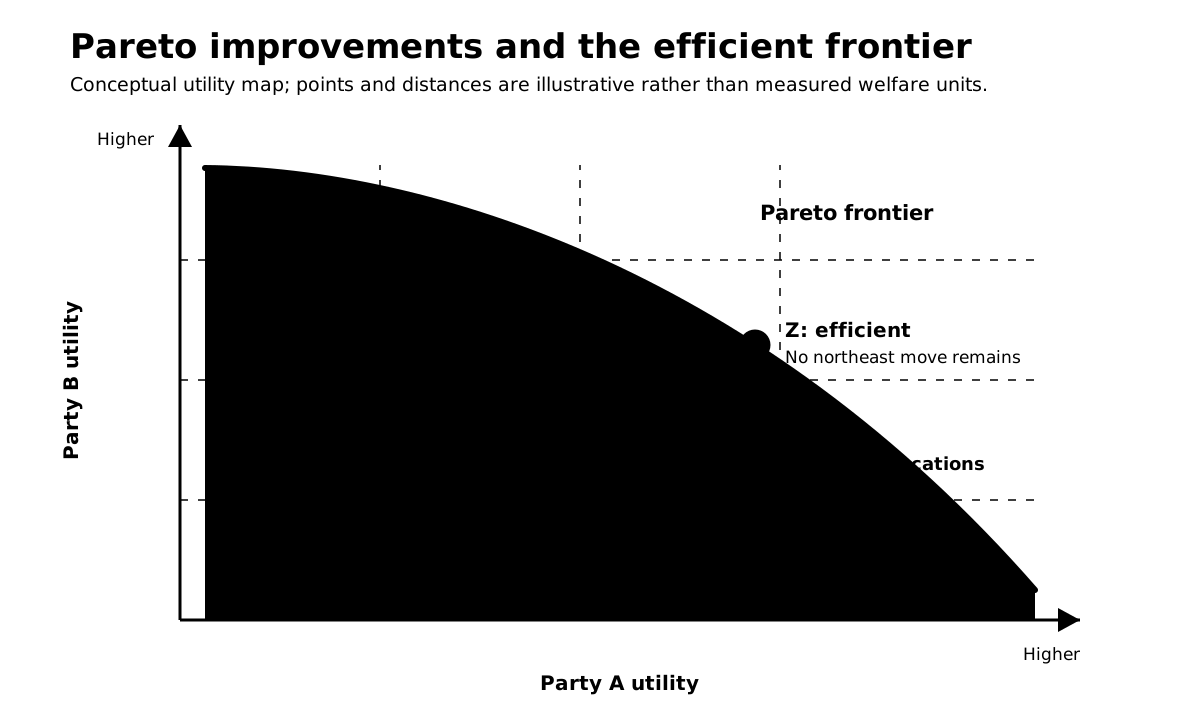
The diagram is conceptual. Utility is not directly observable in many settings, and utility levels generally cannot be compared across people without additional assumptions. The frontier also depends on technology, resources, institutions, information, and which effects are included.
Worked Example: Removing Avoidable Waste
Assume two business units share a processing system. Management evaluates four feasible configurations using annual operating benefits to each unit, measured against the same baseline. The values are hypothetical and exclude effects on other parties for the moment.
| Configuration | Unit A benefit | Unit B benefit | Comparison with current configuration |
|---|---|---|---|
| Current configuration | $400,000 | $400,000 | Baseline |
| Maintenance fix | $450,000 | $400,000 | Pareto improvement: A gains, B is unchanged |
| Workflow redesign | $500,000 | $460,000 | Pareto improvement: both gain |
| Capacity transfer to A | $620,000 | $350,000 | Not a Pareto improvement: A gains, B loses |
The maintenance fix is a Pareto improvement over the current configuration because Unit A gains $50,000 and Unit B is no worse off. The workflow redesign is also a Pareto improvement because both units gain.
The capacity transfer cannot be called a Pareto improvement over the current configuration. Its combined measured benefit is higher:
compared with $800,000 under the current configuration, but Unit B loses $50,000. The higher total may support a separate cost-benefit or value-creation argument, but it does not satisfy the Pareto test unless Unit B is actually made at least as well off and no other affected party loses.
Even the workflow redesign is not proven Pareto improving until the boundary is complete. If it requires unpaid overtime, increases customer errors, raises cybersecurity exposure, or shifts costs to a supplier, the apparent improvement may come at someone else’s expense.
Example: Positive NPV Is Not Enough
Suppose a proposed facility has a projected Net Present Value of $10 million to its owner. The project is also expected to impose an uncompensated present-value cost of $2 million on an affected group.
From the owner’s perspective, the project may be financially attractive. From the defined two-party perspective, moving from no project to the project is not a Pareto improvement because the affected group is worse off.
If the owner could pay compensation of more than $2 million while retaining some of the $10 million gain, the project may satisfy a potential compensation test. But “could compensate” is not the same as “did compensate.” An actual Pareto improvement requires the affected party to be no worse off after compensation and requires all other relevant effects to be included.
This distinction matters in Cost-Benefit Analysis, regulatory analysis, infrastructure appraisal, restructuring, and merger analysis. Aggregate net benefit, affordability, distribution, rights, legality, and implementation are separate questions.
Pareto Efficiency vs. Related Decision Tests
| Test or concept | Core question | What it does not establish |
|---|---|---|
| Pareto improvement | Is at least one party better off with no party worse off? | Whether the new allocation is fair or globally best |
| Pareto efficiency | Is any feasible Pareto improvement still available? | Equality, rights, total welfare, or a unique preferred outcome |
| Pareto frontier | Which feasible allocations have no unambiguous improvement remaining? | Which frontier point society should choose |
| Potential compensation test | Could winners hypothetically compensate losers and remain better off? | That compensation occurs or that the change is fair |
| Cost-benefit analysis | Do measured incremental benefits exceed measured incremental costs from a stated perspective? | That every affected party gains |
| Net present value | Does a project’s discounted financial value exceed its required investment for the stated owner? | Social efficiency or absence of third-party harm |
| Fairness or equity review | How are benefits, costs, resources, or opportunities distributed? | Technical efficiency by itself |
| Portfolio efficient frontier | Which portfolios offer the highest expected return for a level of modeled risk, or lowest modeled risk for a return? | Pareto efficiency across all affected people |
The portfolio efficient frontier and Pareto frontier are related mathematical ideas but are not synonyms. Portfolio analysis typically compares expected return and a risk measure for one decision-maker. Pareto analysis compares preference or welfare outcomes across multiple parties.
Competitive Markets and the Welfare Theorems
The first fundamental welfare theorem establishes, under specified assumptions, a connection between competitive equilibrium and Pareto efficiency. Those assumptions are doing substantial work. A stylized application may require:
- price-taking behavior rather than market power;
- well-defined and enforceable property rights;
- markets for the relevant goods, dates, locations, and states of the world;
- no material unpriced external effects;
- preferences and production possibilities that meet the model’s technical conditions; and
- prices and contracts that coordinate the relevant exchanges.
When markets are incomplete, information is asymmetric, transaction costs are material, contracts cannot specify all relevant states, or one party has market power, the efficiency conclusion may not hold.
Gerard Debreu’s Nobel Prize lecture describes the welfare-theorem relationship between competitive equilibrium and Pareto optimality while noting that the results depend on conditions. The Nobel Prize’s overview of general equilibrium theory also emphasizes that this body of work clarifies conditions for consistency, equilibrium, stability, and efficiency.
The theorem therefore should not be shortened to “markets are always efficient.” It is a conditional result inside a model and a framework for locating where real markets depart from that model.
Why Pareto Efficiency Matters in Finance
Contract renegotiation
A borrower may value covenant flexibility while a lender values a fee, additional collateral, reporting, or pricing protection. A consensual amendment can be a Pareto improvement if each affected party prefers the revised contract and no third-party rights are impaired. Analysts must still check guarantors, other creditor classes, intercreditor terms, taxes, accounting, and regulatory constraints.
Risk sharing
Risk Sharing can move risk toward parties more willing or able to bear it. Insurance, hedging, diversification, and contingent contracts may create gains, but premiums, basis risk, counterparty risk, moral hazard, capital limits, and information problems constrain the feasible allocation.
Capital allocation
A company can sometimes redeploy idle cash, unused capacity, or duplicated systems so one business line benefits without reducing another’s resources. Once genuine slack is exhausted, further reallocation usually creates winners and losers. Management then needs a broader objective, governance process, and capital-allocation rule rather than the Pareto test alone.
Market and policy design
Trading rules, disclosure, settlement systems, taxes, subsidies, and regulation can affect investors, intermediaries, issuers, employees, consumers, and taxpayers differently. A rule with positive aggregate benefits may still impose concentrated costs. The U.S. Office of Management and Budget’s official circulars page links Circular A-4 on regulatory analysis, which treats net benefits, distributional impacts, equity, uncertainty, and non-quantifiable effects as distinct parts of analysis rather than treating efficiency as the only criterion.
When a Pareto Improvement Is Hard to Find
Pareto improvements are demanding because a single harmed party can cause the test to fail. Common obstacles include:
- Externalities: a transaction benefits buyer and seller but imposes pollution, congestion, financial instability, or another cost on outsiders.
- Market power: a party can restrict output, degrade terms, or extract surplus rather than agree to a mutually preferred exchange.
- Asymmetric information: parties cannot price or contract around hidden quality, action, or risk.
- Incomplete contracts: future states and required actions cannot all be specified or enforced.
- Transaction costs: negotiation, valuation, legal work, taxes, switching, and enforcement consume potential gains.
- Indivisibility: a project, asset, or control right cannot be divided into a mutually acceptable allocation.
- Uncertainty: parties disagree about probabilities or bear different downside risks.
- Liquidity and financing constraints: an otherwise beneficial trade cannot be funded at the required time.
- Rights and legal limits: consent, property, fiduciary, employment, environmental, or regulatory rules can constrain feasible changes.
- Many affected parties: identifying, measuring, and compensating every loser may be impractical.
These frictions connect Pareto analysis to Market Failure, Adverse Selection, and Moral Hazard. Government action can address some frictions but can also introduce administrative costs, information problems, incentive distortions, or distributional effects.
How to Evaluate an Allocation
- Define the decision. State the current allocation, proposed change, objective, and time horizon.
- List affected parties. Include indirect, future, contingent, and off-balance-sheet exposures where material.
- Set the boundary. Specify the organization, market, jurisdiction, or social perspective being assessed.
- Identify feasible alternatives. Include operational fixes, contract changes, sequencing, compensation, and the no-action baseline.
- Measure each party’s outcome. Consider cash flow, risk, timing, control, liquidity, service, rights, and nonfinancial effects.
- Do not infer utility from money alone. Preferences over risk, time, control, and uncertainty may differ.
- Check third-party effects. Look for externalities, guarantees, taxes, congestion, systemic exposure, and environmental or community costs.
- Test uncertainty. A party that gains in the base case may bear a larger loss in a downside state.
- Distinguish actual from potential compensation. Record who pays, who receives, timing, enforceability, and transaction cost.
- Apply other criteria. Review total net benefit, distribution, affordability, legality, rights, resilience, and implementation separately.
    flowchart TD
	    A["Define current and proposed allocations"] --> B["Identify every affected party"]
	    B --> C["Measure benefits, costs, risk, and timing"]
	    C --> D{"Anyone worse off?"}
	    D -->|"No, and someone gains"| E["Pareto improvement"]
	    D -->|"Yes"| F["Not a Pareto improvement"]
	    E --> G{"Another feasible improvement remains?"}
	    G -->|"Yes"| H["Allocation is not yet Pareto efficient"]
	    G -->|"No"| I["Allocation is Pareto efficient within the stated boundary"]
	    F --> J["Use broader value, distribution, rights, and policy tests"]
Fairness, Distribution, and Social Choice
Pareto efficiency deliberately avoids making interpersonal comparisons of welfare. That makes the criterion useful for identifying unambiguous improvements, but weak for choosing among efficient outcomes.
Suppose one allocation gives nearly all resources to one person and another distributes resources more evenly. Both can lie on the Pareto frontier. Moving between them makes at least one person worse off, so Pareto efficiency alone cannot select the preferred allocation.
Distributional analysis asks who receives benefits, who pays costs, how effects differ across income or other relevant groups, and whether impacts persist across generations. The OECD’s Cost-Benefit Analysis and the Environment discusses efficiency and distribution as separate dimensions of appraisal. The Nobel Prize’s 1998 overview of Amartya Sen’s work explains why welfare assessment may need to consider distribution and capabilities rather than relying only on average income or resource holdings.
No single efficiency statistic resolves questions about rights, consent, poverty, equality, access, political legitimacy, or acceptable risk. Those require explicit criteria and accountable judgment.
Common Mistakes and Limitations
- Equating efficient with fair: Pareto efficiency permits highly unequal outcomes.
- Calling every gain an improvement: At least one person must gain and no affected person may lose.
- Ignoring outsiders: A transaction can help its direct parties while harming customers, taxpayers, employees, creditors, or communities.
- Treating potential compensation as actual compensation: A hypothetical ability to pay does not make a loser whole.
- Adding dollar gains and calling the result Pareto efficient: Aggregate monetary value and individual preference rankings answer different questions.
- Assuming full resource use proves efficiency: Resources may be used in a wasteful technology or an inferior allocation.
- Assuming competitive equilibrium is unconditionally efficient: Welfare theorems depend on model assumptions.
- Confusing two frontiers: A mean-variance portfolio frontier is not automatically a Pareto frontier across people.
- Ignoring uncertainty: Expected gains can hide state-specific losses, tail exposure, or unacceptable downside.
- Assuming one efficient outcome is uniquely best: Many Pareto-efficient allocations can exist.
- Using the criterion to avoid distributional analysis: Efficiency does not remove the need to show who gains and loses.
- Treating preferences as directly observable: Analysts often infer them imperfectly from choices made under constraints and limited information.
Authoritative Sources
- Nobel Prize: General Equilibrium Theory and Welfare Theory
- Nobel Prize: Gerard Debreu’s Prize Lecture
- Nobel Prize: Amartya Sen and Welfare Economics
- U.S. Office of Management and Budget: Circulars and Regulatory Analysis Guidance
- OECD: Cost-Benefit Analysis and the Environment
These sources discuss economic models or public appraisal frameworks. A particular financial, corporate, or policy decision may require different legal definitions, valuation methods, affected-party boundaries, and evidence.
Related Terms
- Behavioral Economics: Study of how real decision processes compare with economic benchmarks.
- Opportunity Cost: Value of the best feasible alternative forgone by a choice.
- Market Failure: Conditions under which market allocation does not achieve the relevant efficiency benchmark.
- Cost-Benefit Analysis: Structured comparison of incremental costs and benefits from a stated perspective.
- Net Present Value: Present value of incremental cash inflows less outflows for a stated owner or project.
- Risk Sharing: Allocation of uncertain gains, losses, or cash-flow variability among parties.
- Adverse Selection: Pre-contract information problem that can prevent mutually beneficial exchange.
- Moral Hazard: Incentive problem that arises when protection or contracts change behavior after risk is allocated.
FAQs
What is a Pareto improvement?
Can an unfair allocation be Pareto efficient?
Is a positive-NPV project a Pareto improvement?
What is the difference between the Pareto frontier and the efficient frontier in portfolio theory?
Does Pareto efficiency prove that markets need no regulation?
This article provides general financial and economic education. It does not determine whether a specific allocation, contract, transaction, project, investment, or public policy is efficient, fair, lawful, or suitable and does not provide individualized financial, investment, legal, tax, or policy advice.