Capital Budget
Capital budget is a prioritized plan for long-lived investments, their cash timing, funding, approval, and post-project control.
A capital budget is an organization’s approved or proposed plan for investing in long-lived assets and projects over a stated period. It identifies what management intends to build, buy, replace, or improve; when cash will be required; how projects rank against one another; and which approvals and funding constraints apply.
The capital budget is the output of capital budgeting, the decision process used to evaluate investments. It is not the same as capital expenditure recorded under accounting rules: a project budget can include training, startup losses, working capital, contingencies, and other cash needs that may not qualify as capitalized assets.
Key Takeaways
- A capital budget is a controlled project portfolio, not merely a list of equipment purchases.
- Project authorization and annual cash spending are different: a multi-year project may be approved in full but funded through several annual budgets.
- Maintenance, compliance, and safety projects may have priority even when their benefits are difficult to express as incremental revenue.
- NPV, IRR, payback, and strategic scoring answer different questions; no single metric replaces cash, risk, and execution review.
- Actual commitments, spending, forecast cost at completion, and realized benefits should be monitored after approval.
Capital Budget vs. Related Concepts
| Concept | What it is | Main question |
|---|---|---|
| Capital budget | Prioritized plan of approved or proposed long-lived investments | Which projects will receive capital, when, and under whose authority? |
| Capital budgeting | Process for identifying, evaluating, selecting, and reviewing projects | Does the project create enough benefit for its cost and risk? |
| Capital expenditure budget | Detailed spending and control schedule for long-lived assets | How much project cash will be spent and controlled? |
| Operating budget | Plan for revenue and current operating costs | What operating result is expected during the budget period? |
| Cash budget | Forecast of cash receipts, payments, and liquidity | Can the organization fund its obligations and planned projects? |
These documents interact. A new production line belongs in the capital budget, but its hiring, energy, maintenance, and startup costs also affect the operating budget. Milestone payments and financing affect the cash budget. Depreciation affects future accounting profit after the asset becomes available for use.
What a Capital Budget Contains
A useful budget normally records both project economics and control information.
| Field | Why it matters |
|---|---|
| Project purpose and sponsor | Establishes the operating need and accountability. |
| Total authorized project cost | Shows the full expected commitment, not only this year’s payment. |
| Current-period cash budget | Identifies the amount expected to be paid during the budget year. |
| Prior and future spending | Prevents a multi-year project from appearing cheaper because only one year’s installment is shown. |
| Project category | Separates maintenance, replacement, growth, compliance, safety, and technology needs. |
| Business-case measures | Records NPV, IRR, payback, cost avoidance, service capacity, or other relevant benefits. |
| Risk and contingency | Links uncertain scope, price, schedule, and technical assumptions with a supportable reserve. |
| Funding and constraints | Identifies internal cash, borrowing, grants, leases, covenants, or capital-rationing limits. |
| Approval gate | Shows who can authorize the project and under what conditions. |
| Forecast to complete | Updates expected final cost and completion date as evidence changes. |
A project should not be split into smaller requests merely to avoid an approval threshold. The budget should preserve the full cost, dependencies, and future commitments needed to obtain the intended benefit.
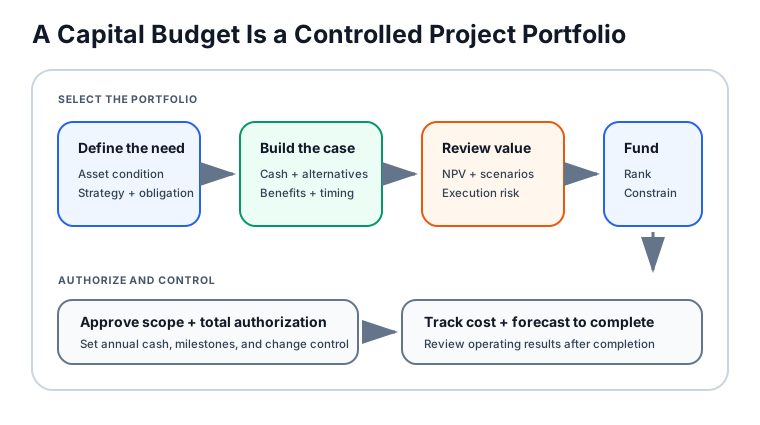
Capital-Budget Workflow
1. Identify the Need
Begin with the business problem, asset condition, service requirement, legal obligation, or growth opportunity. A request framed only as “buy new equipment” makes alternatives difficult to evaluate. The need might instead be to reduce downtime, add 10,000 units of capacity, meet a safety requirement, or replace unsupported software.
2. Develop Alternatives
Compare repair, replacement, lease, outsourcing, process redesign, phased investment, and doing nothing. The cheapest purchase is not necessarily the lowest life-cycle cost, and owning an asset is not always better than contracting for capacity.
3. Estimate Incremental Cash Flows
The project case should include cash flows that change because the project is accepted. A simplified initial cash requirement is:
This is a project-cash formula, not an accounting capitalization formula. Training, startup costs, and working capital may belong in the investment decision even when they are not recorded as part of the asset. Tax treatment is jurisdiction-specific and should be modeled from current applicable rules.
4. Evaluate Economics and Risk
Net present value estimates value after the required return. Internal rate of return summarizes an implied percentage return. Payback emphasizes recovery timing. Scenario and sensitivity analysis test the assumptions that matter most.
Mandatory projects still require analysis. The decision may be which compliant alternative has the lowest life-cycle cost or best risk reduction, not whether to ignore the obligation.
5. Rank the Portfolio
Projects compete for cash, engineering resources, management attention, borrowing capacity, and implementation windows. Rank them using economic value, strategic necessity, safety, compliance, dependencies, and execution risk. A positive NPV does not guarantee immediate funding when resources are constrained.
6. Approve, Monitor, and Review
Approval should establish scope, total authorization, annual cash limit, milestones, contingency access, and change-control authority. After approval, track committed cost, actual spending, schedule, forecast cost to complete, and changes in expected benefits. A post-completion review compares the original case with operating evidence and improves future estimates.
Worked Example: Portfolio Constraint
Assume a company sets a $4.0 million cash capital budget for the coming year:
| Project | Current-year cash | Decision context |
|---|---|---|
| Critical equipment replacement | $1.2 million | Required to sustain current capacity |
| Compliance upgrade | $0.7 million | Required by the operating plan |
| Software automation | $0.9 million | Estimated NPV of $0.25 million |
| Capacity expansion | $2.4 million | Estimated NPV of $0.50 million |
The required replacement and compliance projects consume $1.9 million, leaving $2.1 million. The expansion has the larger NPV but does not fit within the remaining annual cash limit. Management should not simply substitute the smaller project without further work.
Possible responses include:
- test whether the expansion can be staged without increasing total cost or project risk;
- secure additional funding without violating liquidity or covenant limits;
- delay another project whose economic cost of waiting is lower;
- approve the full project subject to a separate multi-year funding authorization; or
- select the software project and preserve remaining capacity for contingencies.
The example distinguishes project value from budget feasibility. It also shows why total project authorization, current-year cash, and future commitments must be visible together.
Approved, Committed, Spent, and Forecast Cost
These amounts are not interchangeable:
- Approved is the authorized ceiling or scope.
- Committed is covered by purchase orders, signed contracts, or other obligations.
- Spent is the amount already paid or recognized under the organization’s tracking policy.
- Forecast cost at completion is the latest estimate of total project cost.
A project can be under its annual cash budget but over its total expected cost if delayed invoices hide a deteriorating forecast. Conversely, spending can run ahead of the monthly schedule while the final cost remains controlled. Both timing and total-cost variances need explanation.
Corporate and Public-Sector Capital Budgets
| Issue | Corporate context | Public-sector context |
|---|---|---|
| Primary objective | Operating value, strategy, resilience, and stakeholder obligations | Public service, policy outcomes, stewardship, and legal authority |
| Funding | Internal cash, debt, equity, leases, or project finance | Appropriations, taxes, debt, grants, or dedicated revenues |
| Decision evidence | Project cash flows, returns, strategy, risk, and capacity | Life-cycle cost, service outcomes, affordability, statutory process, and public accountability |
| Authorization | Board and delegated management limits | Legislative, executive, procurement, and appropriation requirements |
| Review | Financial and operational post-audit | Performance, cost, schedule, compliance, and public reporting |
Government definitions and budget authority vary by jurisdiction. A public capital budget should not be interpreted as though it follows a company’s accounting or approval rules.
Common Failure Modes
- Budgeting only the purchase price while omitting installation, working capital, transition, or shutdown costs.
- Showing one year’s cash outlay without the full multi-year commitment.
- Treating all maintenance spending as discretionary.
- Counting allocated overhead or sunk cost as incremental project cash flow without analysis.
- Using optimistic demand, uptime, or cost-saving assumptions without scenarios.
- Approving a project on IRR while ignoring its NPV, scale, or unusual cash-flow pattern.
- Setting contingency as an unsupported percentage rather than linking it to identified risks.
- Allowing scope changes without reapproval or an updated forecast to complete.
- Measuring project completion by spending rather than operating readiness and realized benefit.
- Confusing budget classification with capital expenditure recognition under financial-reporting rules.
Authority and Further Reading
- White House OMB: Circular A-11 and Capital Programming Guide presents U.S. federal capital programming across planning and budgeting, acquisition, and management-in-use.
- U.S. GAO: Cost Estimating and Assessment Guide describes practices for comprehensive, well-documented, accurate, and credible capital-program cost estimates.
These public-sector sources do not prescribe corporate budgeting. They provide useful control principles for life-cycle planning, alternatives, cost evidence, acquisition, and post-approval management.
Related Terms
- Capital Expenditure Budget: Detailed plan for long-lived asset spending and project control.
- Capital Investment Appraisal: Economic and risk assessment supporting major project decisions.
- Incremental Cash Flow: Cash flow that changes because a project is accepted.
- Initial Investment: Upfront project cash requirement.
- Capital Rationing: Portfolio constraint when acceptable projects exceed available resources.
- Cash Budget: Liquidity plan that tests whether project payments can be funded.
FAQs
Is a capital budget the same as capital expenditure?
Should every positive-NPV project enter the capital budget?
Why review a project after it is completed?
This page provides general financial education, not accounting, tax, legal, procurement, or investment advice. Capital-budget rules and authorization requirements depend on the organization and jurisdiction.