Sterilization
Sterilization uses domestic liquidity operations to offset the reserve-money effect of foreign exchange intervention or other central-bank balance-sheet flows.
Sterilization is the use of domestic liquidity operations to offset the effect that a foreign exchange transaction or another central-bank balance-sheet flow would otherwise have on bank reserves and short-term monetary conditions. In FX intervention, sterilization lets authorities change foreign assets without necessarily accepting the full initial change in reserve money.
Key Takeaways
- An FX purchase normally adds bank reserves; sterilization absorbs some or all of that liquidity.
- An FX sale normally drains bank reserves; sterilization can replace the drained liquidity.
- Full sterilization targets a complete offset, while partial sterilization leaves a net reserve-money change.
- The offset need not be a government-bond sale; central-bank bills, repos, deposits, reserve remuneration, and other tools may be used.
- Stable reserve balances do not prove that every interest rate, risk premium, or exchange-rate effect has been neutralized.
How Sterilization Works
After a Foreign-Currency Purchase
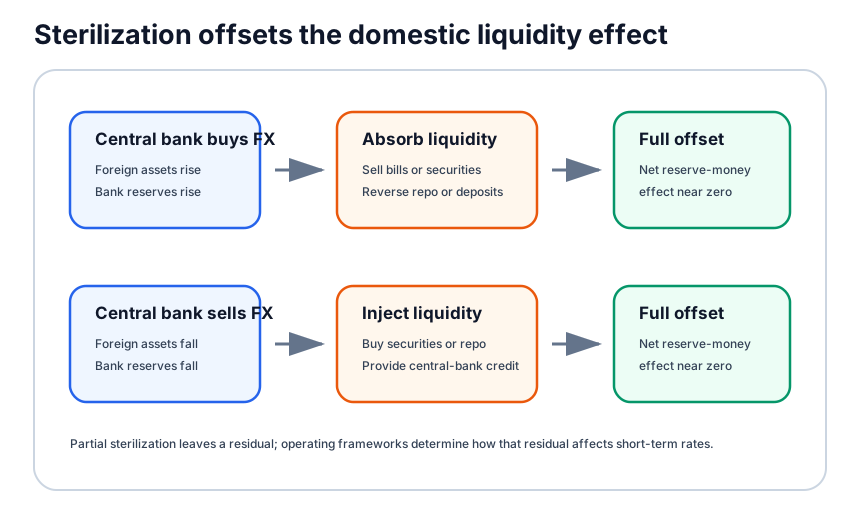
When a central bank buys foreign currency and pays by crediting commercial-bank reserve accounts:
- foreign assets rise
- bank reserve balances rise
- the monetary base rises initially
To sterilize that injection, the central bank can absorb domestic liquidity. A sale of domestic securities or central-bank bills, for example, causes banks to pay with reserve balances.
After a Foreign-Currency Sale
When a central bank sells foreign currency and receives domestic currency:
- foreign assets fall
- bank reserve balances fall
- the monetary base falls initially
To offset that drain, the central bank can inject liquidity through a securities purchase, repo, lending operation, or another tool.
The IMF’s FX intervention policy framework notes that sterilization can offset or remunerate changes in the monetary base so short-term interest rates remain aligned with the operating framework.
Full, Partial, and No Sterilization
| Degree | Domestic liquidity offset | Resulting reserve-money effect |
|---|---|---|
| Full sterilization | Offset equals the initial liquidity effect | Intended net effect is approximately zero |
| Partial sterilization | Offset is smaller than the initial effect | Part of the injection or drain remains |
| No sterilization | No offsetting domestic operation | Full initial reserve-money effect remains |
| Over-sterilization | Offset exceeds the initial effect | Net liquidity moves in the opposite direction |
Actual measurement can be difficult because government balances, currency in circulation, routine open-market operations, and other autonomous factors also change bank reserves.
Worked Example
Assume a central bank buys foreign currency worth 12 billion units of domestic currency.
| Operation | Change in bank reserves |
|---|---|
| FX purchase settles | +12 billion |
| Central-bank bills are sold | -9 billion |
| Net change | +3 billion |
The operation is partially sterilized: 9 billion of the 12 billion injection is absorbed, leaving 3 billion.
If the central bank later absorbs another 3 billion, the cumulative offset becomes full. If unrelated government payments add 4 billion on the same day, the observed reserve balance can still rise even though the FX transaction itself was fully sterilized. Analysts therefore need a complete liquidity bridge, not just end-of-day reserves.
Common Sterilization Tools
| Tool | How it can absorb liquidity | How it can inject liquidity |
|---|---|---|
| Domestic securities | Sell securities | Buy securities |
| Central-bank bills | Issue or increase bills outstanding | Redeem bills without replacing them |
| Repos | Use reverse repos or liquidity-absorbing repos | Use repos or collateralized lending |
| Term deposits | Accept deposits from banks | Allow deposits to mature |
| Government deposits | Shift government cash to the central bank | Spend or transfer balances into commercial banks |
| Reserve remuneration | Preserve a rate floor despite abundant reserves | Adjust terms to influence reserve demand |
| Reserve requirements | Raise requirements to immobilize balances | Lower requirements to release balances |
Tool labels and mechanics vary by jurisdiction. A reserve-requirement change can have broader structural effects than a short-term market operation.
Sterilized vs. Unsterilized FX Intervention
Foreign Exchange Intervention changes the central bank’s foreign position. Sterilization determines how much of the associated domestic-liquidity effect remains.
| Question | Sterilized | Unsterilized |
|---|---|---|
| Are foreign assets changed? | Yes | Yes |
| Is there a domestic offset? | Full or partial | None, or an incomplete offset |
| Does reserve money change from the combined operations? | Intended to be limited or zero under full sterilization | Yes |
| Can the exchange rate still respond? | Possibly, through portfolio, signaling, or liquidity channels | Possibly, including through monetary conditions |
Sterilized intervention is not “no monetary policy.” The offset itself uses monetary instruments and can affect security supply, the yield curve, collateral, or central-bank income.
Operating Framework Matters
Scarce-Reserves or Corridor System
Changes in reserve supply can move the overnight rate unless the central bank offsets them. Sterilization may be necessary to preserve the rate target.
Abundant-Reserves or Floor System
The central bank may pay interest on reserve balances and maintain the policy rate near a deposit-facility floor. Additional reserves may have little immediate effect on the overnight rate, although the balance sheet and other market prices still change.
Reserve-Quantity Target
The authority may focus directly on reserve money or another monetary aggregate. In that framework, the quantity offset is central to the policy stance.
The same FX purchase can therefore require different operational responses across central banks and time periods.
Why Authorities Sterilize
- maintain a short-term interest-rate target while conducting FX operations
- prevent a reserve-accumulation operation from producing unwanted monetary easing
- replace liquidity removed by an FX sale
- separate exchange-market action from the intended domestic policy stance
- manage volatile government or capital-flow effects on bank reserves
- preserve control of an operating target under a peg or managed regime
Sterilization creates flexibility, but it does not remove the underlying foreign-asset exposure or every financial effect of intervention.
Costs and Limitations
- Interest cost: The return paid on sterilization liabilities can exceed the return earned on reserve assets.
- Rollover risk: Short-term bills, deposits, or repos must be renewed or unwound.
- Market-capacity limits: Domestic securities markets may be too shallow to absorb large operations.
- Yield-curve effects: Security issuance or sales can change domestic term premiums and funding costs.
- Collateral effects: Repos and bills can alter the supply of liquid collateral.
- Credit effects: Higher domestic rates or absorbed liquidity can affect bank funding and lending.
- Incomplete offset: Operational delays and autonomous reserve factors can leave a residual.
- Accounting volatility: Currency and interest-rate movements can affect central-bank income and capital.
The IMF’s analysis of sterilization operations emphasizes the central-bank balance sheet and the domestic-liquidity offset.
How to Verify Sterilization
- Measure the FX transaction at settlement, not only announcement.
- Remove valuation effects from the change in foreign assets.
- Trace commercial-bank reserve balances and other monetary-base components.
- Identify domestic securities, bills, repos, deposits, and lending operations.
- Include government balances and currency demand in the liquidity bridge.
- Match the amount and timing of the offset to the FX transaction.
- Check the policy rate and operating-target framework.
- Distinguish a deliberate offset from routine liquidity management.
If the central bank does not disclose intervention or its liquidity bridge, the degree of sterilization may only be estimated.
Common Mistakes
- Defining sterilization as a bond sale only.
- Using broad money instead of bank reserves or the operating target to measure the immediate offset.
- Assuming full sterilization means every market effect is zero.
- Ignoring partial, delayed, or over-sterilization.
- Comparing the face value of two operations without matching settlement dates and valuation.
- Treating a stable policy rate as proof that the central-bank balance sheet did not change.
- Ignoring the interest and rollover cost of sterilization liabilities.
Related Terms
- Foreign Exchange Intervention: Official currency transactions intended to affect FX conditions or policy implementation.
- Unsterilized Foreign Exchange Intervention: An FX operation whose domestic-liquidity effect is not fully offset.
- Open Market Operations: Central-bank purchases and sales used to manage reserves and short-term rates.
- Bank Reserves: Commercial-bank cash and balances held at the central bank.
- Monetary Base: Currency plus qualifying central-bank reserve liabilities.
FAQs
Does sterilization keep the money supply unchanged?
Can sterilization occur without selling government bonds?
Is sterilized intervention costless?
This article is educational and does not provide currency-trading, investment, or policy advice. Operating frameworks and instrument names differ across central banks.