Managed Floating Exchange Rate
A managed floating exchange rate is market-determined but subject to official intervention. Learn how managed and dirty floats work, with risks and examples.
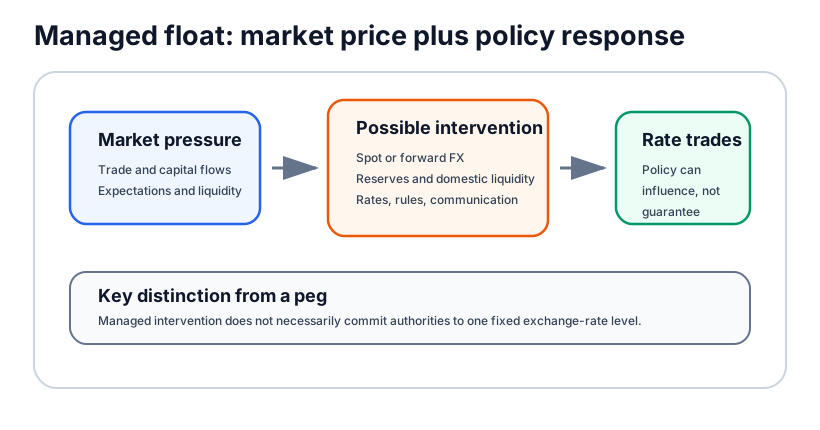
A managed floating exchange rate, also called a managed float or informally a dirty float, is a regime in which market forces move the currency but authorities sometimes intervene to influence the pace, volatility, or broader consequences of that movement. Unlike a fixed peg, the regime does not necessarily commit to one publicly defended exchange-rate level.
Key Takeaways
- Managed float and dirty float usually describe the same broad idea, although “dirty float” is informal and can imply less transparent intervention.
- The exchange rate continues to trade in the market; intervention does not guarantee a target or direction.
- Authorities can intervene directly through FX transactions or indirectly through monetary policy, communication, and market rules.
- Current formal classification systems may use labels such as floating, free floating, or other managed arrangement rather than “dirty float.”
- Intervention can reduce short-term disorder but also consume reserves, create policy conflicts, and obscure the true regime.
How a Managed Float Works
Under a managed float:
- banks, companies, investors, and other participants trade the currency
- market orders move the exchange rate
- authorities monitor the movement and its economic or financial effects
- the central bank may intervene when its policy threshold is reached
- the exchange rate continues to adjust after the intervention
The authority may disclose an objective, such as addressing disorderly conditions, without announcing a fixed parity. In less transparent regimes, market participants may have to infer the intervention rule from reserve changes, official statements, and price behavior.
Why Authorities Intervene
Possible objectives include:
- reducing disorderly or one-sided market conditions
- limiting short-term volatility
- slowing inflation pass-through from depreciation
- addressing foreign-currency funding stress
- accumulating or drawing down reserves
- supporting financial stability
- smoothing adjustment after a large external shock
- influencing competitiveness or the pace of appreciation
These objectives can conflict. Supporting the currency may tighten domestic financial conditions, while resisting appreciation can increase domestic liquidity or inflation pressure.
Intervention Channels
Spot Foreign Exchange Transactions
The central bank buys or sells foreign currency against domestic currency. Selling foreign reserves and buying domestic currency can support the domestic currency, while buying foreign currency can resist appreciation or build reserves.
Forward and Derivative Transactions
Authorities can use forwards, swaps, options, or non-deliverable instruments. These transactions may alter market expectations or future currency exposure without the same immediate reserve movement as a spot trade.
Monetary Policy
Interest-rate changes and domestic liquidity operations can affect the relative return on domestic-currency assets. Monetary policy serves broader objectives, so not every rate move should be labeled exchange-rate intervention.
Communication and Regulation
Official statements, transaction rules, surrender requirements, reserve requirements, capital-flow measures, and market-access changes can influence currency demand and supply.
The BIS paper on foreign exchange intervention and financial stability discusses managed-float intervention, reserve changes, sterilization costs, and financial-stability considerations.
Sterilized vs. Unsterilized Intervention
FX intervention changes the central bank’s balance sheet and can affect domestic liquidity.
- Unsterilized intervention allows that liquidity effect to remain.
- Sterilized intervention uses an offsetting domestic operation intended to neutralize or reduce the liquidity effect.
For example, selling foreign reserves absorbs domestic currency. If the central bank wants to offset that contraction, it may inject domestic liquidity through a separate operation. Sterilization can separate the FX transaction from the immediate monetary-base effect, but it does not make the intervention costless or guarantee success.
Worked Example: Sterilized Support Operation
Assume a currency depreciates rapidly during a period of thin liquidity. The central bank:
- sells part of its foreign reserves for domestic currency
- announces that it is addressing disorderly conditions rather than defending a permanent rate
- injects domestic liquidity separately to offset the monetary contraction
If the currency stabilizes temporarily, that outcome does not prove the authority controls its long-term value. The rate can resume moving as trade flows, capital flows, interest-rate expectations, and risk sentiment change.
For a company with a foreign-currency payment, the correct analysis is not “the central bank will prevent further depreciation.” It is to model the cash-flow effect at several exchange rates and document any hedge.
Managed Float vs. Other Regimes
| Regime | Market role | Intervention or commitment |
|---|---|---|
| Free floating | Rate is market-determined | Intervention is absent or exceptional under the classification |
| Floating | Rate is largely market-determined | Limited intervention can moderate undue fluctuations |
| Managed or dirty float | Market remains important, but intervention is more visible or discretionary | No necessary commitment to one fixed public parity |
| Fixed rate or peg | Market operates around an official anchor | Authorities commit resources and policy to defend a parity or band |
| Other managed arrangement | Residual formal category under some systems | Policy behavior does not fit another defined arrangement |
The boundaries are not universal. The IMF’s revised classification system replaced an older managed-versus-independent-floating distinction with categories including floating and free floating. Its framework also recognizes an “other managed arrangement” residual category.
Accordingly, dirty float is best treated as explanatory market language, not assumed to be the exact label in a current official country classification.
De Jure and De Facto Management
A country may officially declare a float while intervening enough that the observed regime looks managed. Conversely, occasional intervention does not automatically make a regime fixed.
Evidence of de facto management can include:
- repeated reserve changes around particular rate levels
- persistent one-sided central-bank transactions
- narrow exchange-rate movement despite large external shocks
- policy statements tied to a level or corridor
- changes in controls or transaction access
- a widening gap between official and parallel rates
Reserve data require caution. Valuation changes, government transactions, debt flows, and undisclosed derivatives can change reported reserves without representing spot-market intervention.
Why Managed Floats Matter to Businesses and Investors
Managed floating creates two related risks:
- Currency risk: the exchange rate can still move materially.
- Policy-reaction risk: authorities can change the market through transactions, rates, controls, or communication.
Analysts should test:
- transaction exposure from foreign invoices
- translation exposure in financial statements
- economic exposure through pricing and competitors
- foreign-currency debt service
- availability and cost of hedging
- convertibility and repatriation
- effect of reserve depletion or tighter controls
Intervention can change timing and volatility without removing the underlying mismatch.
Potential Benefits and Limitations
Potential Benefits
- authorities retain more exchange-rate flexibility than under a hard peg
- intervention can provide liquidity during disorderly conditions
- reserve transactions can smooth abrupt adjustment
- policymakers can respond to financial-stability or inflation concerns
Limitations and Risks
- Reserve cost: persistent currency sales can reduce reserve buffers.
- Sterilization cost: offsetting domestic operations can create financial or policy costs.
- Moral hazard: market participants may take more currency risk if they expect repeated support.
- Policy conflict: exchange-rate goals can conflict with inflation, growth, or financial stability.
- Opacity: uncertain intervention rules can increase risk premiums and speculative pressure.
- Temporary effect: intervention may not overcome persistent macroeconomic imbalances.
- Control escalation: unsuccessful intervention can be followed by tighter market or capital controls.
No intervention strategy guarantees stability, convertibility, liquidity, or a favorable exchange rate.
How to Evaluate a Managed Float
Before relying on the label:
- Check the official classification and date.
- Compare de jure policy with observed rate behavior.
- Review central-bank statements and transaction disclosures.
- Analyze reserve levels, composition, and valuation effects.
- Distinguish spot, forward, derivative, and indirect intervention.
- Check whether intervention is sterilized.
- Identify capital controls, surrender rules, and convertibility limits.
- Compare official, onshore, offshore, and parallel rates.
- Map the regime to actual cash flows, liabilities, and hedge positions.
The IMF’s exchange-arrangement handbook recommends using AREAER terminology and distinguishing announced arrangements from observed de facto characteristics.
Common Mistakes
- Treating dirty float as a precise legal category: It is usually informal shorthand.
- Assuming managed means fixed: The rate can still move substantially.
- Reading reserve changes as pure intervention: Valuation and government flows can also affect reserves.
- Assuming intervention will succeed: Scale, credibility, fundamentals, and market depth matter.
- Ignoring sterilization: The domestic liquidity effect can change the policy transmission.
- Treating a smooth exchange rate as low risk: Hidden reserve loss, controls, or accumulated imbalances may be growing.
- Using the regime as a trading signal: It does not predict direction or guarantee a policy response.
Related Terms
- Floating Exchange Rate: The broader market-determined regime family.
- Intervention in Foreign Exchange Markets: Direct and indirect official actions intended to influence FX conditions.
- Unsterilized Foreign Exchange Intervention: Intervention whose domestic liquidity effect is not offset.
- International Reserves: External assets available to meet specified public-sector and balance-of-payments needs.
- Capital Controls: Restrictions that can affect currency transactions and cross-border flows.
FAQs
Are managed float and dirty float the same?
Does a managed float have a target exchange rate?
Can sterilized intervention affect the exchange rate?
Why can the official regime differ from the observed regime?
This article is educational and does not provide currency, hedging, investment, legal, or policy advice. Intervention practices and exchange arrangements can change without notice.