Floating Exchange Rate
A floating exchange rate is largely market-determined rather than fixed to a parity. Learn how floating and free-floating regimes differ and why it matters.
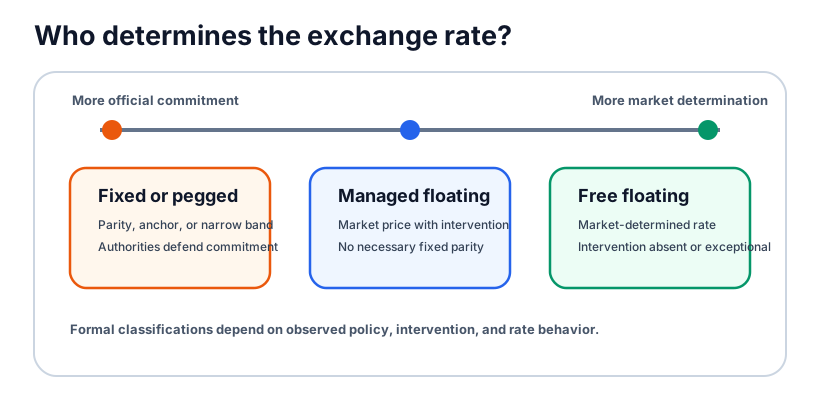
A floating exchange rate is a currency regime in which the price of a currency is largely determined in the foreign exchange market rather than fixed by the authorities at a stated parity. A free float or clean float is the stricter case in which official intervention is absent or exceptional.
Key Takeaways
- Floating describes how an exchange rate is determined, not whether it rises or falls.
- A floating currency can still be influenced by monetary policy, official communication, and occasional foreign exchange intervention.
- Free floating is a narrower classification than floating.
- Market-determined does not guarantee full convertibility, deep liquidity, or one uniform exchange rate.
- Businesses and investors must still measure transaction, translation, and economic currency exposure.
How a Floating Rate Is Determined
Buy and sell orders in the foreign exchange market establish the rate. Those orders reflect:
- trade in goods and services
- cross-border investment and financing
- interest-rate expectations
- inflation and growth expectations
- fiscal and monetary policy
- political and financial risk
- hedging, speculation, and portfolio rebalancing
- central-bank transactions and communication
The market can move continuously as those expectations change. That does not mean every participant receives the same executable rate. Onshore and offshore markets, transaction size, time zone, liquidity, convertibility, and capital controls can create different prices or spreads.
Floating vs. Free Floating
The terms are often used loosely, but formal classifications can be more precise.
| Arrangement | Main rate-setting mechanism | Official role |
|---|---|---|
| Fixed rate or peg | Authorities commit to a parity, narrow band, or anchor | Buy or sell currency and adjust policy to defend the commitment |
| Floating | Rate is largely market-determined without a predictable path | Intervention may occur to moderate disorderly movement, but not to maintain a fixed level |
| Free floating | Rate is market-determined under stricter intervention criteria | Intervention is absent or exceptional under the selected classification |
The IMF’s exchange-rate classification framework distinguishes floating from free floating. Under that framework, floating arrangements can involve intervention intended to moderate undue fluctuations, while policies aimed at a specific exchange-rate level are incompatible with a floating classification.
This means “floating” should not be read as “the central bank never acts.” The evidence must show whether the rate remains mostly market-determined and whether intervention is exceptional, smoothing-oriented, or directed at a level.
Worked Example: Import Payment Under a Floating Rate
Assume a Canadian importer must pay a U.S. supplier $1 million in 60 days.
At an exchange rate of CAD 1.35 per USD, the invoice costs:
If the rate moves to CAD 1.42 per USD, the same invoice costs:
The unhedged Canadian-dollar cost rises by CAD 70,000. The example does not predict where the rate will move. It shows why a floating regime transfers exchange-rate variation into cash-flow planning.
Why Floating Rates Matter
For central banks and governments, a floating rate can provide more room to set monetary policy for domestic conditions than a hard peg. It can also allow external shocks to be absorbed partly through the exchange rate.
For companies and investors, a float makes currency risk visible:
- import costs can rise when the domestic currency depreciates
- export revenue translated into domestic currency can change
- foreign assets and liabilities can produce valuation gains or losses
- debt-service costs can change when borrowing and revenue currencies differ
- expected returns can change after currency conversion
The regime label is only the starting point. A company’s actual exposure depends on invoice currency, timing, pricing power, financing, hedges, and operational offsets.
Potential Benefits and Tradeoffs
Potential Benefits
- Monetary-policy flexibility: Authorities are not required to defend one fixed parity continuously.
- Shock absorption: The exchange rate can adjust when trade, capital flows, or terms of trade change.
- Reduced need for constant parity defense: Reserve use is not mechanically tied to maintaining one announced level.
- Visible market pricing: The quoted rate can incorporate new information quickly.
Tradeoffs and Risks
- Exchange-rate volatility: Importers, exporters, borrowers, and investors face uncertain conversion values.
- Inflation pass-through: Depreciation can raise domestic prices for imported goods and inputs.
- Balance-sheet risk: Foreign-currency debt can become harder to service after depreciation.
- Overshooting and thin-market moves: Prices can move sharply when liquidity is poor or positioning is concentrated.
- Policy uncertainty: Market participants may not know when or how authorities will intervene.
No regime removes economic risk. A peg can shift risk into reserve loss or abrupt devaluation, while a float can produce frequent price movement.
De Jure vs. De Facto Regimes
A country can announce one arrangement but operate another in practice:
- De jure regime: the framework officially declared by the authorities.
- De facto regime: the arrangement inferred from observed rate behavior, intervention, reserves, and policy actions.
A declared float may behave like a narrow band if intervention is persistent. A stated peg may trade at a different offshore or parallel rate if access is restricted. Analysts should therefore verify both the formal rule and actual market behavior.
The IMF’s monetary-policy handbook on exchange-rate arrangements emphasizes this distinction between announced and observed arrangements.
Floating Does Not Mean Fully Convertible
Exchange-rate flexibility and convertibility are separate questions.
A currency can float while:
- access to foreign currency is restricted
- capital transactions require approval
- residents and nonresidents face different rules
- onshore and offshore rates diverge
- settlement or repatriation is delayed
Likewise, a convertible currency can operate under a peg. Do not infer market access from the regime label alone.
How to Evaluate a Floating Regime
Check:
- Official description: What regime do the central bank and government declare?
- Observed behavior: Does the rate move broadly with market conditions or remain inside an apparent corridor?
- Intervention record: Are reserve transactions frequent, exceptional, disclosed, or opaque?
- Policy objective: Is intervention intended to smooth disorderly conditions or defend a level?
- Market structure: Are there official, interbank, offshore, and parallel rates?
- Convertibility: Can relevant users transact and move funds at the quoted rate?
- Reserve position: Does the authority have the capacity and willingness to intervene?
- Exposure: Which cash flows, assets, liabilities, and returns change when the currency moves?
Common Mistakes and Limitations
- Calling every non-pegged currency free-floating: Formal free-float criteria can be stricter.
- Assuming central-bank policy is irrelevant: Interest rates, liquidity, and communication can affect currency demand without a peg.
- Treating depreciation as devaluation: Currency devaluation usually refers to an official reduction under a fixed or managed parity; depreciation is a market price decline.
- Assuming one national rate: Controls and market segmentation can create several relevant rates.
- Using the regime as a forecast: A float does not indicate the direction, timing, or size of future currency movement.
- Ignoring mismatched debt: A borrower can face severe risk even if the exchange-rate regime works as designed.
Related Terms
- Exchange Rate Regime: The broader framework governing currency-price formation.
- Managed Floating Exchange Rate: A market-driven rate with more visible or discretionary official intervention.
- Fixed Exchange Rate: A regime organized around defending a stated parity or narrow band.
- Currency Peg: A link between a currency and an anchor currency, basket, or value.
- Currency Risk: The possibility that exchange-rate changes alter cash flows, values, or returns.
FAQs
Is a floating exchange rate the same as a free float?
Can a central bank intervene under a floating regime?
Does a floating currency always have one market rate?
Is a floating exchange rate safer than a peg?
This article is educational and does not provide currency, hedging, investment, legal, or policy advice. Exchange arrangements and controls can change; verify current official and market sources.