Special Drawing Rights (SDRs)
Special Drawing Rights are IMF-created international reserve assets whose value is based on a basket of five currencies and whose holdings can be exchanged officially.
Special Drawing Rights (SDRs) are international reserve assets created by the International Monetary Fund to supplement the official reserves of participating member countries. An SDR is not a currency and is not ordinary cash; it represents a potential claim on the freely usable currencies of IMF members.
Key Takeaways
- SDR value is based on a basket of five currencies, but an SDR is not itself one of those currencies.
- General allocations are distributed to participating members in proportion to IMF quotas.
- A member’s SDR holdings can differ from its cumulative allocation after exchanges and IMF transactions.
- Members receive interest on SDR holdings and pay charges on cumulative allocations at the same SDR interest rate.
- Individuals and ordinary companies cannot hold official SDRs; holdings are limited to the IMF, participating members, and prescribed official holders.
How SDRs Work
The IMF’s SDR factsheet describes the SDR as a supplementary reserve asset. The IMF can make a general allocation when there is a long-term global need to supplement existing reserve assets, subject to the required institutional approval.
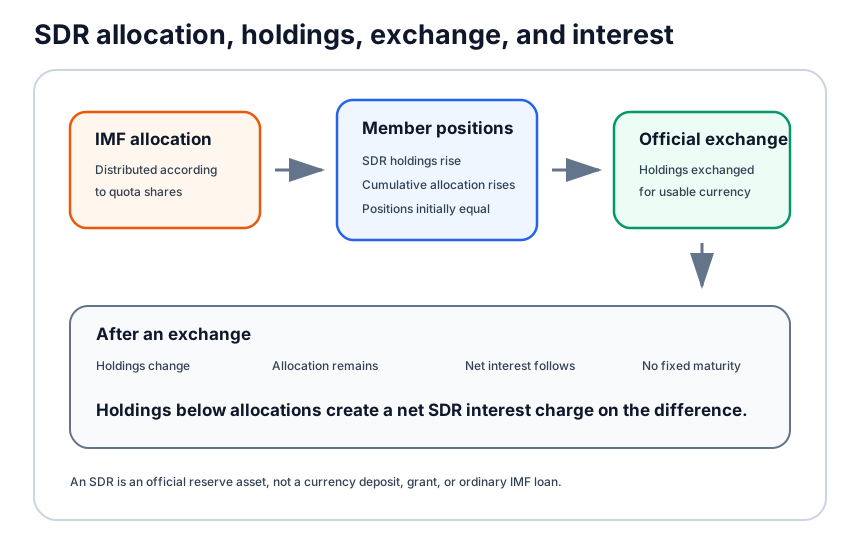
An allocation gives each participating country additional SDR holdings based on its IMF quota share. The country also retains a cumulative allocation position. Those two amounts begin equal but can later diverge.
SDR Holdings
Holdings are the SDR assets currently in a member’s account. They rise when the member:
- receives an allocation
- acquires SDRs from another holder
- receives SDRs in an IMF transaction
- earns SDR interest
Holdings fall when the member:
- exchanges SDRs for a freely usable currency
- transfers SDRs to another holder
- pays IMF charges, assessments, or other eligible obligations
Cumulative SDR Allocations
Cumulative allocations record the SDRs allocated to the member over time. Selling or using SDR holdings does not erase the allocation. This distinction drives the net interest position.
Holdings vs. Allocations
| Position | What it represents | Can it change through an ordinary SDR exchange? |
|---|---|---|
| SDR holdings | Reserve asset currently held | Yes |
| Cumulative SDR allocations | Total allocations received, net of cancellations if any | No |
| Holdings minus allocations | Basis of the member’s net SDR interest receipt or charge | Yes |
If holdings exceed cumulative allocations, the member is a net recipient of SDR interest. If holdings are below cumulative allocations, it pays a net charge on the shortfall. When both positions are equal, interest received and allocation charges broadly offset.
Worked Example
Assume a member receives a general allocation of SDR 1.0 billion.
Immediately after allocation:
| Position | Amount |
|---|---|
| SDR holdings | SDR 1.0 billion |
| Cumulative allocation | SDR 1.0 billion |
| Net position | SDR 0 |
The member later exchanges SDR 300 million for a freely usable currency:
| Position after exchange | Amount |
|---|---|
| SDR holdings | SDR 700 million |
| Cumulative allocation | SDR 1.0 billion |
| Holdings minus allocation | SDR -300 million |
The country now pays a net SDR interest charge on the SDR 300 million shortfall at the applicable SDR interest rate. The exchange supplied usable currency, but it did not cancel the original allocation.
This example omits subsequent interest accruals and other transactions. It shows why an SDR allocation should not be described as cost-free cash.
How an SDR Gets Its Value
The SDR’s value is calculated from fixed currency amounts in a five-currency basket:
- U.S. dollar
- euro
- Chinese renminbi
- Japanese yen
- pound sterling
The IMF publishes the SDR value regularly using market exchange rates. It reviews the basket periodically and can change its composition or currency amounts under its rules.
The basket determines the SDR’s value. It does not mean a holder owns five separate currency deposits. An SDR remains an entry in the IMF’s SDR Department until it is exchanged or used in an eligible transaction.
The SDR Interest Rate
The SDR interest rate is calculated from short-term market interest rates associated with the basket currencies. It is used for:
- interest paid on SDR holdings
- charges on cumulative SDR allocations
- interest rates on certain IMF lending and financial positions
Because the same rate applies to holdings and allocations, a member’s net SDR interest depends mainly on the difference between those positions.
How Members Obtain Freely Usable Currency
A member can exchange SDRs with another participant, commonly through voluntary trading arrangements facilitated by the IMF. The IMF also maintains a designation mechanism under its Articles for circumstances in which voluntary arrangements do not provide sufficient capacity.
The transaction changes the participants’ SDR holdings:
- the seller’s SDR holdings fall and it receives currency
- the buyer’s SDR holdings rise and it supplies currency
- neither member’s cumulative allocation changes merely because of the trade
The relevant currency amount depends on the SDR valuation rate on the transaction date.
What SDRs Are Used For
Eligible official holders can use SDRs to:
- add to International Reserves
- obtain freely usable currency from another official holder
- settle certain obligations to the IMF
- pay selected IMF charges or assessments
- make eligible official transfers or donations
- serve as a unit of account in specified institutions and agreements
An SDR allocation does not direct how a country must use the currency obtained from an exchange. Domestic legal, budgetary, institutional, and accounting rules still determine which authority controls the proceeds and how they may be used.
SDRs vs. Related IMF Positions
| Concept | Main distinction |
|---|---|
| SDR holdings | IMF-created reserve assets held in the SDR Department |
| Cumulative SDR allocations | Allocation position on which SDR charges are assessed |
| Reserve Tranche Position | Liquid claim on the IMF’s General Resources Account arising from quota and IMF currency holdings |
| IMF Quotas | Member subscriptions that influence voting power, allocations, and access |
| IMF credit | Financing provided under an IMF lending arrangement, generally with program terms and charges |
| Reserve currency | National currency held widely in official reserves and international transactions |
SDR holdings and a reserve tranche position are both components of official reserve assets, but they arise in different IMF accounts and change through different transactions.
Why SDRs Matter
For a sovereign-liquidity analyst, SDRs can:
- increase the composition and reported level of official reserves
- provide a channel for obtaining freely usable currency
- change net interest payments when holdings differ from allocations
- affect central-bank and government balance sheets
- support eligible IMF payments and official transactions
The effect on fiscal resources is jurisdiction-specific. An allocation to a central bank does not automatically become budget revenue or spending authority for the government.
How to Evaluate an SDR Position
Check:
- current SDR holdings
- cumulative allocations
- recent SDR transactions
- the applicable SDR interest rate
- the domestic institution that owns and controls the position
- accounting treatment for holdings, allocations, interest, and exchange proceeds
- legal authority over any currency obtained
- whether published reserves already include the holdings
The IMF publishes member SDR allocation and holdings data for source verification.
Risks and Limitations
- Not direct spendable currency: SDRs must be exchanged or used through eligible official channels.
- Interest exposure: A member with holdings below allocations pays a net SDR charge.
- Valuation risk: The value changes with the basket currencies.
- Institutional limits: Domestic law can separate central-bank reserves from government budget resources.
- Access limits: Only participants and prescribed official holders can hold SDRs.
- Data interpretation: Holdings, allocations, and the domestic-currency value are different measures.
- Policy uncertainty: Future allocations require IMF governance decisions and should not be assumed.
Common Mistakes
- Calling the SDR a global currency.
- Treating an allocation as a grant, tax receipt, or ordinary IMF loan.
- Assuming SDR holdings always equal cumulative allocations.
- Saying a country receives five currency deposits when SDRs are allocated.
- Ignoring net SDR interest after holdings are exchanged.
- Adding SDR holdings to total reserves when the published reserve total already includes them.
- Assuming private investors can purchase official SDRs.
Related Terms
- International Monetary Fund: The institution that administers the SDR system.
- IMF Quotas: Member subscriptions used to determine allocation shares and other IMF rights.
- Reserve Tranche Position: A separate liquid reserve claim on the IMF.
- International Reserves: The broader official reserve-asset aggregate that includes SDR holdings.
- Unit of Account: A standard used to measure and report value.
FAQs
Is an SDR a currency?
Does an SDR allocation have to be repaid on a fixed date?
Can individuals or companies hold SDRs?
This article is educational and does not provide investment, legal, accounting, or public-policy advice. Verify current IMF data and domestic legal treatment for country-specific analysis.