Unsterilized Foreign Exchange Intervention
Unsterilized foreign exchange intervention changes central-bank foreign assets and domestic reserve money without a full offsetting liquidity operation.
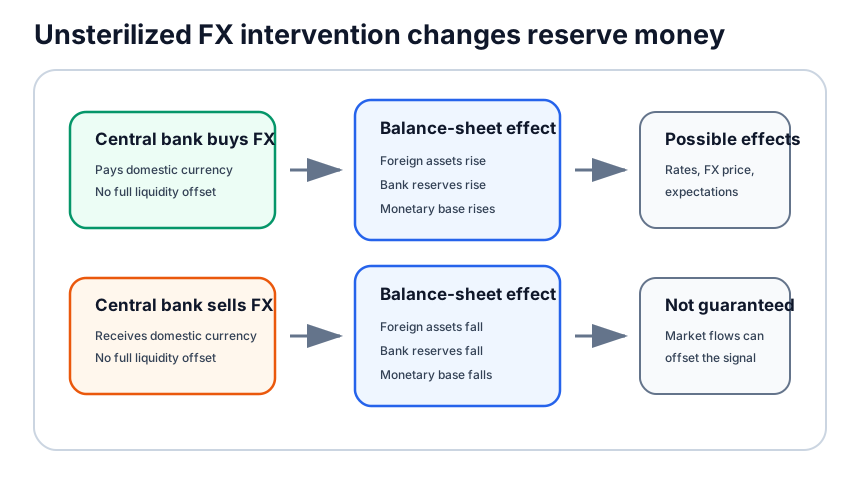
Unsterilized foreign exchange intervention occurs when a central bank buys or sells foreign currency and does not fully offset the resulting change in domestic reserve money or short-term monetary conditions. Buying foreign currency normally adds domestic reserve balances; selling foreign currency normally withdraws them.
Key Takeaways
- The defining feature is the absence of a complete offset to the intervention’s domestic-liquidity effect.
- A foreign-currency purchase increases central-bank foreign assets and usually increases bank reserve balances.
- A foreign-currency sale reduces foreign assets and usually reduces bank reserve balances.
- The initial effect is on the monetary base, not a guaranteed one-for-one change in bank lending, broad money, inflation, or the exchange rate.
- Partial sterilization leaves part of the liquidity effect in place, so the distinction is a continuum rather than always a binary label.
How It Works
Foreign exchange intervention is an asset exchange involving the monetary authority and market participants. The central bank commonly trades foreign currency against its own domestic currency.
Central Bank Buys Foreign Currency
- The central bank acquires a foreign-currency asset.
- It pays by crediting domestic banks’ reserve accounts or otherwise supplying domestic central-bank money.
- Foreign assets rise on the central bank’s asset side.
- Domestic reserve liabilities rise on its liability side.
- If no offsetting operation removes that liquidity, the intervention is unsterilized.
This transaction tends to place downward pressure on the domestic currency, all else equal, because the authority buys foreign currency and supplies domestic currency. The realized exchange-rate effect is not guaranteed.
Central Bank Sells Foreign Currency
- The central bank delivers a foreign-currency asset from its reserves.
- The buyer pays domestic currency.
- Foreign assets decline.
- Domestic reserve balances are debited or absorbed.
- If the liquidity contraction is not offset, the intervention is unsterilized.
This transaction tends to support the domestic currency, all else equal, but its effect can be outweighed by market size, expectations, capital flows, or doubts about policy sustainability.
Worked Example: Central-Bank Balance Sheet
Assume a central bank buys foreign currency worth 10 billion units of domestic currency from commercial banks.
| Central bank balance sheet | Change |
|---|---|
| Foreign reserve assets | +10 billion |
| Commercial-bank reserve balances | +10 billion |
The monetary base initially rises by 10 billion because reserve balances are part of base money. If the central bank takes no offsetting action, the purchase is fully unsterilized.
Now assume it sells 6 billion of domestic securities and receives reserve balances as payment:
| Combined operations | Change |
|---|---|
| FX purchase effect on reserve balances | +10 billion |
| Domestic-security sale effect | -6 billion |
| Remaining reserve-balance increase | +4 billion |
The intervention is partially sterilized. Only 4 billion of the original liquidity injection remains. This simplified example ignores valuation changes, transaction timing, counterparties, and other balance-sheet operations.
Unsterilized vs. Sterilized Intervention
| Feature | Unsterilized intervention | Sterilized intervention |
|---|---|---|
| FX transaction | Central bank buys or sells foreign currency | Same |
| Domestic offset | None, or not enough for a full offset | Separate operation offsets the reserve-money effect |
| Monetary base | Changes initially | Intended to remain broadly unchanged from the FX operation |
| Policy channel | FX transaction and monetary conditions move together | Authorities try to separate the FX action from the domestic-liquidity stance |
| Typical evidence | FX position plus reserve balances, rates, and liquidity operations | FX position plus matching domestic operations or remuneration |
Sterilization can use open-market transactions, central-bank bills, deposits, repos, reserve remuneration, or other liquidity tools. The exact implementation depends on the operating framework.
The IMF’s discussion of sterilized intervention illustrates the distinction through the monetary authority’s balance sheet. Its Integrated Policy Framework note also distinguishes sterilized FX intervention from operations that change short-term monetary conditions.
Why It Matters
Unsterilized intervention combines exchange-rate action with a monetary-policy impulse:
- Reserve balances: The banking system receives or loses central-bank money.
- Short-term rates: Liquidity changes can affect money-market rates, depending on the operating framework.
- Broader financial conditions: Funding costs, credit conditions, and expectations may respond.
- Exchange rate: The transaction changes demand for currencies and may signal a change in policy.
- Official reserves: Purchases add to and sales reduce foreign reserve assets before valuation and other effects.
The channels interact. If the market interprets a one-time operation as a durable change in monetary policy, the expectation effect may matter more than the transaction amount. If the central bank pays interest on abundant reserves and maintains a policy-rate floor, an increase in reserve balances may have a different rate effect than it would in a scarce-reserves system.
Monetary Base Is Not Broad Money
The immediate accounting effect occurs in central-bank money, usually bank reserve balances and therefore the Monetary Base. It does not mechanically create an equal increase in deposits, credit, spending, or inflation.
The wider effect depends on:
- banks’ demand for reserves and willingness to lend
- borrower demand and creditworthiness
- policy-rate implementation
- capital requirements and funding conditions
- public expectations and portfolio choices
- whether later operations absorb the liquidity
Calling every reserve-balance increase “money printing” skips these institutional steps.
When Intervention Is Partially Sterilized
Sterilization can be incomplete because:
- the central bank deliberately wants some monetary easing or tightening
- the offset is smaller than the FX transaction
- offsetting instruments are limited or costly
- the intervention and liquidity operation occur on different dates
- autonomous changes in currency demand or government balances complicate measurement
- interest-rate targets or reserve remuneration absorb part of the effect through another channel
Analysts should measure the net change in relevant central-bank liabilities and domestic operations, not infer sterilization from the FX transaction alone.
How to Evaluate an Intervention
- Identify the transaction: Did the authority buy or sell foreign currency, and against which domestic instrument?
- Measure the reserve effect: How did net foreign assets change after valuation adjustments?
- Trace domestic liabilities: Did commercial-bank reserve balances or another form of base money change?
- Find offsetting operations: Were securities, repos, deposits, central-bank bills, or remuneration used?
- Check timing: Was the offset simultaneous, delayed, partial, or part of routine liquidity management?
- Review the operating framework: Does the central bank target a reserve quantity, a corridor rate, or a floor rate?
- Separate transaction and signal: Did the operation reveal a broader change in policy?
- Test the outcome: What happened to money-market rates, the exchange rate, reserves, and market expectations?
Risks and Limitations
- No guaranteed exchange-rate result: Private capital flows and expectations can overwhelm the operation.
- Inflation or disinflation risk: Persistent monetary expansion or contraction can affect demand and prices, but not mechanically or immediately.
- Interest-rate conflict: The liquidity effect may move short-term rates away from the central bank’s other policy objective.
- Reserve depletion: Repeated foreign-currency sales can reduce external liquidity.
- Balance-sheet risk: Purchases can add duration, credit, and currency exposure.
- Identification problem: Other central-bank and government flows can obscure whether an intervention was sterilized.
- Temporary effect: Market participants may reverse the price move if the policy is viewed as unsustainable.
- Communication risk: An operation can send a different signal from the authority’s stated objective.
Common Mistakes
- Treating any foreign exchange intervention as unsterilized.
- Looking only at reported reserves and ignoring valuation changes.
- Assuming the monetary base and broad Money Supply move one for one.
- Describing a central-bank purchase as successful merely because the currency moved afterward.
- Ignoring partial or delayed sterilization.
- Assuming the same reserve-balance change has the same effect under every central-bank operating system.
Related Terms
- Sterilization: Domestic operations intended to offset the reserve-money effect of an FX transaction.
- Intervention in Foreign Exchange Markets: The broader category of official FX purchases, sales, and related actions.
- International Reserves: External reserve assets available to monetary authorities.
- Bank Reserves: Commercial-bank cash and balances held at the central bank.
- Open Market Operations: Purchases or sales used to adjust reserves and short-term monetary conditions.
FAQs
Does an unsterilized FX purchase increase the money supply?
Can intervention be partly sterilized?
Does selling foreign reserves always strengthen the domestic currency?
This article is educational and does not provide currency-trading, investment, or policy advice. Central-bank operating frameworks and disclosure practices differ by jurisdiction.