Fractional Reserve Banking
Fractional reserve banking lets banks hold part of deposits as reserves while lending the rest, creating credit and deposits.
Fractional reserve banking is a system in which banks keep only a fraction of deposits in reserve and lend out the rest.
That does not mean banks are behaving improperly. It means the banking system is designed to balance:
- liquidity for withdrawals
- credit creation through lending
The Basic Mechanics
If a bank receives new deposits, it may:
- keep part as reserves
- lend part into the economy
The basic reserve relationship is:
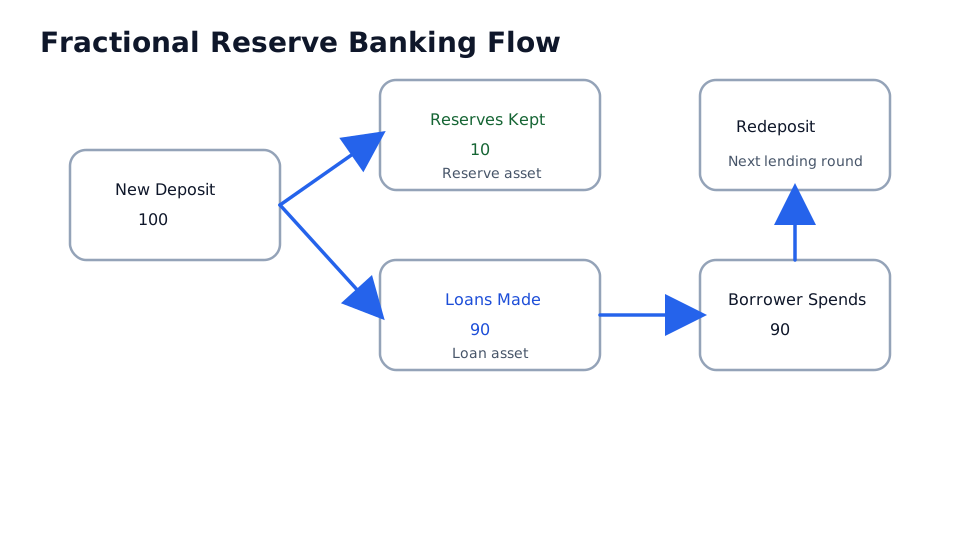
If a bank has $100 of deposits and keeps $10 in reserve, it can potentially lend out the remaining $90, subject to regulation, capital rules, and business judgment.
A Visual Example
An SVG helps here because the core idea is balance-sheet flow: deposit in, reserves held, loans made, and potential redepositing elsewhere in the banking system.
Why This Expands Credit
When loans are spent and the funds are redeposited elsewhere in the banking system, another bank may also keep a fraction and lend the rest.
That is the logic behind the money multiplier concept.
In reality, the process is constrained by:
- reserve rules
- capital requirements
- borrower demand
- bank risk appetite
- central-bank policy
So the simple multiplier is only a teaching model, not a complete description of modern banking.
Why Fractional Reserve Banking Can Be Fragile
The system works as long as not everyone demands cash at once.
If too many depositors try to withdraw simultaneously, a bank can face liquidity stress because much of its balance sheet is tied up in loans or other less liquid assets.
That is one reason bank runs are such an important concept in banking.
Fractional Reserve Banking vs. Full-Reserve Banking
Under full-reserve banking, deposits would be kept fully in reserve and not used for lending in the same way.
Fractional reserve banking instead accepts some liquidity transformation in exchange for a larger supply of credit to households and businesses.
That tradeoff is economically powerful, but it requires regulation, capital, and confidence.
Practical Use
Economists, investors, and policy analysts use Fractional Reserve Banking to connect incentives, prices, output, inflation, trade, credit conditions, or public policy.
Practical Example
A macro or sector note should interpret the term alongside data releases, policy settings, business-cycle conditions, transmission channels, and market pricing.
Decision Check
Ask whether Fractional Reserve Banking changes growth expectations, inflation pressure, exchange rates, interest rates, fiscal capacity, trade flows, or investment behavior.
Watch For
Do not treat an economic concept as a single-variable explanation. Lags, measurement limits, policy reactions, cross-border spillovers, and market expectations can all change the conclusion.
Interpretation Note
Interpret Fractional Reserve Banking as decision evidence, not just a definition. Its weight depends on the transaction, measurement date, jurisdiction, market conditions, and whether Fractional Reserve Banking changes cash flow, risk allocation, reported performance, controls, or investor behavior.
Finance Context
The finance relevance comes from how the concept changes forecasts, discount rates, risk premia, exchange rates, demand, credit conditions, and policy expectations.
Common Confusion
Do not confuse Fractional Reserve Banking with a market forecast by itself. The concept becomes useful only after linking it to timing, policy response, data quality, and investor expectations.
Evidence To Pull
Pull the source dataset, release calendar, revision history, policy statement, market pricing, and forecast bridge. For Fractional Reserve Banking, the useful evidence shows whether rates, inflation, demand, currency, credit conditions, or risk appetite changed a finance assumption.
Decision Impact
For Fractional Reserve Banking, the decision impact is whether a forecast, discount rate, inflation case, currency assumption, demand view, credit outlook, or policy expectation changes. If no finance assumption changes, keep the economic idea outside the base-case model.
What To Verify
Verify Fractional Reserve Banking against the source dataset, release date, revision history, policy channel, market pricing, and forecast bridge. Fractional Reserve Banking matters when it changes rates, inflation, demand, currencies, credit conditions, or risk appetite in the model.
Decision Trace
Trace Fractional Reserve Banking from economic condition to finance assumption: rate path, inflation, demand, currency, credit spread, fiscal capacity, or risk appetite. Fractional Reserve Banking matters when that channel changes a forecast, valuation input, financing cost, stress scenario, or portfolio exposure.
Use Boundary
The use boundary for Fractional Reserve Banking is reached when rates, inflation, demand, currency, credit spreads, fiscal capacity, and risk appetite do not change a finance assumption. In that case, keep the concept as macro context rather than a base-case input.
Decision Marker
The decision marker for Fractional Reserve Banking is the moment an economic concept changes a finance input: rate path, inflation assumption, demand forecast, currency view, credit spread, fiscal risk, or scenario weight. If the model input is unchanged, keep it as context.
Source Check
The source check for Fractional Reserve Banking is the economic input: official data series, central-bank statement, fiscal release, market price, survey, spread, rate path, or scenario assumption. Prefer dated source evidence over narrative when Fractional Reserve Banking affects a finance model.
Decision Evidence
Decision evidence for Fractional Reserve Banking should show the data series, date, source, transmission channel, affected model input, and scenario impact. Fractional Reserve Banking can change finance analysis only when it alters rates, inflation, demand, currency, credit, or risk appetite assumptions.
Review Evidence
Review evidence for Fractional Reserve Banking should make the economics evidence traceable, not just definitional. For Fractional Reserve Banking, tie the evidence to the data series, source agency, vintage, calculation method, and any revision history and explain why that evidence is reliable enough for the finance decision.
Before relying on Fractional Reserve Banking, document the decision context: the jurisdiction, base period, frequency, seasonal adjustment, and release date used. Keep the Fractional Reserve Banking evidence trail visible: cross-checks against related indicators, methodology notes, and limits on comparability across regions or time. In Economics work, Fractional Reserve Banking matters when it changes inflation views, growth assumptions, policy interpretation, currency analysis, or market expectations.
- Source: cite the record, filing, contract, model input, system log, or policy that supports Fractional Reserve Banking.
- Timing: record when Fractional Reserve Banking is measured: date, period, jurisdiction, market condition, or processing window that could change the financial conclusion.
- Boundary: distinguish Fractional Reserve Banking from nearby concepts that require different evidence or support a different finance decision.
- Decision use: identify the approval, valuation input, allocation step, control, disclosure, or risk decision affected if the evidence for Fractional Reserve Banking were different.
The practical risk for Fractional Reserve Banking is that economic terms can be overread when the data vintage, jurisdiction, and measurement method are not explicit. If those facts are unavailable, keep Fractional Reserve Banking in the explanatory layer instead of treating it as decision-grade evidence.
Materiality Check
Fractional Reserve Banking is material when it can change a finance conclusion, not just when Fractional Reserve Banking appears in a document. For Fractional Reserve Banking, test whether the evidence affects growth, inflation, rates, employment, currency values, policy stance, or market expectations. If those decision points are unchanged, keep Fractional Reserve Banking explanatory and avoid overweighting it in the final decision.
A practical materiality check is to name the decision that would change if Fractional Reserve Banking is wrong, stale, missing, or tied to the wrong period. Fractional Reserve Banking warrants deeper review only when a different data vintage, jurisdiction, or method would change the economic conclusion used in finance analysis.
FAQs
Does fractional reserve banking mean banks create money?
Is reserve ratio the only limit on bank lending?
Why is confidence so important in this system?
Related Terms
- Banking: The broader system in which fractional reserve banking operates.
- Reserve Requirement: A rule that influences how much must be held back.
- Bank Run: A stress event tied to confidence and liquidity.
- Money Multiplier: A teaching concept related to redepositing and credit expansion.
- Liquidity: The key constraint that keeps the system stable or unstable.