Earnings Management
Earnings management uses accounting judgments or operating decisions to influence reported results; learn its methods, boundaries, costs, and warning signs.
Earnings management is the deliberate use of accounting judgments, transaction timing, presentation choices, or operating decisions to influence reported profit or another performance measure. The objective may be to meet a forecast, smooth volatility, satisfy a covenant, increase compensation, or shape how investors interpret results.
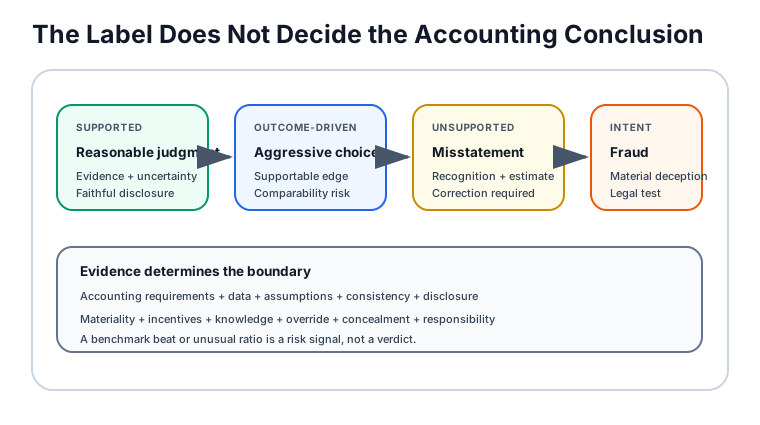
The term does not define one accounting violation. Some choices are supportable within an accounting framework, some reduce transparency without creating a material misstatement, and some cross into error or fraudulent financial reporting. The conclusion depends on the facts, accounting requirements, disclosure, materiality, and evidence of intent.
Key Takeaways
- Accrual-based management changes estimates, recognition, classification, or timing within the reporting process.
- Real-activities management changes business decisions, such as discounting products or delaying maintenance, to affect reported results.
- A permitted accounting choice can still reduce comparability or future performance when it is selected mainly to reach a target.
- Meeting a benchmark is not proof of manipulation; the analyst needs transaction and estimate evidence.
- Small intentional misstatements cannot be excused automatically by a numerical threshold.
- Cash flow, working capital, estimate changes, journal entries, and non-GAAP reconciliations should be reviewed together.
- Earnings management becomes fraud when intentional material misstatement or omission designed to deceive is established under the relevant standards and law.
Accounting Choices vs. Operating Decisions
| Form | How reported results can change | Economic consequence |
|---|---|---|
| Estimate change | Adjusting credit losses, warranty reserves, useful lives, or provisions | Later catch-up expense or loss if assumptions are too optimistic |
| Recognition timing | Accelerating revenue or delaying expense recognition | Reverses in later periods if underlying economics do not improve |
| Classification | Moving costs or gains between subtotals or cash-flow categories | May alter margins or operating cash flow without changing total cash |
| Non-GAAP adjustment | Excluding selected charges or adding alternative measures | Can improve comparability or obscure recurring costs |
| Real operating action | Discounting, overproducing, reducing discretionary spending, or delaying investment | Changes actual sales, inventory, cost, capacity, or future growth |
Accounting choices affect how transactions are measured and presented. Real activities affect the transactions themselves. Both can influence reported earnings, but their evidence and long-term costs differ.
Common Earnings-Management Methods
Revenue timing
Management may accelerate contract signing, offer period-end discounts, modify delivery terms, or pressure distributors to accept inventory. Revenue still must meet the applicable recognition requirements. Undisclosed return rights, side agreements, or premature cut-off can create a misstatement.
Reserves and allowances
Credit-loss, return, warranty, litigation, restructuring, and inventory-obsolescence estimates can shift expense between periods. A supportable estimate may lie within a range, but consistently choosing the most favorable edge can indicate bias.
Capitalization and useful lives
Recording a current cost as an asset delays expense. Extending an asset’s useful life reduces current depreciation. Either treatment requires support from the accounting framework and underlying economics.
Big-bath charges and cookie-jar reserves
A company may record an excessive charge in a weak year, creating lower future expenses or reserves that can later be released. The initial charge and every later release need evidence; calling an amount “conservative” does not make it appropriate.
Real-activities management
Examples include offering deep discounts to accelerate sales, producing more units to spread fixed overhead across inventory, delaying maintenance or advertising, reducing research, or selling an asset to recognize a gain. These actions may be legal business decisions while still sacrificing margin, cash flow, resilience, or future growth.
Worked Example: Understating a Credit-Loss Allowance
Assume a lender has USD 100 million of receivables. Its documented model and current customer evidence support an allowance range of USD 3.2 million to USD 3.8 million. Management records only USD 1.5 million so pretax income reaches a compensation target.
Using the bottom of the supportable range:
| Item | Amount |
|---|---|
| Supportable allowance | USD 3.2 million |
| Recorded allowance | USD 1.5 million |
| Possible understatement | USD 1.7 million |
| Possible pretax-income overstatement | USD 1.7 million |
The entry increases current profit and net receivables by USD 1.7 million relative to that estimate. It does not improve customer credit quality or cash collections. If losses later emerge, a catch-up provision can reduce future earnings.
The reviewer should not infer intent from the number alone. Relevant evidence includes model governance, aging, customer defaults, collateral, subsequent collections, prior estimates, approval records, compensation terms, and communications about the target. The accounting and fraud conclusions depend on materiality and what management knew.
Why Managers May Influence Earnings
- meeting analyst guidance or avoiding a reported loss;
- achieving bonus, vesting, or promotion thresholds;
- maintaining debt covenants or regulatory capital;
- supporting an offering, acquisition, or share-based transaction;
- reducing apparent volatility;
- avoiding scrutiny from boards, lenders, or investors;
- managing tax or distributable-profit outcomes; or
- hiding deterioration long enough to obtain financing or complete a transaction.
An incentive creates risk, not proof. Managers also make legitimate estimates under uncertainty and can change operations for sound commercial reasons.
How Analysts Can Evaluate Earnings Management Risk
Reconcile earnings with cash
Compare net income with operating cash flow over multiple periods. Explain receivables, inventory, payables, contract assets, deferred revenue, provisions, taxes, and factoring rather than treating every divergence as manipulation.
Track estimates through time
Record allowance rates, useful lives, impairments, return reserves, pension assumptions, and tax valuation allowances. Compare each estimate with later outcomes and operating evidence.
Test period-end activity
Review sales, returns, credits, journal entries, acquisitions, disposals, and financing immediately before and after period end. Sharp cut-off patterns can be legitimate but require explanation.
Read policy and segment changes
A consolidated result can hide weakness in one segment. Check recasts, reorganizations, discontinued operations, policy changes, and differences between management metrics and financial-statement definitions.
Reconcile non-GAAP measures
Identify each exclusion and whether comparable gains and losses receive consistent treatment. SEC staff guidance notes that recurring cash operating expenses, inconsistent adjustments, and individually tailored recognition methods can make a non-GAAP measure misleading.
Examine incentives and governance
Understand compensation thresholds, covenant headroom, forecast pressure, override access, audit-committee challenge, whistleblower reports, auditor changes, and control deficiencies.
Earnings Management, Error, and Fraud
| Classification | Intent | Accounting result | Evidence needed |
|---|---|---|---|
| Reasonable judgment | Faithful estimate under uncertainty | Within the applicable framework | Assumptions, data, approval, and disclosure |
| Aggressive but supportable choice | Desired reporting outcome influences selection | May remain within a supportable range | Consistency, transparency, incentives, and alternatives |
| Accounting error | Unintentional | Incorrect recognition, measurement, presentation, or disclosure | Cause, amount, periods, and correction requirements |
| Fraudulent reporting | Intentional deception | Material misstatement or omission | Knowledge, actions, concealment, responsibility, and legal standards |
The boundary is not determined by management’s label. A technically permitted election may produce lower-quality information, while an unsupported estimate can be a material error even without proven fraud.
Costs and Limitations
Earnings management can borrow performance from future periods, weaken cash flow, distort incentives, reduce comparability, increase audit and legal costs, and damage management credibility. Real-activities management can be especially difficult to reverse because it changes customers, employees, suppliers, inventory, and investment.
Detection is also imperfect. Accrual models and benchmark tests can identify unusual patterns but have false positives. A growing company, cyclical business, acquisition, or supply disruption can produce the same ratios as aggressive reporting.
Common Mistakes
Assuming earnings management is always within GAAP. Some conduct uses permitted judgment; other conduct violates accounting or securities requirements.
Calling every estimate change manipulation. New evidence can require a legitimate update.
Treating a penny beat as proof. A benchmark creates an incentive, but transaction-level evidence is still required.
Looking only at accruals. Real operating decisions can change both profit and cash.
Assuming cash earnings cannot be managed. Factoring, payment timing, inventory reductions, and classification choices can alter operating cash-flow presentation.
Ignoring aggregate effects. Individually small adjustments can become material together or because they change a key trend or contractual outcome.
Official Sources
- PCAOB: AS 2401, Consideration of Fraud in a Financial Statement Audit discusses management bias, override, journal entries, estimates, unusual transactions, and fraud risk.
- SEC: Staff Accounting Bulletin No. 99 explains why quantitative thresholds alone do not determine materiality.
- SEC: Non-GAAP Financial Measures interpretations identifies adjustments and presentation practices that can be misleading.
- SEC: The Numbers Game is the SEC chairman’s historical discussion of target-driven accounting and reporting quality.
Related Terms
- Quality of Earnings: Analysis of earnings persistence, cash conversion, estimates, and transparency.
- Financial Statement Fraud: Intentional material misstatement or omission designed to deceive financial-statement users.
- Channel Stuffing: Excessive channel shipments requiring recognition, return, collection, and demand analysis.
- Accrual Accounting: Recognition of economic activity when earned or incurred rather than solely when cash moves.
- Material Misstatement: An error or omission that could reasonably affect user decisions under the relevant framework.
- Restatement: Correction of previously issued financial statements when the applicable requirements call for revision.
FAQs
Is earnings management always fraudulent?
What is real-activities earnings management?
Can cash flow reveal earnings management?
Why does materiality matter?
This article provides general accounting and financial-analysis education, not audit, forensic, legal, tax, compensation, or investment advice. Specific conclusions require complete evidence and the governing standards.