Material Misstatement
A material misstatement is an incorrect or omitted amount, classification, presentation, or disclosure that could affect financial-statement users.
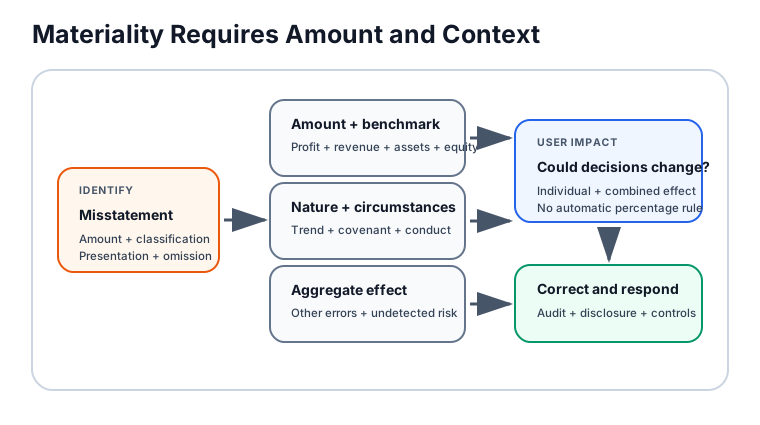
A material misstatement is an incorrect or omitted amount, classification, presentation, or disclosure in financial statements that, individually or together with other misstatements, could reasonably influence users’ decisions. It can result from error or fraud and can be material because of its size, nature, circumstances, or combined effect.
Materiality is entity- and context-specific. There is no universal percentage below which a misstatement is automatically harmless, and a matter can be material even when it does not change total assets or net income.
Key Takeaways
- Misstatements include errors in amounts, classification, presentation, and required disclosures.
- Fraud involves intent; an unintentional error can still be material.
- Auditors consider quantitative and qualitative factors, both individually and in aggregate.
- Planning materiality guides audit scope but does not create permission to record known errors below that amount.
- A small error can be material if it changes a loss to profit, hides a covenant breach, affects compensation, or concerns unlawful conduct.
- Risk of material misstatement is assessed before considering the effect of the auditor’s substantive procedures.
- Identified misstatements should be accumulated, evaluated, communicated, and corrected or reflected in the audit conclusion as required.
What Counts as a Misstatement
| Type | Example | Possible effect |
|---|---|---|
| Recognition | Revenue recorded before required criteria are met | Revenue, receivables, profit, and tax overstated |
| Measurement | Credit-loss allowance based on unsupported assumptions | Assets and profit overstated |
| Classification | Financing cash inflow shown as operating cash flow | Operating cash generation appears stronger |
| Presentation | Material operation not presented separately when required | Trends and continuing performance obscured |
| Disclosure | Related party, guarantee, uncertainty, or policy omitted | Users lack information needed to assess risk |
| Consolidation | Controlled entity excluded from the reporting group | Assets, liabilities, revenue, and exposure incomplete |
A misstatement can arise from inaccurate data, omitted information, an inappropriate accounting policy, incorrect application, unreasonable estimate, mathematical error, or management override.
Materiality Is More Than a Percentage
Quantitative benchmarks can provide a starting point. Depending on the entity and users, an auditor might consider profit before tax, revenue, assets, equity, expenses, or another measure. The selected benchmark and percentage require professional judgment.
Qualitative circumstances can make a smaller amount important. SEC Staff Accounting Bulletin No. 99 identifies considerations such as whether a misstatement:
- masks a change in earnings or another trend;
- changes a loss into income or the reverse;
- affects compliance with a regulatory requirement;
- affects loan covenants or contractual requirements;
- increases management compensation;
- concerns a significant business segment; or
- conceals an unlawful transaction.
These are considerations, not an automatic checklist. The governing accounting, auditing, and securities-law standards control.
Worked Example: Small Revenue Error, Large Profit Effect
Assume a company has annual revenue of USD 40 million and expected pretax income of USD 1 million. It records USD 400,000 of revenue before the customer obtains the contracted service. There is no related current-period cost in this simplified example.
| Measure | Correct | Reported | Effect |
|---|---|---|---|
| Revenue | USD 40.0 million | USD 40.4 million | +1.0% |
| Pretax income | USD 1.0 million | USD 1.4 million | +40.0% |
The error is only 1% of revenue but 40% of pretax income. Suppose USD 1.25 million of pretax income is also the annual bonus threshold. The error changes compensation and may alter the apparent earnings trend.
This does not automatically prove fraud. The auditor evaluates the contract, service delivery, journal entry, cut-off process, amount, incentives, knowledge, other errors, and management’s response. Even if one benchmark appears small, the total context can make the misstatement material.
Individual and Aggregate Misstatements
Audit evaluation does not stop with the largest error. Several smaller misstatements can be material together, especially when they affect the same account, trend, estimate, location, or management objective.
Offsetting errors also require care. An overstated asset and understated liability may leave net assets unchanged while both statement lines and related disclosures are wrong. A current-period overstatement can offset an unrelated prior-period understatement without making either accounting treatment appropriate.
Auditors also consider the possible effect of undetected misstatements, not just items already found. Sampling and other audit procedures provide evidence within a reasonable-assurance model rather than testing every transaction.
Risk of Material Misstatement
Risk of material misstatement (RMM) is the risk that financial statements are materially misstated before the audit. It is assessed at:
- the financial-statement level, where risks can affect many accounts or disclosures; and
- the assertion level, for particular transaction classes, balances, presentations, and disclosures.
RMM reflects inherent risk and control risk. Inherent risk is susceptibility to misstatement before controls; control risk is the risk that controls do not prevent, detect, and correct it on time. Detection risk concerns the auditor’s procedures and is separate from RMM.
Examples of higher inherent risk include complex estimates, unusual transactions, related parties, rapid change, fraud incentives, and significant judgment. Strong, tested controls can affect the planned audit response but do not eliminate inherent uncertainty.
Planning Materiality and Tolerable Misstatement
Auditors establish a materiality level for the financial statements as a whole and may establish lower levels for particular accounts or disclosures. They also determine tolerable misstatement for audit procedures so that the aggregate of undetected and uncorrected misstatements is unlikely to exceed overall materiality.
These amounts can change as the audit progresses. If expected profit falls sharply, a benchmark based on profit may need reassessment, which can require additional work.
Planning amounts are audit tools. They are not safe harbors for management to ignore known accounting errors, and they do not replace qualitative evaluation.
Error vs. Fraud
The primary distinction is intent:
- Error is an unintentional misstatement, such as a processing mistake or mistaken application of a standard.
- Fraudulent financial reporting is an intentional material misstatement or omission designed to deceive users.
- Asset misappropriation can also cause financial statements to be materially misstated when theft is recorded incorrectly or concealed.
An auditor considers fraud risk and evidence but does not make the final legal determination that fraud occurred. A correction or restatement alone does not prove intent.
How Auditors Respond
- Identify the affected account, disclosure, assertion, period, and population.
- Determine how the misstatement occurred and whether it indicates a control deficiency or fraud risk.
- Perform additional procedures to quantify the known and possible effects.
- Accumulate misstatements other than those clearly trivial under the audit approach.
- Communicate identified misstatements to the appropriate level of management and governance.
- Request correction and evaluate management’s reasons if an item remains uncorrected.
- Reassess materiality, risk, sampling, other accounts, and prior periods.
- Evaluate the aggregate effect on the financial statements and auditor’s report.
The response depends on the assertion and evidence. A disclosure omission may require legal or specialist analysis; an inventory error may require expanded count or valuation procedures.
How Analysts Should Evaluate a Possible Misstatement
Read the primary document. Distinguish an allegation, audit finding, company correction, regulatory charge, settlement, and final order.
Bridge old and corrected amounts. Identify every affected period, statement line, subtotal, ratio, and per-share amount.
Trace cash and economics. Some corrections change timing or classification without changing total cash; others reveal fictitious assets, omitted liabilities, or unsupported transactions.
Assess recurrence. Determine whether the issue is isolated, affects a repeated estimate, or appears across products, locations, and periods.
Review controls and governance. Consider management override, audit-committee response, auditor involvement, material weaknesses, remediation, and personnel changes.
Update valuation carefully. Correct the historical base and forecast assumptions, but do not assume every error recurs indefinitely or has no future effect.
Common Mistakes
Applying a fixed 5% rule. Percentages can inform analysis, but qualitative factors and aggregation matter.
Confusing materiality with accuracy. An immaterial error is still an error; materiality determines significance and response, not whether accounting is correct.
Assuming every material misstatement is fraud. Intent requires separate evidence.
Netting unrelated errors. Offsetting effects can still leave line items, disclosures, trends, or periods materially wrong.
Ignoring disclosure omissions. Users can be misled without a numerical overstatement.
Treating planning materiality as permanent. New information can change the benchmark, amount, and audit response.
Official Sources
- PCAOB: AS 2105, Consideration of Materiality addresses materiality in audit planning and performance, including quantitative and qualitative factors.
- SEC: Staff Accounting Bulletin No. 99 explains why exclusive reliance on numerical thresholds is inappropriate.
- PCAOB: AS 2110, Identifying and Assessing Risks of Material Misstatement covers financial-statement- and assertion-level risk assessment.
- PCAOB: AS 2810, Evaluating Audit Results addresses accumulation and evaluation of identified misstatements.
Related Terms
- Materiality: The significance of information or error in the context of user decisions.
- Analytical Procedures: Comparisons of recorded information with independently developed expectations.
- Financial Statement Fraud: Intentional material misstatement or omission designed to deceive users.
- Internal Control: Processes designed to support reliable reporting and timely correction.
- Restatement: Correction of previously issued statements when the applicable requirements call for revision.
- Revenue Recognition: Principles governing when and how customer-contract revenue is recorded.
FAQs
What makes a misstatement material?
Is every material misstatement fraud?
Is there a universal materiality percentage?
Can several small errors become material together?
This article provides general accounting and audit education, not audit, accounting, legal, regulatory, or investment advice. Materiality and correction decisions require the facts and standards applicable to the entity and engagement.