Audit Committee
An audit committee oversees financial reporting, external-auditor independence, internal control, complaints, and related governance matters.
An audit committee is a board committee that oversees an organization’s financial reporting, external audit, internal control, and related complaint or investigation processes. Its role is to challenge, monitor, and escalate; management prepares the financial statements, and the independent auditor performs the audit and expresses the audit opinion.
The committee’s exact authority, membership, and duties depend on corporate law, listing rules, securities regulation, governing documents, and jurisdiction. Requirements for a U.S. exchange-listed issuer are not automatically the requirements for a private company, nonprofit, foreign issuer, or entity in another market.
Key Takeaways
- The audit committee is part of the board, not a substitute for management, internal audit, or the external auditor.
- Independence supports objective oversight, but independence alone does not provide accounting, industry, technology, or regulatory competence.
- For U.S. listed issuers subject to Rule 10A-3, the committee has specified responsibilities for the external auditor, complaints, advisers, and funding.
- Effective oversight requires timely evidence, private access to assurance providers, and follow-up on unresolved matters.
- The committee should understand significant estimates, unusual transactions, non-GAAP measures, control deficiencies, and reporting deadlines.
- Approval of a paper or presentation does not guarantee that financial statements are error-free or that fraud has been prevented.
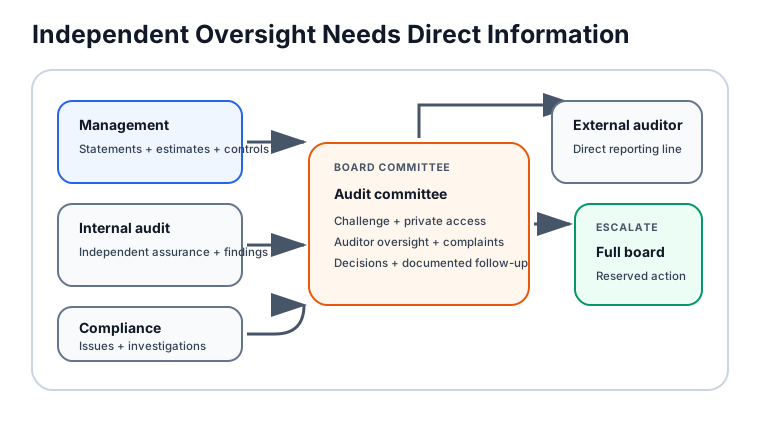
Where the Audit Committee Fits
| Participant | Primary responsibility | What the audit committee should expect |
|---|---|---|
| Board of directors | Overall governance and reserved decisions | Clear committee mandate, appointments, resources, and escalation path |
| Management | Financial statements, records, controls, estimates, and compliance | Complete, timely information and accountable control owners |
| Internal audit | Independent assurance and advisory work under its mandate | Risk-based plan, unrestricted access, findings, and remediation tracking |
| Compliance function | Advice, monitoring, investigation, and regulatory coordination | Material issues, trends, root causes, and status of corrective action |
| External auditor | Independent audit or other engagement under applicable standards | Audit strategy, independence, significant findings, disagreements, and opinion |
| Audit committee | Independent oversight and challenge | Decisions, questions, escalation, and documented follow-up |
The reporting lines should preserve independence. If management can restrict the committee’s access to the external auditor, internal audit leader, compliance officer, or records, the oversight design is weakened.
Core Responsibilities
External-auditor oversight
For covered U.S. listed issuers, Exchange Act Rule 10A-3 makes the audit committee directly responsible for appointment, compensation, retention, and oversight of the registered public accounting firm, including resolution of disagreements between management and the auditor. The auditor reports directly to the committee.
The committee should assess audit quality, independence, staffing, expertise, scope, fees, non-audit services, significant risks, and whether management is constraining the audit. Reappointing the same firm each year is not evidence that this assessment occurred.
Financial reporting
Oversight includes understanding significant accounting policies and estimates, unusual transactions, corrected and uncorrected misstatements, related parties, going concern, segment reporting, tax uncertainty, non-GAAP measures, and material changes from prior periods.
The committee does not recreate every calculation. It asks whether the process, assumptions, controls, evidence, and disclosures are adequate and whether the external auditor has a different view.
Internal control over financial reporting
The committee monitors how management identifies significant accounts and risks, designs controls, evaluates deficiencies, prevents override, and remediates failures. A material weakness can exist even if the current financial statements are not materially misstated.
Complaints and investigations
Rule 10A-3 requires covered listed issuers to establish procedures for receiving, retaining, and treating complaints about accounting, internal accounting controls, or auditing matters, including confidential anonymous employee submissions. The process should protect evidence, manage conflicts, prevent retaliation, and route significant matters independently of implicated personnel.
Internal audit and compliance
Where these functions exist, the committee often approves or reviews mandates, leadership appointments, plans, budgets, access, findings, and remediation. The division of responsibilities with risk or other board committees should be documented to avoid gaps and duplication.
U.S. Listed-Issuer Requirements
Rule 10A-3 establishes minimum audit-committee standards that U.S. exchanges and national securities associations apply through listing rules, subject to specified scope and exemptions. These include:
- member independence under the rule’s criteria;
- direct responsibility for the registered public accounting firm;
- complaint procedures for accounting and auditing matters;
- authority to engage independent counsel and other advisers; and
- appropriate issuer funding for auditors, advisers, and ordinary committee expenses.
Exchange rules can add requirements, including composition, financial literacy, charters, and annual evaluations. Foreign private issuers and other entities can have modified structures or exemptions. Current legal and listing advice is necessary for a particular issuer.
Annual Oversight Cycle
| Stage | Committee focus |
|---|---|
| Audit planning | Scope, materiality, significant risks, locations, specialists, timing, and independence |
| Interim reporting | Estimates, controls, unusual transactions, liquidity, disclosure, and emerging risks |
| Year-end close | Misstatements, judgments, going concern, legal matters, control deficiencies, and draft report |
| Filing or publication | Final statements, disclosures, certifications, audit opinion, and unresolved matters |
| Post-report review | Lessons learned, audit quality, remediation, internal-audit plan, and future priorities |
Urgent issues should not wait for a scheduled quarterly meeting. The chair needs a protocol for convening members, preserving evidence, engaging advisers, and informing the full board.
Worked Example: Revenue Estimate and Auditor Disagreement
Assume management records USD 12 million of variable consideration from customer contracts. The external auditor believes the supportable amount is USD 8 million because return and rebate data indicate a higher expected reversal. The USD 4 million difference could materially affect profit and a debt covenant.
The audit committee should not simply choose the midpoint. It should ask:
- Which contract terms and accounting requirements govern the estimate?
- What historical and current data support each assumption?
- Did management change the method, data source, or override a control?
- How does the difference affect profit, tax, covenants, compensation, and guidance?
- Is the auditor’s disagreement resolved, and what happens to the audit report if it is not?
- Does the issue indicate a control deficiency or require expanded investigation?
The committee might ask management to correct the estimate, obtain specialist analysis, expand testing, revise disclosures, or investigate possible override. Its minutes should capture the issue, evidence considered, challenges raised, advice obtained, decision, and follow-up. The committee’s oversight does not replace management’s accounting judgment or the auditor’s independent conclusion.
Questions That Produce Better Oversight
- What changed since the last meeting, and why?
- Which estimate has the widest reasonable range and greatest profit sensitivity?
- What did management initially propose that the auditor challenged?
- Which control failures recur, and why are remediation dates moving?
- Where does internal audit lack access, skills, data, or budget?
- Which non-audit relationships could affect auditor independence?
- What complaints involve senior management or financial reporting?
- Which assumptions in guidance differ from those used in impairment, liquidity, or going-concern analysis?
- What evidence contradicts the preferred conclusion?
Board materials should arrive early enough for review and distinguish decisions from information items.
Independence, Expertise, and Skepticism
Independence concerns relationships and interests that can impair objective judgment. Expertise concerns the ability to understand the business, reporting framework, estimates, technology, controls, and audit. Skepticism means asking for persuasive evidence and considering contradictory information.
No one member needs to perform every specialist task. The committee can use management, auditors, internal specialists, and independent advisers, but it must understand enough to evaluate their work and conflicts.
Long tenure, social ties, cross-directorships, consulting relationships, and dependence on management for information can weaken challenge even when formal eligibility tests are met. Formal independence is a minimum condition, not a complete effectiveness assessment.
Warning Signs of Weak Oversight
- meetings occur only immediately before filing deadlines;
- the external auditor rarely meets privately with the committee;
- recurring control findings remain open without accountable owners;
- management filters complaints or restricts investigator access;
- complex estimates are approved without sensitivity analysis;
- non-GAAP measures change without clear reconciliation;
- the committee receives large data packs but no decision-focused analysis;
- auditor independence is treated as an annual form rather than an ongoing assessment; or
- minutes record approvals but not challenge, evidence, or follow-up.
These signs require context. A committee’s effectiveness cannot be measured solely by meeting count or report length.
Common Mistakes
Saying the committee ensures accuracy. Management owns reporting, and the auditor owns the audit opinion; oversight cannot guarantee outcomes.
Applying U.S. listed-company rules universally. Entity type, venue, jurisdiction, and exemptions matter.
Confusing independence with competence. Both are needed, along with time, access, and resources.
Treating compliance as one agenda item. Material investigations and regulatory issues require evidence, ownership, and follow-up.
Relying on management summaries alone. Independent sessions and direct access to assurance providers are essential.
Approving remediation without testing it. Closure should require evidence that the redesigned control operates effectively.
Official Sources
- SEC: Standards Relating to Listed Company Audit Committees explains Rule 10A-3 independence, auditor oversight, complaint, adviser, and funding requirements.
- PCAOB: AS 1301, Communications with Audit Committees addresses engagement terms, audit strategy, significant findings, disagreements, difficulties, and timely two-way communication.
- SEC: Role of Audit Committees in Financial Reporting discusses oversight of reporting, internal control, audit quality, and auditor independence.
- SEC: High-Quality Independent Audits and Audit Committee Oversight explains the audit committee’s role in selecting and overseeing an independent auditor.
Related Terms
- Corporate Governance: The structures and processes through which an organization is directed and overseen.
- Internal Control: Processes designed to provide reasonable assurance about specified objectives.
- Compliance: The process of identifying and meeting applicable obligations and internal commitments.
- Financial Statement Audit: An independent reasonable-assurance engagement resulting in an audit opinion.
- Sarbanes-Oxley Act: U.S. legislation containing public-company reporting, audit, control, and governance provisions.
- Material Misstatement: An error or omission that could reasonably affect financial-statement users.
FAQs
Does an audit committee prepare the financial statements?
Must every company have an audit committee?
What does audit committee independence mean?
Can an audit committee prevent all fraud?
This article provides general accounting and corporate-governance education, not legal, audit, listing, compliance, or investment advice. Apply current requirements for the relevant entity and jurisdiction.