Hurdle Rate
Minimum acceptable project return used in capital budgeting to decide whether expected returns compensate for risk and opportunity cost.
The hurdle rate is the minimum acceptable return a project, acquisition, or investment must clear before a firm is willing to commit capital.
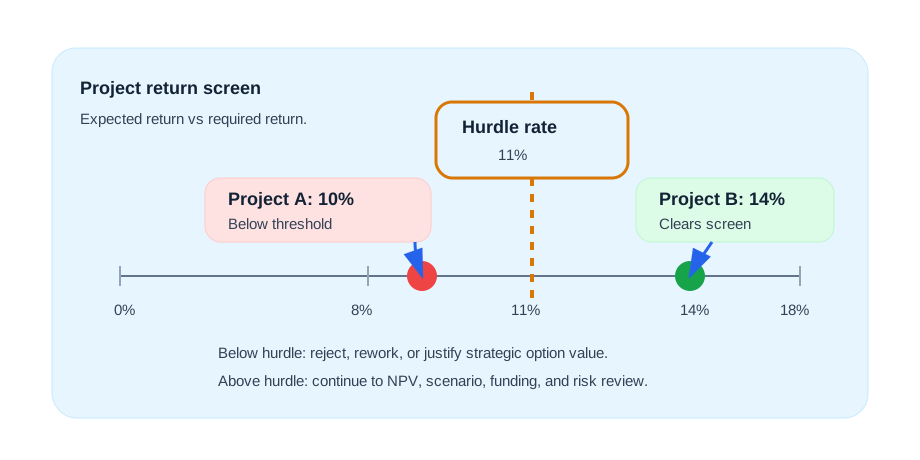
It is a capital-budgeting threshold, not a guarantee of approval. A project that falls below the hurdle rate usually fails the return screen. A project above the hurdle rate still needs a positive Net Present Value, credible forecast, and risk review.
Basic Formula
A practical hurdle-rate build often starts with a base cost of capital and then adjusts for project risk:
For many corporate projects, the base rate begins with Weighted Average Cost of Capital (WACC). Management may then adjust upward or downward for project-specific risk, currency, country exposure, strategic uncertainty, capital scarcity, or business-line differences.
Why Hurdle Rate Matters
Hurdle rates force investment proposals to compete against the company’s opportunity cost of capital. They help management ask whether the project earns enough to justify the cash, balance-sheet capacity, management attention, and risk being committed.
Hurdle-rate discipline is common in:
- capital budgeting and project ranking
- acquisition screening
- expansion and replacement-capex reviews
- private investment underwriting
- real estate, infrastructure, and energy project finance
- board approval packages and capital-allocation policies
The useful question is not “is the return positive?” The useful question is “is the expected return high enough for this specific risk?”
How Firms Set Hurdle Rates
There is no single universal hurdle rate. A company may use one standard policy rate for small ordinary projects and separate risk-adjusted rates for major or unusual investments.
| Input | How It Affects The Hurdle Rate |
|---|---|
| Company WACC | Often the starting point for operating projects that resemble the existing business. |
| Project risk | Riskier cash flows may require a higher threshold than the company average. |
| Country or currency exposure | Cross-border projects may require extra risk premium or currency consistency checks. |
| Capital rationing | If capital is scarce, the company may raise the threshold to prioritize the strongest projects. |
| Strategic or option value | A project may receive further review even if the base-case return is close to the threshold. |
The rate should match the cash flows being tested. Using a low corporate average rate for a speculative project can make weak investments look stronger than they are.
Hurdle Rate vs. Cost of Capital
Hurdle rate and Cost of Capital are closely related, but they are not identical.
| Concept | Main Role | Analyst Check |
|---|---|---|
| Cost of capital | Estimates the return required by capital providers. | Is the rate consistent with the company’s financing mix and risk? |
| Hurdle rate | Sets the approval threshold for a project or investment. | Is the project risk comparable to the rate being used? |
| Discount rate | Converts forecast cash flows into present value. | Does the rate match the cash-flow type, currency, and forecast horizon? |
WACC is often a starting point, but a hurdle rate is a decision rule. It can include management policy, risk adjustments, and capital-allocation constraints.
Worked Example
Suppose a company has a baseline WACC of 9%. A proposed expansion is riskier than the company’s core business because demand is less proven, so management adds a 2% project-risk adjustment.
Now compare two projects:
| Project | Expected Return | Initial Screen |
|---|---|---|
| Warehouse automation | 10% | Below the 11% hurdle; rework or reject unless the strategic case is unusually strong. |
| New service line | 14% | Clears the hurdle; continue to NPV, scenario, execution, and funding review. |
The 14% project is not automatically approved. It clears the return threshold, but the investment committee still needs to test cash-flow timing, downside cases, funding capacity, and whether the forecast is realistic.
Public Source Checks
Useful public sources can support the base-rate and company-context pieces of a hurdle-rate analysis:
- U.S. Treasury Daily Treasury Rates: Treasury yields for U.S. dollar risk-free-rate support.
- Federal Reserve H.15 Selected Interest Rates: Selected market interest-rate series for rate-environment checks.
- FRED 10-Year Treasury Constant Maturity Rate: Downloadable long-rate series often used in valuation support.
- SEC EDGAR Company Search: Company filings for capital spending, segment risk, leverage, liquidity, and management discussion.
Public sources help anchor observable market rates and company context. The project-specific premium still requires analyst judgment, management policy, and sensitivity analysis.
Scenario Question
A company uses its 8% corporate WACC as the hurdle rate for every project. A proposed overseas expansion has unfamiliar regulatory exposure, local-currency cash flows, and demand uncertainty, but the model still uses the same 8% threshold.
Answer: The hurdle rate may be too low for the project risk. The analyst should test a risk-adjusted hurdle rate, explain the currency and country assumptions, and show whether the project still creates value under a higher required return.
Quiz
When Hurdle Rate Misleads
A hurdle rate can mislead when:
- the same rate is applied to projects with very different risk
- management raises the rate to reject a project without explaining the economics
- a strategic project is approved despite weak economics without documenting the option value
- forecast cash flows and the discount rate are adjusted for the same risk, causing double-counting
- nominal cash flows are compared with a real hurdle rate, or vice versa
- the hurdle rate ignores leverage, tax, currency, and claim-priority differences
- the project clears the percentage hurdle but destroys value on an NPV basis
- capital rationing is real but not shown in project-ranking analysis
The hurdle rate should discipline the model, not replace the model.
Review Checklist
Before relying on a hurdle rate, document:
- valuation date, currency, and forecast horizon
- base rate source and whether it starts from WACC, risk-free rate, or another benchmark
- project-specific risk adjustments and why they are not already in the cash flows
- whether the rate is nominal or real, pre-tax or after-tax, project-level or equity-level
- NPV at the hurdle rate and sensitivity at lower and higher rates
- project scale, capital required, and capital-rationing context
- board or investment-committee policy behind the threshold
- whether related metrics such as IRR, MIRR, payback period, and profitability index agree or conflict
Related Terms
- Cost of Capital: The broad financing benchmark from which many hurdle rates begin.
- Weighted Average Cost of Capital (WACC): A common starting point for company-level project thresholds.
- Required Rate of Return: The return investors or managers require for taking risk.
- Risk-Adjusted Discount Rate: A discount rate adjusted for cash-flow risk.
- Net Present Value (NPV): The value created at a chosen required return.
- Internal Rate of Return (IRR): A project-return metric compared with the hurdle rate.
- Investment Appraisal: The broader process of evaluating whether an investment should be approved.