IRR vs. MIRR
Comparison of traditional IRR and MIRR, used to decide when project-return analysis needs explicit financing and reinvestment assumptions.
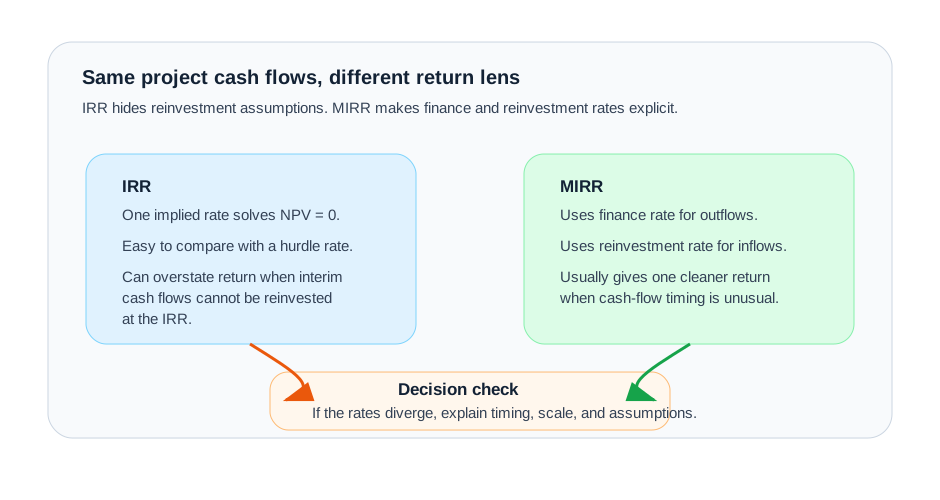
IRR vs. MIRR compares two project-return measures used in capital budgeting. Internal Rate of Return (IRR) asks what discount rate makes project NPV equal zero. Modified Internal Rate of Return (MIRR) asks what return connects financed outflows with reinvested inflows.
The difference matters when ordinary IRR produces an optimistic, ambiguous, or hard-to-defend percentage return. MIRR is often the cleaner companion metric because it forces the analyst to state the finance rate and reinvestment rate explicitly.
Quick Decision Rule
Use IRR as a compact return screen when cash flows are conventional and the project is being compared with a clear Hurdle Rate.
Use MIRR when:
- interim cash flows are material
- the ordinary IRR is unusually high
- the project has nonstandard cash-flow timing
- cash flows change sign more than once
- management wants a realistic reinvestment assumption
- the project is being compared with other investments that use explicit funding costs
Neither metric replaces Net Present Value (NPV). NPV still answers the value-creation question in currency terms.
Core Difference
| Issue | IRR | MIRR |
|---|---|---|
| Main output | One implied return rate. | One modified return rate. |
| Reinvestment assumption | Often interpreted as reinvestment at the IRR. | Uses an explicit reinvestment rate. |
| Negative cash flows | Included directly in the IRR equation. | Discounted using an explicit finance rate. |
| Multiple-rate problem | Possible when signs change more than once. | Usually produces one answer. |
| Best use | Simple return screen for conventional projects. | Better return screen when reinvestment and funding assumptions matter. |
| Weakness | Can overstate return or rank projects poorly. | Still depends on chosen rates and does not measure dollar value directly. |
The practical question is not “which metric is always better?” The better question is “which metric explains this project’s cash-flow pattern without hiding assumptions?”
Formula Comparison
IRR is the rate \(r\) that solves:
MIRR is commonly framed as:
The formulas show the behavioral difference. IRR solves for a single rate inside the cash-flow equation. MIRR first transforms the cash flows using chosen finance and reinvestment rates, then annualizes the bridge.
Worked Example
Suppose a project requires $100,000 upfront and produces $50,000 at the end of each of the next three years.
The ordinary IRR is roughly 23.4%. That is a useful headline return, but it can imply that interim cash flows are reinvested at a high rate.
Now assume:
- finance rate:
6% - reinvestment rate:
8% - positive cash flows compounded to year 3:
$162,320 - present value of negative cash flows:
$100,000
The MIRR is lower because it uses a more realistic reinvestment rate. The project may still be attractive, but the return story is less aggressive.
IRR vs. MIRR vs. NPV
| Decision Question | Best Metric To Start With | Why |
|---|---|---|
| Does the project clear the return threshold? | IRR or MIRR | Both give a percentage return to compare with a hurdle rate. |
| How much value does the project create? | NPV | NPV measures value in dollars, not just a rate. |
| Are interim cash flows important? | MIRR | MIRR makes reinvestment assumptions visible. |
| Are projects mutually exclusive and different in size? | NPV | Percentage returns can favor smaller projects. |
| Are cash flows nonstandard? | MIRR and NPV | IRR may produce multiple or misleading answers. |
For major capital-allocation decisions, the strongest analysis usually shows NPV, IRR, MIRR when relevant, payback or discounted payback, and sensitivity to key assumptions.
Public Source Checks
Useful public sources can support the market-rate and company-context inputs around IRR and MIRR:
- SEC EDGAR Company Search: Company filings for capital expenditure plans, acquisitions, project commitments, segment risk, leverage, liquidity, and management discussion.
- SEC Financial Statement Data Sets: Structured XBRL-derived statement data for cash-flow, debt, tax, and profitability context.
- U.S. Treasury Daily Treasury Rates: Treasury yields for U.S. dollar base-rate support.
- Federal Reserve H.15 Selected Interest Rates: Market interest-rate series that can support finance-rate and reinvestment-rate assumptions.
Public sources do not validate a private project forecast by themselves. The analyst still needs the model workbook, cash-flow timing, tax assumptions, working-capital schedule, exit assumptions, and approval memo.
Scenario Question
A business unit wants to approve a small automation project because it has a 45% IRR. A larger expansion has a 17% IRR but creates much more NPV. The automation project also returns cash early, while the expansion creates larger cash flows later.
Answer: IRR alone is not enough. The analyst should compare NPV, MIRR, project scale, capital rationing, and downside risk. The high-IRR project may be efficient, but the larger project may create more shareholder value.
Quiz
When The Comparison Misleads
The IRR vs. MIRR comparison can mislead when:
- the reinvestment rate is selected only to force a desired result
- the finance rate does not match the project’s funding source or risk
- cash flows are mixed between project-level, equity-level, and financing-level views
- nominal cash flows are compared with real return assumptions
- taxes, fees, working capital, and terminal value are not modeled consistently
- project scale is ignored
- management treats a high return rate as more important than value creation
- the decision is based on one base case without sensitivity analysis
MIRR can make assumptions clearer, but it cannot rescue a weak forecast.
Review Checklist
Before presenting IRR and MIRR side by side, document:
- initial investment, interim cash flows, and terminal cash flows
- whether cash-flow signs change more than once
- finance rate used in MIRR
- reinvestment rate used in MIRR
- project hurdle rate and risk adjustment
- NPV at the required return
- project scale and capital-rationing context
- whether the metric is project-level, equity-level, gross, net, pre-tax, or after-tax
- sensitivity to revenue, margins, capex, taxes, working capital, timing, and exit value
Related Terms
- Internal Rate of Return (IRR): The traditional project-return metric.
- Modified Internal Rate of Return (MIRR): The adjusted return metric with explicit finance and reinvestment rates.
- Net Present Value (NPV): The value-creation metric that should anchor major investment decisions.
- Hurdle Rate: The return threshold used to screen project acceptability.
- Reinvestment Rate: The rate used to compound interim positive cash flows in MIRR.
- Profitability Index: A value-per-dollar metric sometimes used when capital is rationed.
- Payback Period: A cash recovery measure often reviewed alongside return metrics.