Operating Budget
Accrual-based revenue and expense plan used to control operations, test margins, and connect business activity with cash needs.
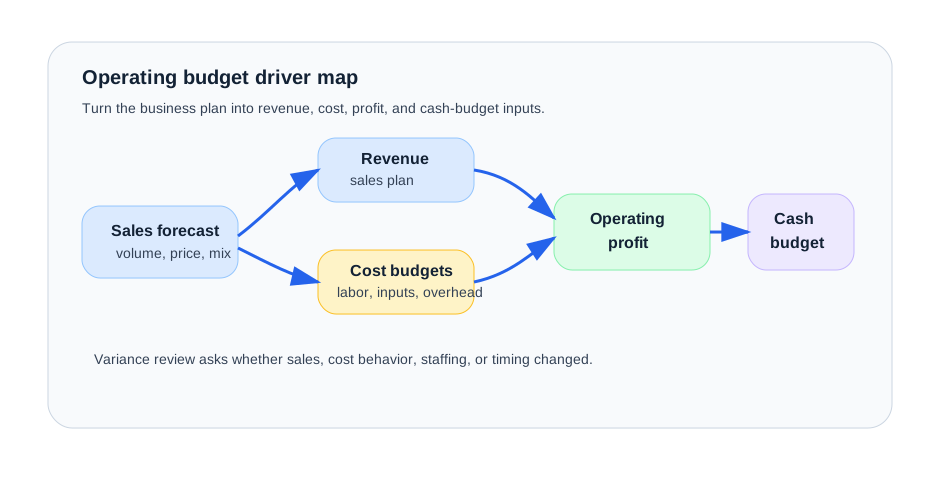
An operating budget is a forecast of revenue, operating costs, and operating profit for a period, usually a month, quarter, or fiscal year. It translates a business plan into expected sales volume, pricing, labor, materials, overhead, selling costs, and administrative expenses.
The operating budget is not just an accounting schedule. It is a management control tool that connects strategy, staffing, production, cost behavior, margin targets, and liquidity planning.
Basic Formulas
Operating budgets often start with revenue:
Then the budget separates fixed and variable cost behavior:
Budgeted operating profit is:
The exact structure depends on the business model. A manufacturer may need production, materials, labor, and overhead budgets. A software company may focus more on subscription revenue, headcount, hosting, sales commissions, and customer support.
Main Components
| Component | What It Forecasts | Finance Question |
|---|---|---|
| Revenue budget | Volume, price, mix, discounts, and churn. | Is the sales plan realistic and tied to demand evidence? |
| Production or service delivery budget | Output, staffing, utilization, and capacity. | Can operations deliver the forecast volume? |
| Materials or direct cost budget | Unit inputs, vendor prices, freight, and scrap. | How sensitive is margin to input costs? |
| Labor budget | Headcount, wages, benefits, overtime, and contractors. | Does staffing match the activity plan? |
| Overhead budget | Rent, utilities, maintenance, software, insurance, and support costs. | Which costs are fixed, semi-fixed, or controllable? |
| Selling and administrative budget | Sales, marketing, finance, legal, HR, and office costs. | Are growth costs and support costs aligned with revenue? |
The budget should be detailed enough to explain performance variances, but not so granular that managers cannot maintain it.
Operating Budget vs. Cash Budget
The operating budget and Cash Budget answer different questions.
| Question | Operating Budget | Cash Budget |
|---|---|---|
| Main focus | Revenue, expense, and operating profit. | Cash receipts, payments, and liquidity. |
| Accounting basis | Usually accrual. | Cash timing. |
| Main users | FP&A, operating managers, CFO, board. | Treasury, CFO, lenders, restructuring advisors. |
| Key risk | Margin miss, cost overrun, or volume shortfall. | Cash gap, borrowing need, or covenant pressure. |
A strong planning process ties the two together. Revenue growth may improve operating profit but still consume cash if receivables, inventory, payroll, or capex rise first.
Worked Example
Suppose a company plans to sell 10,000 units at $50 each.
Variable cost is $28 per unit and fixed operating costs are $120,000.
Budgeted operating profit is:
If unit sales fall to 8,500, revenue drops and fixed costs are spread over fewer units. That is why operating budgets often include sensitivity cases for volume, price, labor, and input costs.
Variance Analysis
The operating budget becomes useful after actual results arrive. Variance analysis compares actual performance with budget and asks why the difference occurred.
| Variance | Typical Driver | Management Response |
|---|---|---|
| Revenue shortfall | Volume, price, mix, churn, sales timing. | Reforecast demand, adjust pricing, or reduce discretionary costs. |
| Gross margin miss | Materials, labor, freight, waste, utilization. | Review sourcing, staffing, productivity, and pricing. |
| Payroll overrun | Overtime, hiring pace, benefits, contractors. | Update headcount plan and approval controls. |
| Overhead overrun | Utilities, repairs, software, insurance, rent. | Separate one-time items from recurring run-rate changes. |
| Cash pressure despite profit | Receivables, inventory, capex, debt service. | Update the cash budget and working-capital plan. |
Good variance analysis separates controllable execution problems from market changes and timing differences.
Public Source Checks
Useful public sources can support benchmark and company-context assumptions:
- SEC EDGAR Company Search: Filings for segment performance, revenue trends, margin discussion, cost risks, liquidity, and management commentary.
- SEC Financial Statement Data Sets: Structured XBRL-derived statement data for revenue, operating income, expenses, assets, debt, and cash-flow context.
- Federal Reserve H.15 Selected Interest Rates: Rate context when borrowing costs affect budgeted interest, working-capital financing, or liquidity planning.
Public data can support benchmark context. The operating budget itself should tie to the sales forecast, staffing plan, procurement assumptions, production plan, overhead commitments, and current management reforecast.
Scenario Question
A company hits its revenue budget, but operating profit is below plan. The variance report shows overtime, freight premiums, and scrap costs above budget because production was rushed to meet demand.
Answer: The revenue budget was not enough. Management should revise the production, labor, and direct-cost budgets, then test whether pricing, staffing, supplier terms, or capacity planning must change to protect margin.
Quiz
When Operating Budgets Mislead
An operating budget can mislead when:
- revenue is budgeted without volume, price, mix, and churn support
- fixed and variable costs are not separated
- headcount timing is inconsistent with the sales plan
- production capacity is assumed rather than tested
- inflation, supplier pricing, or wage pressure is ignored
- non-cash expenses are confused with cash payments
- one annual budget hides monthly or seasonal pressure
- managers treat the original budget as more reliable than the latest forecast
The budget should be a control system, not a static target that survives after the facts change.
Review Checklist
Before relying on an operating budget, document:
- forecast period and planning version
- unit volume, price, mix, churn, and sales timing assumptions
- fixed, variable, and semi-variable cost classifications
- headcount, wage, overtime, and contractor assumptions
- production capacity, supplier, freight, and input-cost assumptions
- overhead commitments and discretionary spending controls
- variance thresholds and reforecast cadence
- reconciliation to cash budget, working-capital forecast, and capital expenditure plan
- sensitivity to volume, price, margin, wage, and supplier-cost changes
Related Terms
- Cash Budget: The liquidity forecast connected to the operating plan.
- Financial Control: The broader control process that uses budgets and variance review.
- Budgeted Revenue: The revenue line that often anchors the operating budget.
- Variable Expense: Costs that move with activity volume.
- Operating Cycle: The operating timing cycle that affects budget-to-cash conversion.
- Income Statement: The statement where operating-budget assumptions are eventually reported as actual results.
- Capital Expenditure Budget: The investment plan that may be coordinated with operating capacity needs.