Accounting Rate of Return
Accounting-profit return measure used as a simple capital-budgeting screen, but weaker than discounted cash-flow metrics for major investments.
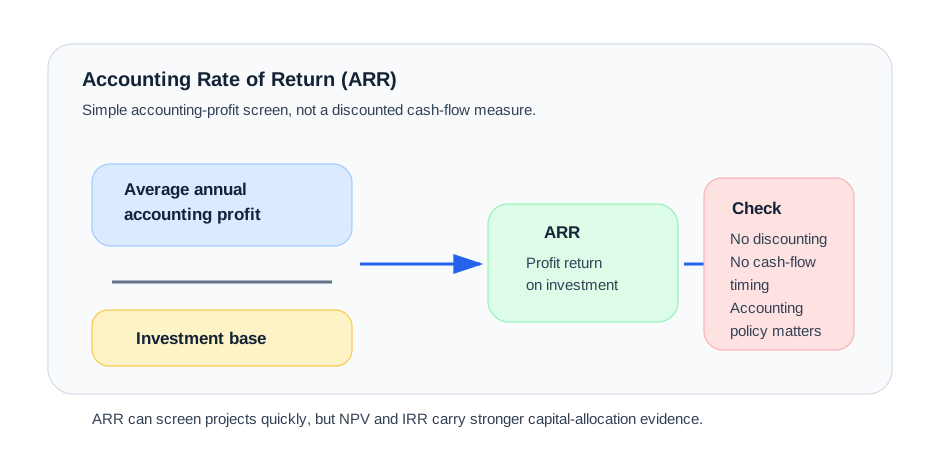
The accounting rate of return (ARR) compares expected accounting profit with the investment required for a project or asset. It is simple, familiar, and easy to explain, but it is not a discounted cash-flow metric.
ARR can be useful as a quick internal screen. It becomes risky when it replaces Net Present Value (NPV), Internal Rate of Return (IRR), and cash-flow scenario analysis for major capital decisions.
Basic Formula
A common version is:
Some companies use average investment instead:
That policy choice matters. ARR is not as standardized as NPV, so the analyst should always state the denominator being used.
What ARR Measures
ARR measures accounting profitability relative to invested capital. It usually starts from accrual accounting profit after depreciation, not cash flow.
| Component | Typical Source | Analyst Check |
|---|---|---|
| Average annual accounting profit | Forecast income statement or management budget. | Does it include depreciation, tax, and allocated overhead consistently? |
| Initial investment | Capital request, fixed-asset budget, or project model. | Does it include installation, working capital, and required startup costs? |
| Average investment | Average book value over the project life. | Is salvage value or residual book value included? |
Because ARR uses accounting profit, it can move when depreciation policy, capitalization policy, or overhead allocation changes even if project cash economics are unchanged.
Worked Example
Suppose a project requires an initial investment of $200,000 and is expected to generate average annual accounting profit of $30,000.
The project has an accounting rate of return of 15% under the initial-investment version.
If the same company uses average investment and the average book value is $120,000, the ARR becomes:
The project did not change. The reported ARR changed because the denominator changed.
ARR vs. NPV and IRR
ARR answers a different question from discounted cash-flow metrics.
| Metric | Main Question | Uses Time Value Of Money? | Main Weakness |
|---|---|---|---|
| ARR | How much accounting profit is earned relative to investment? | No | Can be distorted by accounting policy and timing. |
| NPV | How much value is created at the required return? | Yes | Sensitive to forecast and discount-rate assumptions. |
| IRR | What return rate is implied by the cash flows? | Yes | Can mislead with scale, timing, and reinvestment assumptions. |
| MIRR | What return rate results using explicit finance and reinvestment rates? | Yes | Depends on the chosen rates. |
ARR is easy to compute, but it usually should sit below NPV in the decision hierarchy for long-lived projects.
When ARR Can Still Help
ARR can be useful when:
- managers need a simple profitability screen
- accounting profit targets are part of internal performance measurement
- the project is small enough that full discounted cash-flow modeling is not practical
- ARR is used as a secondary check beside NPV, IRR, MIRR, payback, and risk review
- the organization wants to compare forecast accounting return with reported segment performance
ARR is weakest when cash-flow timing, working capital, tax, salvage value, or project duration is important.
Public Source Checks
Useful public sources can support accounting-profit and investment inputs for public-company comparisons:
- SEC EDGAR Company Search: Filings for income statements, depreciation disclosures, capital expenditures, segment discussion, and management commentary.
- SEC Financial Statement Data Sets: Structured XBRL-derived statement data that can support public-company profit, asset, depreciation, and cash-flow context.
- SEC EDGAR Application Programming Interfaces: Documentation for machine-readable submissions and XBRL company-facts data.
Public filings can support benchmark context. A project ARR still depends on the internal forecast, accounting policy, capital budget, depreciation schedule, tax assumptions, and approval memo.
Scenario Question
A project has a 22% ARR because depreciation is slow and accounting profit looks strong. The same project has negative NPV at the company’s 11% hurdle rate because most cash inflows arrive late and working capital is heavy.
Answer: ARR should not override NPV. The project may look profitable on an accounting basis while destroying value after timing, risk, and capital cost are considered.
Quiz
When ARR Misleads
ARR can mislead when:
- depreciation policy inflates or depresses accounting profit
- the denominator changes between initial investment and average investment
- project cash flows arrive late but accounting profit appears steady
- working capital requirements are excluded
- salvage value and residual asset risk are ignored
- tax, overhead allocation, or capitalization policy changes the profit measure
- ARR is compared across projects with different lives
- a high ARR project has low or negative NPV
The problem is not that ARR is useless. The problem is treating an accounting-profit ratio as if it were a cash-flow valuation metric.
Review Checklist
Before relying on ARR, document:
- whether the denominator is initial investment or average investment
- accounting profit definition and forecast period
- depreciation method and useful life
- tax treatment and overhead allocation
- capex, installation cost, working capital, and salvage value
- project life and timing of benefits
- NPV and IRR comparison
- whether ARR is being used for screening, ranking, performance measurement, or final approval
Related Terms
- Net Present Value (NPV): A discounted cash-flow measure of value creation.
- Internal Rate of Return (IRR): The discount rate that sets NPV to zero.
- Modified Internal Rate of Return (MIRR): A return measure that makes reinvestment and financing assumptions explicit.
- Hurdle Rate: The required-return threshold ARR should not replace.
- Payback Period: A cash recovery metric sometimes reviewed alongside ARR.
- Income Statement: The statement where accounting profit is reported.
- Balance Sheet: The statement where investment and asset book values are reflected.