Modified Internal Rate of Return (MIRR)
Project-return metric that separates financing and reinvestment assumptions to reduce IRR's reinvestment and multiple-rate problems.
The modified internal rate of return (MIRR) is a project-return metric designed to fix some of the weaknesses of ordinary Internal Rate of Return (IRR).
It does that by separating two assumptions:
- the rate used to finance negative cash flows
- the rate used to reinvest positive cash flows
That usually makes MIRR more realistic than IRR when interim cash flows cannot be reinvested at the project’s own IRR, or when a project has nonstandard cash-flow timing.
Why MIRR Exists
Traditional IRR can mislead because it often assumes interim positive cash flows are reinvested at the IRR itself. That may be unrealistic, especially when the IRR is unusually high.
MIRR improves on that by using explicit rates instead:
- a finance rate for negative cash flows
- a reinvestment rate for positive cash flows
It also avoids the multiple-IRR problem that can appear when cash flows change sign more than once. MIRR is still a percentage return, but its assumptions are usually easier to defend in a capital-budgeting memo.
Basic Formula
Where:
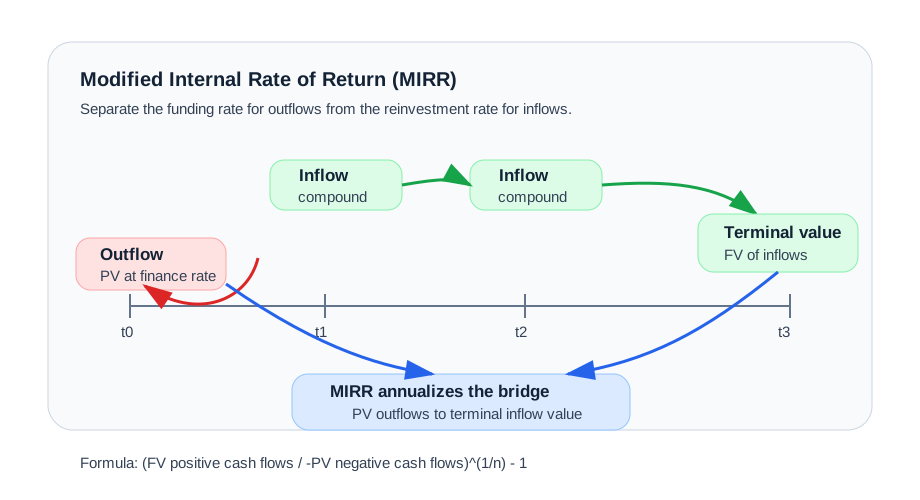
- positive cash flows are compounded forward at the reinvestment rate
- negative cash flows are discounted back at the finance rate
- \(n\) is the number of periods
How MIRR Works
MIRR converts a project into two values:
| Step | Treatment | Purpose |
|---|---|---|
| Negative cash flows | Discount to present value at the finance rate. | Reflect the cost of funding outflows. |
| Positive cash flows | Compound to the terminal year at the reinvestment rate. | Reflect what interim inflows can realistically earn. |
| MIRR calculation | Find the annualized rate linking present outflows to terminal inflows. | Produce one return measure for comparison. |
The finance rate may come from the company’s borrowing cost, project funding rate, or required return on capital. The reinvestment rate may come from WACC, a treasury reinvestment assumption, or another realistic rate for redeploying interim cash flows.
Worked Example
Suppose a project has:
- an initial outflow of
$100,000 - inflows of
$50,000in years 1, 2, and 3 - a reinvestment rate of
8% - a finance rate of
6%
First, compound the positive cash flows to year 3:
Then compare that with the present value of the initial outflow:
That rate summarizes the project under more realistic reinvestment assumptions than plain IRR.
MIRR vs. IRR vs. NPV
Net Present Value (NPV) remains the stronger value-creation test because it measures value in currency. MIRR and IRR summarize return as a percentage.
| Metric | What It Measures | Strength | Common Weakness |
|---|---|---|---|
| IRR | Discount rate that makes NPV equal zero. | Simple return summary. | Can imply unrealistic reinvestment and can produce multiple answers. |
| MIRR | Return using explicit finance and reinvestment rates. | Cleaner assumption set for nonstandard cash flows. | Still a percentage and still depends on chosen rates. |
| NPV | Value created at a chosen required return. | Best dollar-value decision rule. | Sensitive to discount rate, forecast, and terminal assumptions. |
That does not make IRR useless. It means MIRR can be the cleaner companion metric when reinvestment assumptions matter, while NPV should still carry the value-creation conclusion.
Public Source Checks
Useful public sources can support the rates and company context used in MIRR analysis:
- SEC EDGAR Company Search: Filings for capital spending, acquisitions, project commitments, segment risk, leverage, and management discussion.
- SEC Financial Statement Data Sets: Structured statement data for cash-flow, debt, tax, and profitability context.
- U.S. Treasury Daily Treasury Rates: Treasury yields for U.S. dollar base-rate support.
- Federal Reserve H.15 Selected Interest Rates: Market interest-rate series for finance-rate and reinvestment-rate context.
Public sources can anchor observable rates and public-company context. The project cash-flow forecast, finance rate, reinvestment rate, tax treatment, and terminal year remain analyst assumptions.
Scenario Question
A project shows a 38% IRR because most cash comes back early. The analyst calculates MIRR using a 7% reinvestment rate and a 6% finance rate, and MIRR falls to 18%.
Answer: The lower MIRR does not mean the project is bad. It means the original IRR relied on a reinvestment assumption that may not be realistic. The analyst should compare MIRR, NPV, the hurdle rate, and downside cases before making the approval recommendation.
Quiz
When MIRR Misleads
MIRR can mislead when:
- the finance rate or reinvestment rate is chosen without support
- cash-flow timing is wrong or inconsistent with project operations
- the project has large terminal value assumptions that dominate the result
- MIRR is used to rank mutually exclusive projects with very different scale
- the project clears the MIRR threshold but has weak or negative NPV
- tax, working-capital, debt-service, or exit assumptions are hidden
- the reinvestment rate is changed to force a desired conclusion
- MIRR is compared across projects with different currencies, risk profiles, or horizons without adjustment
MIRR improves the return metric, but it does not make the forecast reliable by itself.
Review Checklist
Before relying on MIRR, document:
- each cash-flow date and sign
- finance rate used for negative cash flows
- reinvestment rate used for positive cash flows
- whether the rate assumptions are nominal or real and pre-tax or after-tax
- terminal year and project horizon
- NPV at the required return
- whether ordinary IRR gives multiple or misleading answers
- sensitivity to finance rate, reinvestment rate, exit value, taxes, working capital, and project delay
Related Terms
- Internal Rate of Return (IRR): The traditional return metric that MIRR is designed to improve on.
- IRR vs MIRR: A direct comparison of the two return measures.
- Net Present Value (NPV): The value-based metric often used alongside MIRR.
- Hurdle Rate: The required return a project must exceed to be attractive.
- Discount Rate: Central to how project cash flows are valued.
- Reinvestment Rate: The rate used to compound interim positive cash flows in MIRR.
- Investment Appraisal: The broader process for evaluating whether a capital project should proceed.