Variable Expense
Cost that changes with business activity, used in budgeting, margin analysis, contribution margin, and operating leverage decisions.
A variable expense is a cost that changes with production volume, sales volume, usage, or another activity driver. Raw materials, packaging, payment processing fees, sales commissions, freight, and usage-based cloud costs are common examples.
Variable expenses matter because they shape gross margin, contribution margin, break-even volume, cash needs, and Operating Leverage. A business with high variable costs may scale differently from one with mostly fixed costs.
Basic Formula
The simplest formula is:
Total cost combines fixed and variable costs:
Contribution margin per unit is:
That contribution margin is what remains to cover fixed costs and then profit.
Common Examples
| Variable Expense | Activity Driver | Analyst Check |
|---|---|---|
| Raw materials | Units produced. | Is input pricing fixed, indexed, or exposed to commodity swings? |
| Packaging | Units shipped. | Does packaging cost change with product mix? |
| Sales commissions | Revenue or bookings. | Are commissions paid on bookings, billings, collections, or gross margin? |
| Payment processing fees | Transaction volume or revenue. | Are fees percentage-based, fixed per transaction, or tiered? |
| Freight and delivery | Units shipped, weight, distance, service level. | Are fuel, carrier, and rush-shipping assumptions current? |
| Usage-based cloud costs | Compute, storage, API calls, bandwidth. | Does usage scale linearly or improve with volume discounts? |
The cost driver matters. A cost that looks variable in total may be semi-variable, step-fixed, or contractually capped.
Variable vs. Fixed Expense
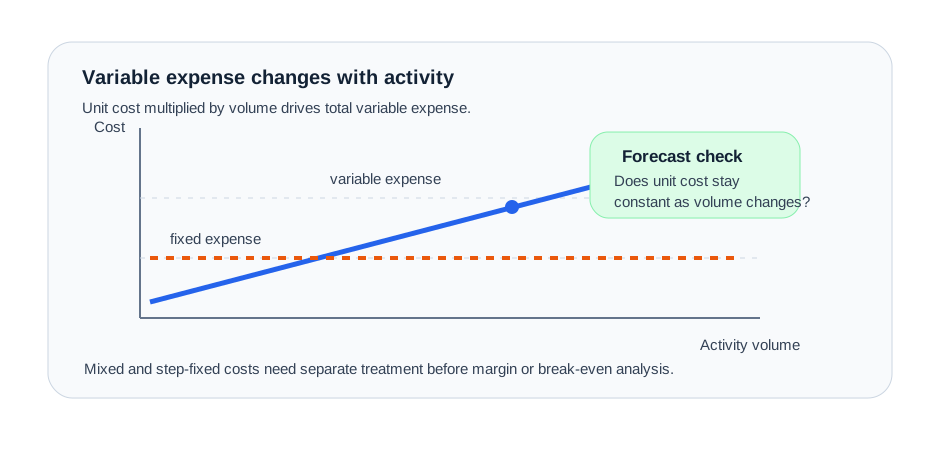
Variable expense and Fixed Expense behave differently as activity changes.
| Issue | Variable Expense | Fixed Expense |
|---|---|---|
| Behavior | Moves with volume, usage, or sales. | Stays broadly stable within a relevant range. |
| Examples | Materials, commissions, shipping, processing fees. | Rent, base salaries, insurance, core software contracts. |
| Margin effect | Changes contribution margin per unit. | Changes break-even point and operating leverage. |
| Forecast risk | Driver and unit-cost assumptions may be wrong. | Capacity and step-cost assumptions may be wrong. |
Many costs are mixed. For example, a warehouse contract may include a fixed base fee plus a variable pick-and-pack fee.
Worked Example
Suppose a company sells a product for $80 per unit. Variable cost is $45 per unit and expected volume is 10,000 units.
Contribution margin per unit is:
If fixed costs are $250,000, the company needs enough contribution margin to cover that fixed cost base before it earns operating profit.
Why It Matters For Budgeting
Variable expenses are central to Operating Budget and Cash Budget work because they change when the activity forecast changes.
| Budget Question | Why Variable Expense Matters |
|---|---|
| What happens if volume rises? | More revenue may also require more materials, freight, commissions, and support cost. |
| What happens if volume falls? | Variable costs may fall, but fixed costs may not. |
| How sensitive is margin? | Unit variable cost changes can move gross margin and contribution margin quickly. |
| How much cash is needed? | Supplier payment timing can make variable costs a liquidity issue. |
| Where is the break-even point? | Contribution margin determines how many units are needed to cover fixed costs. |
Variable expense assumptions should usually be tied to volume, mix, pricing, supplier contracts, and recent actual cost trends.
Public Source Checks
Useful public sources can support external context:
- SEC EDGAR Company Search: Filings for cost of revenue, margin discussion, supplier concentration, inflation risk, logistics costs, and management discussion.
- SEC Financial Statement Data Sets: Structured XBRL-derived statement data for revenue, cost of revenue, gross profit, operating expenses, and cash-flow context.
- BLS Producer Price Index: Public input-price context for domestic producer prices by product and service categories.
Public data can support benchmark context, but the decision model should rely on company-specific supplier contracts, purchase orders, production volumes, sales mix, commission plans, logistics terms, and current cost trends.
Scenario Question
A company plans to increase sales volume by 25% and assumes gross margin will stay flat. The model does not update freight, payment fees, sales commissions, or overtime costs.
Answer: The forecast may understate variable expense. The analyst should connect each variable cost to its driver, test whether unit costs change at higher volume, and update contribution margin and cash needs.
Quiz
When Variable Expense Misleads
Variable expense analysis can mislead when:
- the activity driver is wrong or too broad
- unit costs are assumed constant despite supplier or capacity constraints
- mixed costs are treated as fully variable
- sales commissions are modeled on revenue but paid on bookings or collections
- freight, payment processing, returns, and waste are omitted
- input inflation is ignored
- one-time cost reductions are treated as permanent
- a lower variable cost per unit requires higher fixed-cost commitments
The right question is whether the cost behavior remains valid over the forecast range.
Review Checklist
Before relying on variable expense assumptions, document:
- activity driver and forecast volume
- unit variable cost and source evidence
- whether the cost is truly variable, mixed, step-fixed, or capped
- supplier contracts, price indexes, and renewal dates
- sales commission and payment-fee mechanics
- freight, returns, waste, and service-level assumptions
- sensitivity to volume, mix, supplier pricing, and inflation
- effect on contribution margin, break-even point, and cash needs
Related Terms
- Fixed Expense: Costs that remain stable within a relevant activity range.
- Contribution Margin: Revenue remaining after variable costs.
- Break-Even Point: The level of activity where contribution margin covers fixed costs.
- Operating Leverage: Sensitivity of operating profit to revenue changes caused by cost structure.
- Operating Budget: The budget where variable costs are tied to sales and activity plans.
- Cash Budget: The liquidity forecast affected by payment timing for variable costs.
- Runway: The liquidity horizon that variable-cost changes may extend or shorten.